

Family office lending gives investors and developers a faster, more flexible route to capital than banks typically offer, and Capitalfunding is a direct example, a family-office-backed lender with over $1 billion in closed loans and an A+ BBB rating. It fits bridge, fix-and-flip, ground-up construction, rental/DSCR, multifamily, and ultra-luxury deals where speed or nonstandard collateral would otherwise stall your timeline. The rest of this guide breaks down pricing, underwriting, and how to structure a package that closes fast.
TL;DR:
- Family office lenders can approve deals within 10 to 21 business days, offering faster funding than banks, sometimes in just days after documentation.
- Loan pricing generally ranges from 2.5% to 4.5% over one-month SOFR, resulting in gross yields of about 6% to 8%, with flexibility on terms and leverage.
- These lenders focus on operator experience, deal merit, and property value, making them suitable for complex, high-value, or off-market properties with entitlements or construction risks.
- Borrowers should include comprehensive package documentation such as ARV comps, rehab budgets, business plans, and proof of equity, assembled before contacting lenders.
- Negotiable points include interest reserve funding, extension length and cost, draw pacing, prepayment terms, and leverage, especially for experienced investors or unique projects.
Table of Contents
- What Is Family Office Lending in Real Estate Terms?
- How Do Family Office Lenders Underwrite a Deal?
- How Does Family Office Lending Differ From Banks and Private Credit Funds?
- What Risks and Protections Should Borrowers Expect?
- What Qualifications and Documents Do Borrowers Need?
- What Negotiation Points Have the Most Flexibility?
- What Legal and Regulatory Steps Should Borrowers Take?
- An Editorial Take on Speed, Cost, and What Actually Matters
- How to Apply for a Family Office Loan With Capitalfunding
- Sources
- FAQ
What Is Family Office Lending in Real Estate Terms?
Family office lending, in practical market terms, is private capital deployed directly into real estate deals by a lender backed by family-office wealth rather than a bank balance sheet or an institutional fund. It covers the same loan types you already know from hard-money lending, just with more patient capital behind it and fewer layers of committee approval.
The core products look like this:
- Bridge and hard-money loans cover the gap between purchase and permanent financing, or between acquisition and stabilization.
- Fix-and-flip loans fund purchase and renovation for investors who plan to sell within 12 to 18 months.
- Ground-up construction loans finance vertical builds in staged draws tied to completed work.
- Rental and DSCR loans qualify borrowers on property cash flow rather than personal income, useful for investors scaling a portfolio.
- Multifamily bridge loans fund value-add repositioning on apartment properties before permanent debt takes over.
- Ultra-luxury single-family bridge loans finance high-value homes, including properties over $10 million, that many conventional lenders decline outright.
Pricing in this space tracks broader private credit trends. Commercial real estate debt funds commonly price loans at roughly 2.5% to 4.5% over 1-month Term SOFR, which translates to gross borrower yields in the 6% to 8% range at recent index levels.
Most bridge loans run 24 to 36 months, often with a six- or twelve-month extension option built in. Structurally, expect a non-recourse or limited-recourse loan tied to the asset, with a draw and reimbursement schedule for construction costs and an exit built around refinance or sale once the business plan is executed.
How Do Family Office Lenders Underwrite a Deal?
Family office lenders underwrite the deal and the operator, not just the property on paper. Getting your package right the first time is the single biggest lever you control over speed to close.
Lenders typically weigh, in rough order of priority:
- Operator experience. A track record of completed projects similar in scope carries more weight than a strong credit score alone.
- Conservative ARV. Comps supporting the after-repair value need to hold up under scrutiny, not just optimism.
- Title and appraisal. Clean title and a defensible third-party valuation move a file forward without delay.
- Entitlement and environmental risk. Ground-up and value-add construction deals get extra scrutiny here.
- Rent roll and income history. For rental, DSCR, or multifamily loans, current and projected cash flow drives the loan amount.
Your loan package should include a signed purchase contract or letter of intent, a line-item rehab budget, ARV comps, a written business plan with a clear exit strategy, personal and entity financials, and proof of the equity or escrow you’re bringing to the table. Assemble these before you call a lender, not after a term sheet request.
Pro Tip: Match your contractor’s payment schedule to the lender’s draw schedule before work starts. Most private lenders reimburse renovation costs after a stage is complete and inspected, not upfront, so a contractor expecting cash on day one can create a cash-flow gap you didn’t budget for.
How Does Family Office Lending Differ From Banks and Private Credit Funds?
Family office lenders make decisions differently than banks or institutional private credit funds, and that difference shows up in your timeline. A bank loan runs through a credit committee with multiple sign-offs and standardized boxes to check. A family office lender, backed by a single capital source with direct decision authority, can approve a deal relationship by relationship, deal by deal.
That speed is measurable. A private lender can move from signed term sheet to funding in 10 to 21 business days on a straightforward deal, sometimes faster once the file is complete.
Return expectations differ too. Family offices generally target net returns in the 7% to 12% range and prioritize capital preservation, while private equity funds often chase 15% to 25% IRR and take on more structural risk to get there. Family offices also tend to favor deal-by-deal approvals over blind-pool commitments, giving them more direct oversight of each asset.
A family office lender tends to be the right fit when:
- Your deal carries entitlement risk that a bank’s box-checking process won’t accommodate.
- Construction costs or timelines have some built-in variability.
- You need capital released in stages rather than a single lump sum.
- The property itself (ultra-luxury, unusual use, or off-market) doesn’t fit conventional underwriting.
What Risks and Protections Should Borrowers Expect?
Every private loan carries real risk, and understanding it before you sign protects your equity, not just your timeline. The biggest exposure in a bridge or fix-and-flip loan is a shorter term paired with a higher rate than a conventional mortgage. If your renovation runs long or your exit (sale or refinance) slips, you could face a maturity default even on a project that’s fundamentally sound.
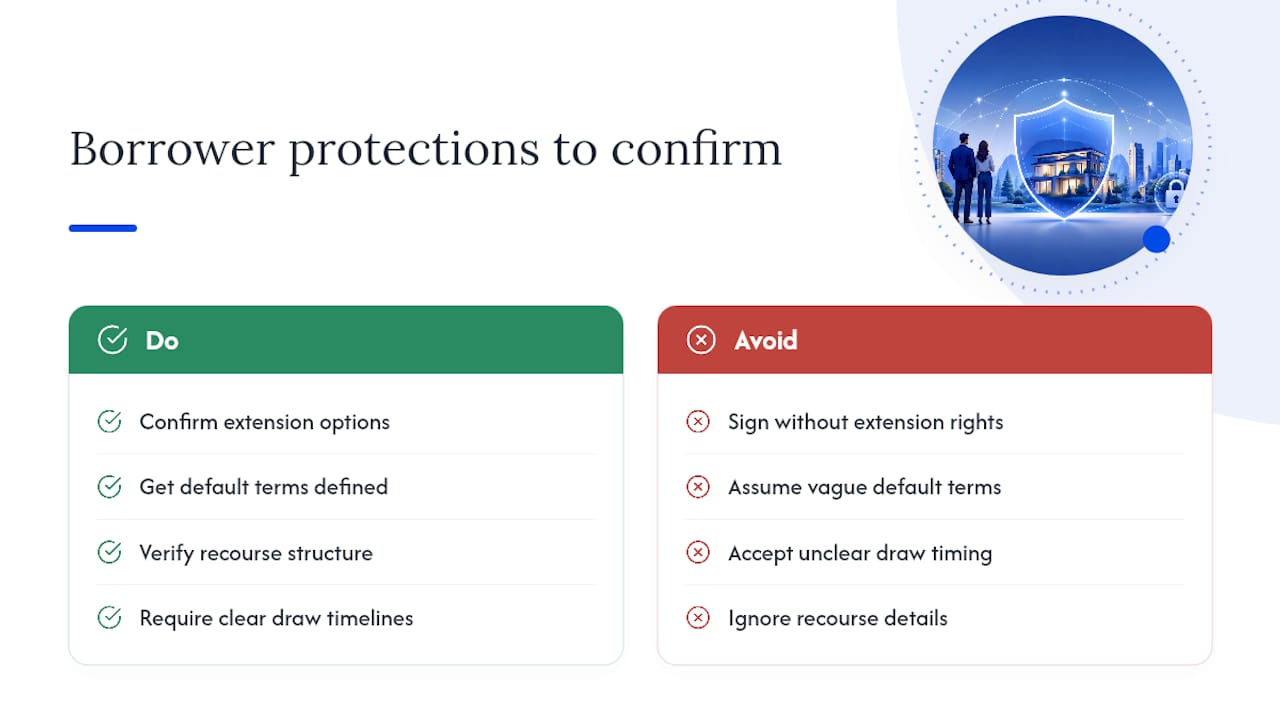
The protections worth confirming before you close:
Extension options. A loan with a built-in six- or twelve-month extension gives you room if permitting or construction takes longer than planned, rather than forcing a rushed sale into a soft market.
Clear default terms. Know exactly what triggers default (missed payment, failure to complete draws, expired insurance) and what cure period you get before the lender can act.
Recourse structure. Confirm whether the loan is non-recourse to you personally or carries a completion guaranty, and understand the difference before you sign.
Draw process transparency. A defined inspection and reimbursement timeline protects you from delayed funding that stalls your contractor mid-project.
Reputable family office lenders put these terms in writing at the term sheet stage, not buried in closing documents. If a lender won’t clarify extension rights or default triggers before you commit, treat that as a warning sign, not a formality to skip.
What Qualifications and Documents Do Borrowers Need?
Family office lenders qualify borrowers on the deal and the operator’s ability to execute it, which is a different bar than a bank’s income and credit-score checklist. You still need to show financial capacity, but the emphasis shifts toward experience and liquidity.
Expect to provide:
- Proof of funds for your down payment or equity contribution, whether that’s a bank statement or a letter from your capital source.
- Entity documents if you’re borrowing through an LLC, including operating agreement and formation paperwork.
- A track record summary listing prior projects, especially ones similar in scope to the one you’re financing now.
- Personal financial statement covering assets, liabilities, and liquidity, even on non-recourse loans.
- Credit report, though the bar here is typically more forgiving than a conventional mortgage, particularly for experienced flippers.
- Insurance binder for the property, required before funds are released at closing.
First-time investors aren’t automatically disqualified, but expect a lender to ask for a stronger equity position or a completion guaranty to offset the lack of a track record. Borrowers with several completed projects and clean exits behind them typically see faster approvals and more flexible terms on rate and leverage.
What Negotiation Points Have the Most Flexibility?
Loan terms in family office lending are far more negotiable than most first-time borrowers assume, largely because a single decision-maker, not a committee, is setting the terms. That flexibility is one of the practical advantages of this capital source over a conventional bank product.
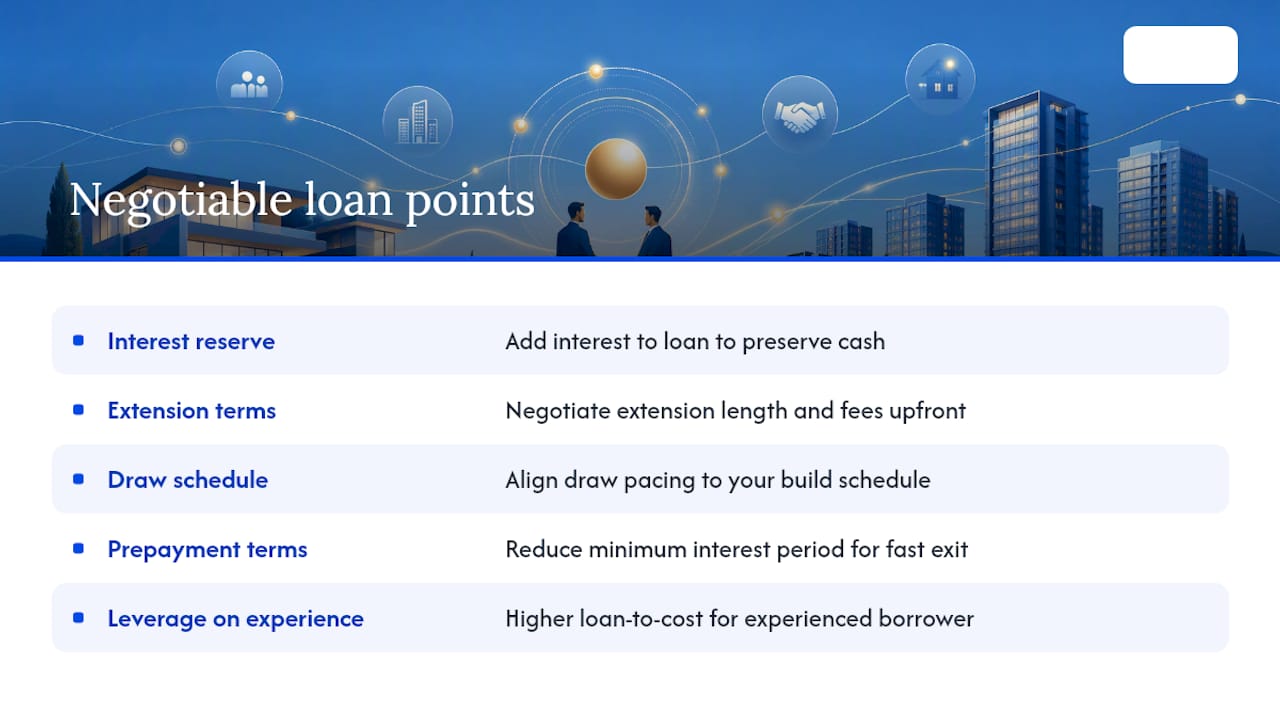
Points worth raising before you sign a term sheet:
Interest reserve. Ask whether interest can be built into the loan amount rather than paid out of pocket monthly, which preserves your cash during the renovation or construction phase.
Extension terms. Negotiate the length and cost of an extension option upfront rather than discovering the fee structure when you actually need it.
Draw schedule pacing. If your project has an unusual sequencing (site work before vertical construction, for example), ask the lender to structure draws around your actual build schedule instead of a generic template.
Prepayment terms. Some lenders charge a minimum interest period; if you expect a fast exit, negotiate this down before closing.
Leverage on experience. A borrower with several completed flips has real standing to negotiate loan-to-cost higher than a first-timer would get.
None of this is guaranteed, and a lender’s flexibility depends on deal quality and your track record. But raising these points at the term sheet stage, rather than after you’ve signed, is where you actually have leverage.
What Legal and Regulatory Steps Should Borrowers Take?
Private real estate loans move fast, but that speed doesn’t remove the legal groundwork you need before closing. Borrowing through an LLC or other entity is standard practice in this space, and it matters for liability protection as well as loan structuring, so confirm your entity is properly formed and in good standing before you apply.
Have an attorney review the loan agreement, particularly the default provisions, personal guaranty language if any, and the extension mechanics, before you sign. Title work needs to be clean, and any liens, easements, or entitlement issues should surface during due diligence, not after you’ve closed. For construction and ground-up deals, confirm permitting status and zoning compliance with local authorities directly rather than relying solely on the seller’s representations.
Interest rates and fees on private loans are subject to state usury laws in some jurisdictions, though most states carve out exceptions for business-purpose loans made to entities. Ask your lender directly how the loan is structured with respect to your state’s rules, and don’t assume terms that applied to a deal in another state will transfer to yours.
An Editorial Take on Speed, Cost, and What Actually Matters
The conventional wisdom on private lending treats rate as the whole story, and that’s a mistake I keep seeing borrowers make. A slightly higher rate on a family office lending relationship is often the cheaper option once you price in what a bank’s timeline actually costs you: a lost acquisition, a blown renovation schedule, or a construction loan that falls through during permitting delays.
Capitalfunding’s track record, over $1 billion in closed loans with an A+ BBB rating, reflects a lender built for exactly that kind of deal pressure. Its program range, from fix-and-flip to ground-up construction to ultra-luxury single-family financing above $10 million, exists because conventional underwriting boxes simply don’t fit those transactions. A flipper racing a 30-day close, or a developer needing staged construction capital without a bank’s twelve-week approval cycle, benefits directly from a lender that can close in days rather than months.
The real caveat is this: speed and flexibility carry a price, and that’s the correct tradeoff only when the deal’s economics support it. If your timeline has real slack and your collateral fits a conventional box cleanly, a bank probably beats a private lender on cost. Family office lending earns its premium when timing, complexity, or property type make that bank box the wrong box entirely.
— Daly Kay DiNatale
How to Apply for a Family Office Loan With Capitalfunding
Capitalfunding gives you a direct path to close, without the committee delays that stall conventional bank financing. Getting a quote starts with three steps: put together a one-page deal summary covering the property address, your ARV estimate, the loan amount you need, and your equity position; request a term quote and provide proof of funds; then review and sign a term sheet, with Capitalfunding able to move from signed terms to funding in days rather than the weeks a bank timeline typically demands.

Which program fits depends on your deal. Flippers and short-term renovation borrowers should start with the fix-and-flip program. Developers building from the ground up will want the ground-up construction program, which structures draws around your actual build schedule. For bridge financing on commercial or income-producing assets, the hard money and bridge loan program covers acquisition, stabilization, and repositioning deals, including ultra-luxury single-family properties that other lenders won’t touch.
Rate and fee structures get finalized at the term sheet stage, and Capitalfunding lays out pricing and leverage upfront so there’s no surprise language buried in closing documents. If your next deal needs capital that moves as fast as your timeline does, start your quote request today.
Sources
For a deeper look at how bridge financing actually moves from application to funding, Excel Cap Management’s primer on bridge loans covers the mechanics in plain terms. If you’re weighing external capital against funding a deal yourself, The Infinite Banker’s guide to self-financing real estate lays out that alternative path.
On Capitalfunding’s own site, the commercial bridge loan program page details terms for multifamily, retail, and industrial deals, while the multifamily bridge loan program page speaks directly to value-add apartment investors ready to move on their next acquisition.
This article is general information, not a substitute for advice from a qualified financial advisor. Consult a qualified financial professional about your own circumstances before acting on anything here.
- Private Credit in CRE Lending: A Primer | RMR
- How Does a Bridge Loan Work? The Process Explained | Requity Group
- How Private Lending Works for Real Estate Investors | DealMachine
FAQ
What Is Family Office Lending?
Family office lending is private real estate financing backed by family-office capital rather than a bank or institutional fund, typically covering bridge, fix-and-flip, construction, rental/DSCR, multifamily, and ultra-luxury property loans.
How Fast Can a Family Office Lender Close?
A private lender can move from signed term sheet to funding in 10 to 21 business days on a straightforward deal, and Capitalfunding markets the ability to close in as little as a few days once documentation is complete.
What Rate Should I Expect on a Family Office Loan?
Private CRE debt commonly prices at 2.5% to 4.5% over 1-month Term SOFR, landing borrower yields around 6% to 8% gross depending on leverage and risk profile.
Can Family Office Lenders Finance Ultra-Luxury Properties?
Yes. Capitalfunding specifically finances ultra-luxury single-family homes over $10 million, a category many conventional and even standard private lenders decline.
Do I Need Perfect Credit to Qualify?
No. Family office lenders weigh operator experience, equity position, and deal quality more heavily than credit score, though a personal financial statement and credit report are still standard parts of the package.
