

Luxury Spec Financing: U.S. Builders’ $2M+ Deals Banks Often Decline

Developer and lender review luxury build financing

For luxury spec projects well above the local median price, the fastest and most flexible paths are private hard money and bridge loans, jumbo construction loans with interest reserves, and, where the market allows, construction-to-permanent structures. We find that private direct lenders are often the practical choice for these deals because they close quickly, underwrite flexibly, and can finance unusual or super-jumbo collateral that banks typically decline. The next move is simple: assemble a lender-ready package and start the conversation early.


  • Private construction loans commonly charge origination fees of 1.50% to 3.00%, plus appraisal, title, legal, inspection, and interest costs; model them early.
  • Banks use loan to value benchmarks up to 80% for construction, but custom comparables, equity needs, and 18 to 24 month schedules can constrain funding.
  • Choose the exit before applying: permanent takeout usually needs a stronger appraisal and seasoning, while rental refinancing can protect you if resale demand weakens.
  • Every draw needs invoices, lien waivers, and inspection approval, and disbursement typically takes about five business days after a satisfactory inspection.

Capitalfunding
capitalfunding.com
Finance Your Luxury Build
Capital Funding offers construction loans for developers, including projects other lenders may not finance, such as ultra-luxury homes over $10 million.

Explore construction financing

Table of Contents

What Makes Luxury Spec Construction Loans Different

A luxury spec build generally means a speculative, builder-financed project priced well above the local median price, often with custom finishes, architect-driven design, and construction timelines that run longer than a typical production home. These factors change how lenders view risk, and they change the loan products that actually fit.

Conventional construction loans are built around conforming price bands and predictable comparable sales. Luxury spec projects break that model in three ways:

  • Appraisal complexity: finding true comparables for custom finishes and architectural features is harder, which slows underwriting at traditional banks.
  • Loan-to-value constraints: banks often cap advances well below what a luxury project needs to stay fully funded through completion.
  • Timeline mismatch: bank committees move on standardized schedules that rarely match an 18 to 24 month luxury build.

Because of this, builders typically choose among construction-only loans, construction-to-permanent structures, and private bridge or hard money loans, each suited to a different stage of the project and a different exit plan.

The Structural Mechanics Behind High-End Spec Financing

Luxury spec loans are built around a handful of mechanics that lenders use to control risk while keeping capital moving as the project progresses.

  1. Staged draw schedules: funds release in increments tied to completed construction phases, confirmed by a third-party inspection before each disbursement.
  2. Interest reserves: lenders size a reserve, often as part of the total loan amount, to cover interest payments during construction so the developer is not paying carry costs out of pocket.
  3. Entity-based underwriting: loans are typically made to an LLC or similar entity, with personal guarantors standing behind the debt and lenders reviewing entity structures as part of qualification.
  4. Appraisal standards: luxury appraisals need a prospective market-value opinion that accounts for finished-quality upgrades, built on uniform standards and supported by true high-end comparable sales.
  5. Cross-collateral and blanket liens: on larger or multi-project deals, lenders sometimes secure the loan against more than one asset to strengthen the collateral position.

Interest reserve accounting matters more than builders expect: reserve draws are typically tracked separately from construction draws, and lenders retain the right to advance reserve funds by journal entry to keep interest current, a mechanic reflected in representative construction loan agreements.

Pro Tip: Ask your lender for a written interest reserve schedule before closing, so you know exactly how much carry is covered and when you would need to fund the gap yourself.

Your Underwriting and Qualification Checklist

Private lenders and banks both evaluate luxury spec deals on similar fundamentals, though the thresholds and flexibility differ sharply. Supervisory guidance from the Federal Reserve sets loan-to-value benchmarks that banks use internally, commonly up to 80% for construction and commercial real estate, which is one reason bank financing feels tight on a $4 million custom build.

Before you approach any lender, prepare:

  • A clear picture of your equity position, since most lenders expect meaningful borrower-funded equity in the deal, not just leverage against future value.
  • Entity and personal tax returns for the past two to three years, along with current balance sheets and profit and loss statements.
  • A certified construction budget, broken down by trade, with contingency clearly stated rather than buried in the total.
  • A track record showing completed luxury projects, ideally with addresses, sale prices, and timelines a lender can verify.
  • Guarantor information, since most construction lenders require a personal guaranty behind the entity, particularly on first-time or larger deals.

Builders who come prepared with this package consistently move through underwriting faster, whether the lender is a bank or a private fund.

Choosing Your Exit: Permanent Takeout, Bridge Sale, or Hold

Your exit strategy shapes the loan from day one, not just at the end. Lenders price and size spec loans differently depending on whether you plan to sell at completion or refinance into permanent debt.

  • Permanent takeout: suits builders who want to hold the finished asset as a rental or who have a buyer lined up for a long-term loan; it typically requires a stronger appraisal and seasoning period.
  • Bridge-to-sale: the default plan for most spec builders, where the construction loan is repaid directly from sale proceeds, often within months of completion.
  • Bridge-to-rental conversion: a practical fallback if the luxury resale market softens, letting you refinance into a rental DSCR structure rather than selling at a discount.
  • Staged sales: relevant on multi-unit luxury spec projects, where phased closings reduce carry exposure instead of waiting for one buyer on every unit.

Lenders look closely at your stated exit when sizing the loan, because a firm takeout commitment or realistic sale comparables directly affect how much they are willing to advance and how the appraisal gets framed.

What Luxury Spec Financing Actually Costs

Expect several cost categories on a luxury spec loan: origination fees, appraisal and title charges, inspection fees for each draw, legal costs, and the interest carry itself, which is usually funded upfront through the interest reserve. Origination fees on private construction financing commonly run in the 1.50% to 3.00% range of the loan amount, a meaningful line item that builders should model early rather than discover at closing.

As an illustrative example only, say a $2 million spec build carries a $1.4 million construction loan: a 2% origination fee would run $28,000, plus appraisal, title, and per-draw inspection costs that typically add a few thousand dollars more across the project. A $6 million project financed at $4.2 million would scale proportionally, with origination costs rising alongside loan size even as percentage fees stay similar.
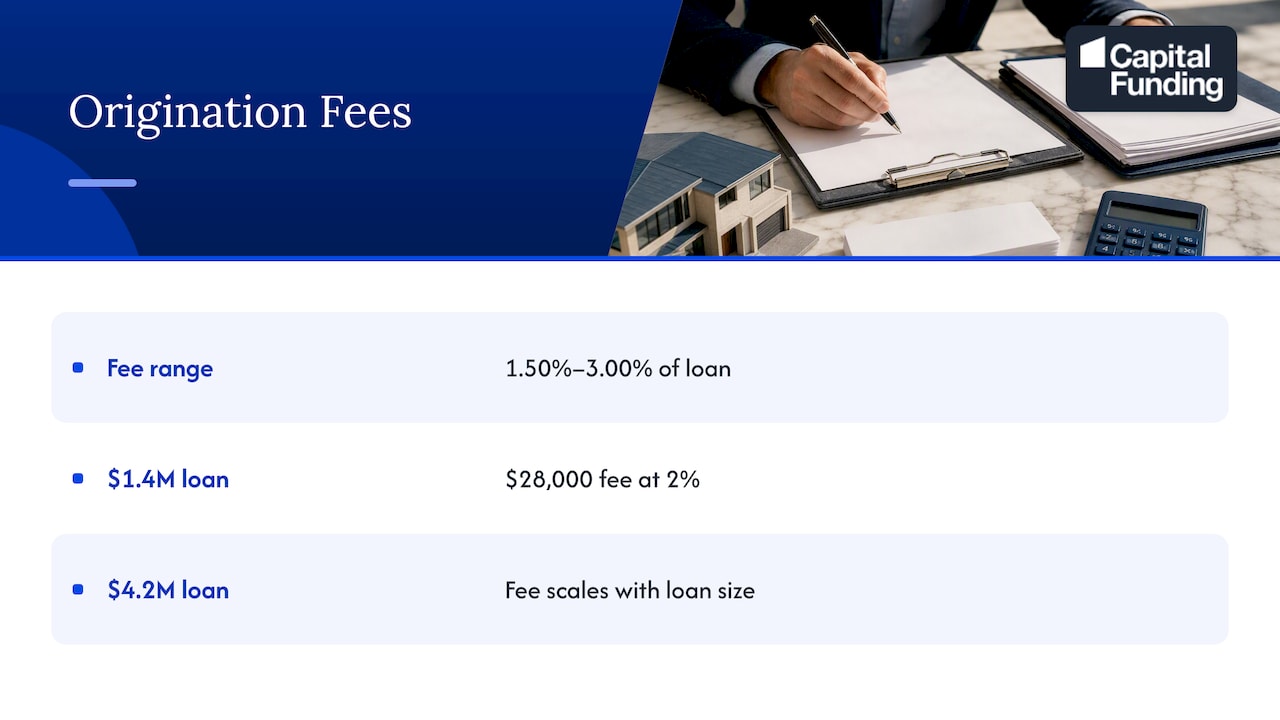
Origination fee range and loan examples

Interest reserve sizing directly affects your monthly cash flow: a well-sized reserve means you are not pulling carry costs from operating capital, while an undersized one can force out-of-pocket interest payments mid-build. Budget soft costs and contingency generously, since luxury finishes routinely run over initial estimates.
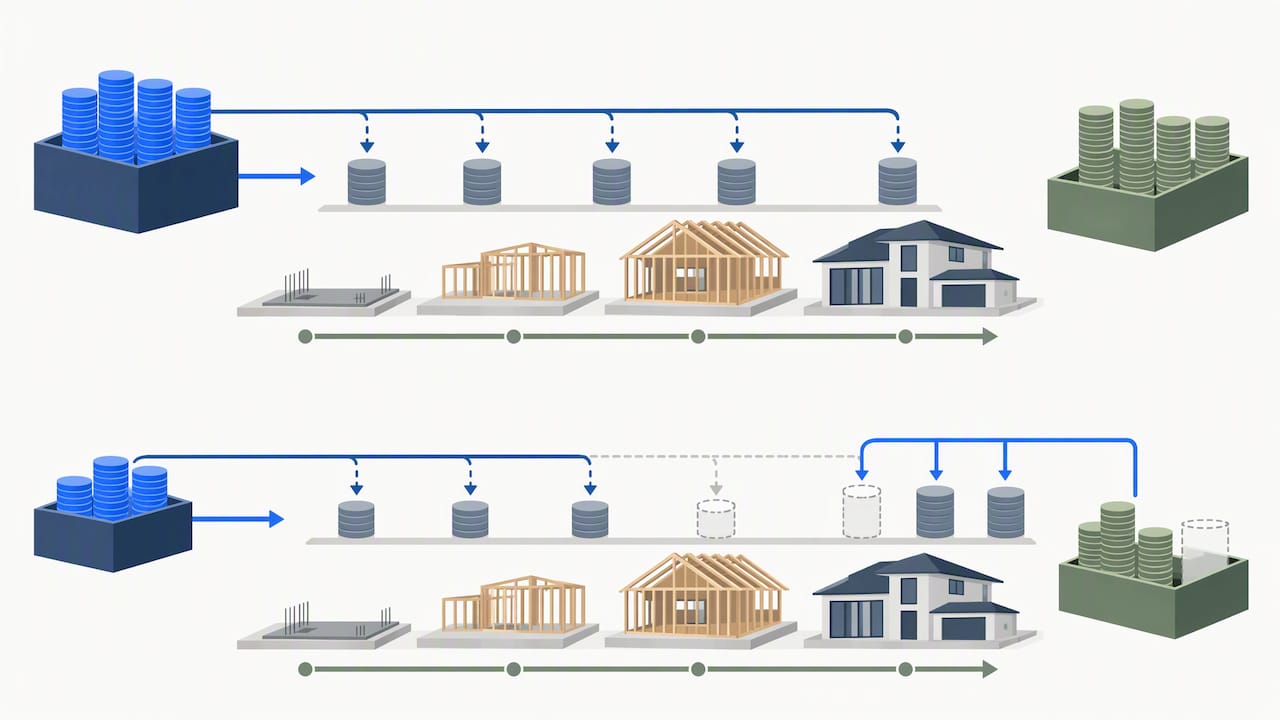
Interest reserve protects operating cash during construction

How Draws, Inspections, and Disbursements Actually Work

Each draw round follows a consistent pattern: you submit a draw request with supporting invoices, an inspector verifies completed work matches the request, and the lender or a title and disbursement agent releases funds once lien waivers are confirmed.

  1. Submit the draw package, including invoices, updated lien waivers from contractors and subcontractors, and photos of completed work.
  2. Schedule the inspection, which confirms the percentage of completion claimed in the draw request matches what is physically built.
  3. Wait for disbursement, which representative public construction loan agreements show typically occurs within about five business days of a satisfactory inspection.

Common holds happen when lien waivers are missing, invoices do not match the draw schedule, or inspection findings differ from what was requested. The fastest way around this is organizing every subcontractor’s paperwork into a standard packet before the draw is even requested, so nothing is chasing signatures after the inspector has already signed off.

Pro Tip: Build a draw packet template with your general contractor before breaking ground, so every subcontractor knows exactly what documentation is expected at each stage.

Why Private Lenders Often Win on Luxury Spec Deals

Luxury spec builders frequently run into the same wall: banks hesitate on super-jumbo loan amounts, unusual collateral, or compressed timelines. We built our programs specifically around that gap. Backed by family office capital, we close hard money and bridge loans in days rather than the weeks or months a bank committee requires, and we have financed ultra-luxury single-family projects that other lenders turned down.

Our Ground Up Construction Program fits new luxury spec builds directly, while our Hard Money Loan Program suits builders who need fast carry financing or a quick start on land acquisition. To get the strongest terms:

  • Bring a certified budget, your track record, and a realistic exit plan to the first conversation.
  • Have your entity documents and guarantor information ready before you apply.
  • Be specific about timeline needs so we can structure draws around your actual construction schedule.

We have the track record to back these closings.

What Experienced Builders Should Prioritize

Speed of close matters, but clarity matters more. When we talk with developers, the strongest negotiators ask pointed questions: how fast is disbursement after inspection, how is the interest reserve sized, and what exactly triggers the takeout or sale exit.

Come to the table with a clean budget, a credible appraisal, and real sales comparables for your market. Ask for disbursement service-level commitments in writing, and hand your general contractor a standard draw packet checklist before the first dollar is drawn. That single habit prevents more delays than any clause in the loan agreement.

— Daly Kay DiNatale

Financing Your Next Luxury Spec Build With Us

Luxury spec builders need a lender who moves at the project’s pace, not a committee’s. We offer ground-up construction financing, hard money and bridge loans for fast starts, and the flexibility to finance ultra-luxury projects other lenders turn away, all backed by family office capital that lets us close in days.
Capitalfunding

If you are breaking ground on a new luxury spec build, our Ground Up Construction Program is the natural starting point, and if you need fast carry capital or a bridge into construction, our Hard Money Loan Program is built for exactly that. Reach out through Capitalfunding to start a prequalification conversation and get a real answer on terms within days, not weeks.

This article is general information, not a substitute for advice from a qualified financial advisor. Consult a qualified financial professional about your own circumstances before acting on anything here.

FAQ

How much would a $100,000 construction loan cost per month?

The monthly cost depends on the interest rate and whether interest is paid from a reserve or out of pocket. As an illustrative example only, a $100,000 balance at a construction rate in the 8.99% to 10.99% range would run roughly $750 to $920 in monthly interest-only payments, before fees.

What is the monthly payment on a $300,000 construction loan?

Using the same illustrative approach, a loan at a rate in the 8.99% to 10.99% range would carry interest-only payments that vary depending on the loan balance and draw schedule, since interest typically accrues only on funds already disbursed.

Who is the best luxury home builder in the USA?

There is no single recognized “best” luxury home builder nationally, since the right choice depends on region, project scale, and design style. Builders are better evaluated locally, by verified track record, licensing, and completed luxury projects in your specific market.

Who are the biggest home lenders in the US?

The largest conventional mortgage lenders in the US are typically large national banks and mortgage companies, but luxury spec construction is a different lending category entirely. For spec and ground-up construction financing, private direct lenders often serve builders faster and more flexibly than traditional bank lenders, particularly on super-jumbo or ultra-luxury projects.

What should I check before choosing a lender for a luxury spec project?

Look for a lender’s track record on comparable project sizes, how quickly they close, and whether their draw and interest reserve terms are spelled out in writing. You can verify licensing for any lender through NMLS Consumer Access before signing a commitment letter.

Sources

Luxury Spec Financing: U.S. Builders’ $2M+ Deals Banks Often Decline

November 1, 2026

Written By: David DiNatale, Esq

  • For luxury spec projects well above the local median price, the fastest and most flexible paths are private hard money and bridge loans, jumbo construction loans with interest reserves, and, where the market allows, construction-to-permanent structures. We find that private direct lenders are often the practical choice for these deals because they close quickly, underwrite flexibly, and can finance unusual or super-jumbo collateral that banks typically decline. The next move is simple: assemble a lender-ready package and start the conversation early.


    • Private construction loans commonly charge origination fees of 1.50% to 3.00%, plus appraisal, title, legal, inspection, and interest costs; model them early.
    • Banks use loan to value benchmarks up to 80% for construction, but custom comparables, equity needs, and 18 to 24 month schedules can constrain funding.
    • Choose the exit before applying: permanent takeout usually needs a stronger appraisal and seasoning, while rental refinancing can protect you if resale demand weakens.
    • Every draw needs invoices, lien waivers, and inspection approval, and disbursement typically takes about five business days after a satisfactory inspection.

    Capitalfunding
    capitalfunding.com
    Finance Your Luxury Build
     
    Capital Funding offers construction loans for developers, including projects other lenders may not finance, such as ultra-luxury homes over $10 million.

    Explore construction financing

    Table of Contents

    What Makes Luxury Spec Construction Loans Different

    A luxury spec build generally means a speculative, builder-financed project priced well above the local median price, often with custom finishes, architect-driven design, and construction timelines that run longer than a typical production home. These factors change how lenders view risk, and they change the loan products that actually fit.

    Conventional construction loans are built around conforming price bands and predictable comparable sales. Luxury spec projects break that model in three ways:

    • Appraisal complexity: finding true comparables for custom finishes and architectural features is harder, which slows underwriting at traditional banks.
    • Loan-to-value constraints: banks often cap advances well below what a luxury project needs to stay fully funded through completion.
    • Timeline mismatch: bank committees move on standardized schedules that rarely match an 18 to 24 month luxury build.

    Because of this, builders typically choose among construction-only loans, construction-to-permanent structures, and private bridge or hard money loans, each suited to a different stage of the project and a different exit plan.

    The Structural Mechanics Behind High-End Spec Financing

    Luxury spec loans are built around a handful of mechanics that lenders use to control risk while keeping capital moving as the project progresses.

    1. Staged draw schedules: funds release in increments tied to completed construction phases, confirmed by a third-party inspection before each disbursement.
    2. Interest reserves: lenders size a reserve, often as part of the total loan amount, to cover interest payments during construction so the developer is not paying carry costs out of pocket.
    3. Entity-based underwriting: loans are typically made to an LLC or similar entity, with personal guarantors standing behind the debt and lenders reviewing entity structures as part of qualification.
    4. Appraisal standards: luxury appraisals need a prospective market-value opinion that accounts for finished-quality upgrades, built on uniform standards and supported by true high-end comparable sales.
    5. Cross-collateral and blanket liens: on larger or multi-project deals, lenders sometimes secure the loan against more than one asset to strengthen the collateral position.

    Interest reserve accounting matters more than builders expect: reserve draws are typically tracked separately from construction draws, and lenders retain the right to advance reserve funds by journal entry to keep interest current, a mechanic reflected in representative construction loan agreements.

    Pro Tip: Ask your lender for a written interest reserve schedule before closing, so you know exactly how much carry is covered and when you would need to fund the gap yourself.

    Your Underwriting and Qualification Checklist

    Private lenders and banks both evaluate luxury spec deals on similar fundamentals, though the thresholds and flexibility differ sharply. Supervisory guidance from the Federal Reserve sets loan-to-value benchmarks that banks use internally, commonly up to 80% for construction and commercial real estate, which is one reason bank financing feels tight on a $4 million custom build.

    Before you approach any lender, prepare:

    • A clear picture of your equity position, since most lenders expect meaningful borrower-funded equity in the deal, not just leverage against future value.
    • Entity and personal tax returns for the past two to three years, along with current balance sheets and profit and loss statements.
    • A certified construction budget, broken down by trade, with contingency clearly stated rather than buried in the total.
    • A track record showing completed luxury projects, ideally with addresses, sale prices, and timelines a lender can verify.
    • Guarantor information, since most construction lenders require a personal guaranty behind the entity, particularly on first-time or larger deals.

    Builders who come prepared with this package consistently move through underwriting faster, whether the lender is a bank or a private fund.

    Choosing Your Exit: Permanent Takeout, Bridge Sale, or Hold

    Your exit strategy shapes the loan from day one, not just at the end. Lenders price and size spec loans differently depending on whether you plan to sell at completion or refinance into permanent debt.

    • Permanent takeout: suits builders who want to hold the finished asset as a rental or who have a buyer lined up for a long-term loan; it typically requires a stronger appraisal and seasoning period.
    • Bridge-to-sale: the default plan for most spec builders, where the construction loan is repaid directly from sale proceeds, often within months of completion.
    • Bridge-to-rental conversion: a practical fallback if the luxury resale market softens, letting you refinance into a rental DSCR structure rather than selling at a discount.
    • Staged sales: relevant on multi-unit luxury spec projects, where phased closings reduce carry exposure instead of waiting for one buyer on every unit.

    Lenders look closely at your stated exit when sizing the loan, because a firm takeout commitment or realistic sale comparables directly affect how much they are willing to advance and how the appraisal gets framed.

    What Luxury Spec Financing Actually Costs

    Expect several cost categories on a luxury spec loan: origination fees, appraisal and title charges, inspection fees for each draw, legal costs, and the interest carry itself, which is usually funded upfront through the interest reserve. Origination fees on private construction financing commonly run in the 1.50% to 3.00% range of the loan amount, a meaningful line item that builders should model early rather than discover at closing.

    As an illustrative example only, say a $2 million spec build carries a $1.4 million construction loan: a 2% origination fee would run $28,000, plus appraisal, title, and per-draw inspection costs that typically add a few thousand dollars more across the project. A $6 million project financed at $4.2 million would scale proportionally, with origination costs rising alongside loan size even as percentage fees stay similar.

    Origination fee range and loan examples

    Interest reserve sizing directly affects your monthly cash flow: a well-sized reserve means you are not pulling carry costs from operating capital, while an undersized one can force out-of-pocket interest payments mid-build. Budget soft costs and contingency generously, since luxury finishes routinely run over initial estimates.

    Interest reserve protects operating cash during construction

    How Draws, Inspections, and Disbursements Actually Work

    Each draw round follows a consistent pattern: you submit a draw request with supporting invoices, an inspector verifies completed work matches the request, and the lender or a title and disbursement agent releases funds once lien waivers are confirmed.

    1. Submit the draw package, including invoices, updated lien waivers from contractors and subcontractors, and photos of completed work.
    2. Schedule the inspection, which confirms the percentage of completion claimed in the draw request matches what is physically built.
    3. Wait for disbursement, which representative public construction loan agreements show typically occurs within about five business days of a satisfactory inspection.

    Common holds happen when lien waivers are missing, invoices do not match the draw schedule, or inspection findings differ from what was requested. The fastest way around this is organizing every subcontractor’s paperwork into a standard packet before the draw is even requested, so nothing is chasing signatures after the inspector has already signed off.

    Pro Tip: Build a draw packet template with your general contractor before breaking ground, so every subcontractor knows exactly what documentation is expected at each stage.

    Why Private Lenders Often Win on Luxury Spec Deals

    Luxury spec builders frequently run into the same wall: banks hesitate on super-jumbo loan amounts, unusual collateral, or compressed timelines. We built our programs specifically around that gap. Backed by family office capital, we close hard money and bridge loans in days rather than the weeks or months a bank committee requires, and we have financed ultra-luxury single-family projects that other lenders turned down.

    Our Ground Up Construction Program fits new luxury spec builds directly, while our Hard Money Loan Program suits builders who need fast carry financing or a quick start on land acquisition. To get the strongest terms:

    • Bring a certified budget, your track record, and a realistic exit plan to the first conversation.
    • Have your entity documents and guarantor information ready before you apply.
    • Be specific about timeline needs so we can structure draws around your actual construction schedule.

    We have the track record to back these closings.

    What Experienced Builders Should Prioritize

    Speed of close matters, but clarity matters more. When we talk with developers, the strongest negotiators ask pointed questions: how fast is disbursement after inspection, how is the interest reserve sized, and what exactly triggers the takeout or sale exit.

    Come to the table with a clean budget, a credible appraisal, and real sales comparables for your market. Ask for disbursement service-level commitments in writing, and hand your general contractor a standard draw packet checklist before the first dollar is drawn. That single habit prevents more delays than any clause in the loan agreement.

    — Daly Kay DiNatale

    Financing Your Next Luxury Spec Build With Us

    Luxury spec builders need a lender who moves at the project’s pace, not a committee’s. We offer ground-up construction financing, hard money and bridge loans for fast starts, and the flexibility to finance ultra-luxury projects other lenders turn away, all backed by family office capital that lets us close in days.

    Capitalfunding

    If you are breaking ground on a new luxury spec build, our Ground Up Construction Program is the natural starting point, and if you need fast carry capital or a bridge into construction, our Hard Money Loan Program is built for exactly that. Reach out through Capitalfunding to start a prequalification conversation and get a real answer on terms within days, not weeks.

    This article is general information, not a substitute for advice from a qualified financial advisor. Consult a qualified financial professional about your own circumstances before acting on anything here.

    FAQ

    How much would a $100,000 construction loan cost per month?

    The monthly cost depends on the interest rate and whether interest is paid from a reserve or out of pocket. As an illustrative example only, a $100,000 balance at a construction rate in the 8.99% to 10.99% range would run roughly $750 to $920 in monthly interest-only payments, before fees.

    What is the monthly payment on a $300,000 construction loan?

    Using the same illustrative approach, a loan at a rate in the 8.99% to 10.99% range would carry interest-only payments that vary depending on the loan balance and draw schedule, since interest typically accrues only on funds already disbursed.

    Who is the best luxury home builder in the USA?

    There is no single recognized “best” luxury home builder nationally, since the right choice depends on region, project scale, and design style. Builders are better evaluated locally, by verified track record, licensing, and completed luxury projects in your specific market.

    Who are the biggest home lenders in the US?

    The largest conventional mortgage lenders in the US are typically large national banks and mortgage companies, but luxury spec construction is a different lending category entirely. For spec and ground-up construction financing, private direct lenders often serve builders faster and more flexibly than traditional bank lenders, particularly on super-jumbo or ultra-luxury projects.

    What should I check before choosing a lender for a luxury spec project?

    Look for a lender’s track record on comparable project sizes, how quickly they close, and whether their draw and interest reserve terms are spelled out in writing. You can verify licensing for any lender through NMLS Consumer Access before signing a commitment letter.

    Sources

About the author

Apply Now