
- Land acquisition. A private lender provides a hard money land loan to secure the site before entitlement is complete.
- Pre-development capital. Bridge or pre-development financing covers soft costs, engineering, legal fees, and carrying costs during the approval period.
- Entitlement completion. Once permits are secured, the developer transitions to a construction loan, often still from a private lender given bank hesitancy.
- Construction draw phase. The private lender funds draws as construction milestones are met, keeping contractors on schedule.
- Permanent financing or sale. The developer refinances into a long-term loan or sells the completed asset to retire the private debt.
Private lenders vs. banks: costs, speed, and execution compared
The core tradeoff between private lenders and traditional banks comes down to three variables: cost, speed, and operational execution. Understanding all three prevents developers from making decisions based on headline rates alone.
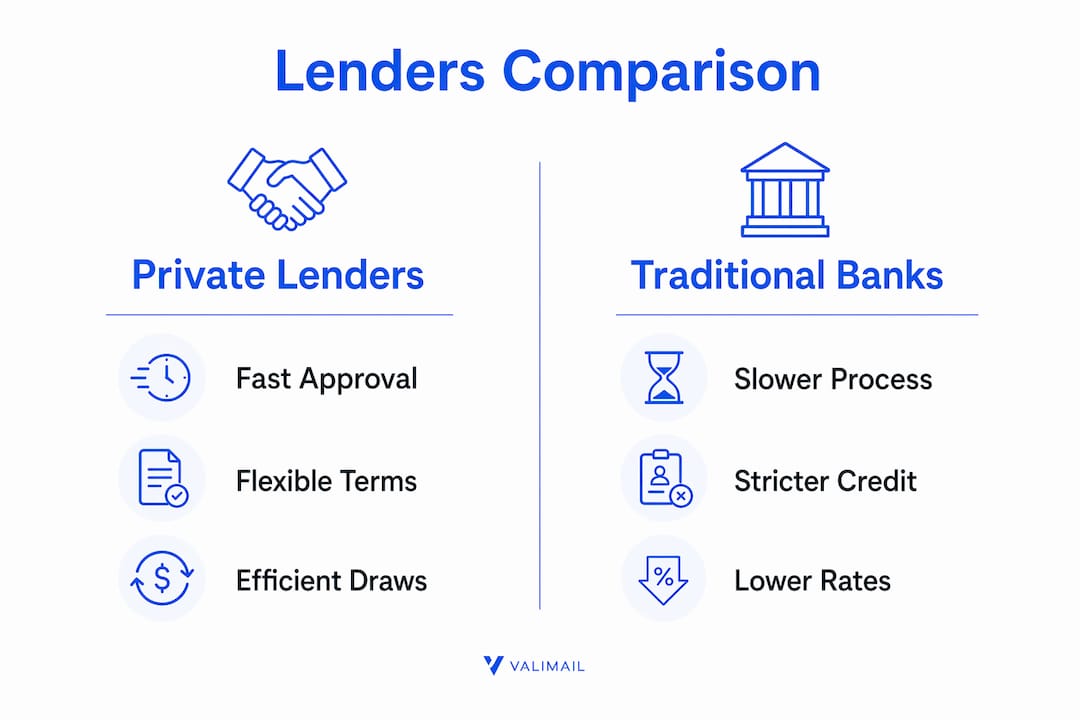
| Feature | Private Lenders | Traditional Banks |
|---|---|---|
| Approval speed | Days to 2 weeks | 30–90 days |
| Interest rates | Higher (asset-based pricing) | Lower (credit-based pricing) |
| Leverage limits | Flexible, deal-specific | Strict, formula-driven |
| Draw disbursement | Fast, efficient | Slow, inspection-heavy |
| Unsold inventory tolerance | High (e.g., 10 homes) | Low (e.g., 4 homes) |
| Project type flexibility | Broad, including niche deals | Narrow, conventional only |
| Post-closing support | Active, responsive | Limited |
Experienced builders prioritize draw processing efficiency over lower interest rates when choosing a lender. That is a counterintuitive finding, but it reflects real project economics. A delayed draw does not just cost interest. It stops subcontractors, triggers penalty clauses, and can push a project’s completion date back by weeks. Private lenders who manage draws efficiently function as a hidden project manager, reducing delays and cost overruns throughout the construction cycle.
Private lending’s biggest operational benefit is speed and flexibility, but higher borrowing rates can erode project margins if not modeled carefully. The developer who chooses a private lender purely on rate without modeling throughput, draw timing, and inventory turnover is making an incomplete decision.
Pro Tip: Before comparing lender rates, model the cost of a 30-day delay in your draw schedule. In most Florida construction projects, a single delayed draw costs more in contractor downtime and soft costs than the rate differential between a private lender and a bank.
Practical applications of private lending for Florida investors and developers
Private lending is not a single product. It is a category of financing tools that serve different stages of a project’s life cycle. Florida developers who use private capital effectively match the right loan type to the right project phase.
The most common applications include:
- Ground-up construction loans. Private lenders fund new construction from permit to certificate of occupancy, with draw schedules tied to verified milestones. This is the primary product for developers building spec homes or small multifamily projects. Capitalfunding’s ground-up construction program is built specifically for this use case.
- Bridge loans for entitlement gaps. Developers use short-term private capital to carry a site through the entitlement process without losing the land to a competing buyer or running out of operating capital.
- Fix-and-flip financing. Investors acquiring distressed properties for renovation and resale use private lenders because the speed of acquisition matters more than the rate differential.
- Hard money land loans. Developers secure raw land before entitlement is complete, using asset value rather than income to qualify. Capitalfunding covers hard money land loans in Florida across a range of project sizes and locations.
- Commercial bridge loans. Multifamily, retail, and industrial developers use private bridge capital to acquire or reposition assets before stabilization.
One risk that Florida developers consistently underestimate is system-level liquidity. Banks hold $987 billion in unfunded commitments to nonbank lenders, meaning simultaneous draws across the market could create capital availability pressures. That risk is real. Developers should maintain contingency plans, including relationships with multiple private lenders, to avoid being caught without capital at a critical project phase.
Pro Tip: Evaluate every private lender on three criteria before signing a term sheet: underwriting speed, draw disbursement track record, and post-closing responsiveness. A lender who is slow on draws will cost you more than a lender with a slightly higher rate who funds on time.
Developers who evaluate lenders on execution quality rather than headline rates consistently report better project outcomes. Rate is one input. Execution is the variable that determines whether a project finishes on time and on budget.
Key Takeaways
Private lenders are the primary capital source for Florida developers navigating bank retreat, lengthy entitlement timelines, and niche project types that banks will not finance.
| Point | Details |
|---|---|
| Banks have structurally retreated | Banks reduced leverage and facility sizes, creating a permanent gap that private lenders now fill. |
| Florida entitlement timelines demand bridge capital | Approval periods of 6–24 months require pre-development financing to keep projects moving. |
| Draw efficiency matters more than rate | Experienced developers choose lenders based on draw speed and execution, not just interest rates. |
| Inventory capacity drives profit | Private lenders allow builders to carry more unsold homes, increasing annual revenue despite higher rates. |
| Liquidity risk requires contingency planning | Developers should maintain relationships with multiple private lenders to protect against capital availability gaps. |
What I’ve learned about private lending in Florida development
Working in Florida real estate finance, the most common mistake I see developers make is treating private lending as a last resort. They exhaust every bank option first, lose weeks in the process, and then approach a private lender under time pressure. That sequence is backwards. Private lending should be part of your capital stack design from day one, not a fallback when the bank says no.
The second mistake is fixating on rate. I have watched developers choose a lender with a rate 50 basis points lower, only to lose that savings three times over because the lender’s draw process was slow and disorganized. The draw schedule is where projects live or die. A lender who funds draws within 48 hours of inspection approval is worth more to your project than one who takes two weeks and charges less.
Florida’s entitlement environment makes this even more acute. When you are carrying a site through a 12-month rezoning process, the cost of capital is real, but the cost of losing the site or missing a market window is catastrophic. Private lenders who understand Florida’s approval timelines and structure their terms accordingly are genuinely valuable partners, not just expensive money.
My recommendation is to build relationships with private lenders before you need them. Know their underwriting criteria, their draw process, and their track record on projects similar to yours. When the right deal appears, you will be ready to move in days rather than weeks.
— Daly Kay DiNatale
Capitalfunding’s private lending programs for Florida developers
Florida developers need a lender who understands the market’s specific demands: long entitlement timelines, niche project types, and the need to move fast when a deal is ready.
Capitalfunding is a direct private lender backed by a family office, with over $1 billion in closed loans and an A+ BBB rating. Capitalfunding closes hard money and bridge loans in days, not months, and finances projects that traditional banks decline, including ultra-luxury single-family homes above $10 million. From ground-up construction to fix-and-flip to commercial bridge financing, Capitalfunding structures each loan around your project’s specific timeline and capital needs. If you are a Florida developer looking for a financing partner who executes with speed and precision, Capitalfunding is built for exactly that.
FAQ
What is the role of private lenders in Florida development?
Private lenders provide fast, flexible financing for Florida developers when traditional banks impose strict credit limits or decline construction loans entirely. They fill critical gaps during entitlement, pre-development, and construction phases.
How do private lenders differ from banks in construction lending?
Private lenders approve deals faster, accept higher unsold inventory limits, and fund draws more efficiently than banks. The tradeoff is higher borrowing rates that must be modeled carefully against project margins.
Why do Florida developers need bridge financing during entitlement?
Florida entitlement timelines range from 6–9 months for minor rezonings to 18–24 months for major developments. Bridge financing keeps projects funded and contractors scheduled during those approval periods.
Are private lenders regulated in Florida?
Private lenders operating in Florida are subject to state and federal lending regulations, including licensing requirements under the Florida Office of Financial Regulation. Developers should verify that any private lender they work with holds the appropriate licenses for their loan type.
What loan types do private lenders offer Florida developers?
Private lenders offer ground-up construction loans, hard money land loans, bridge loans, fix-and-flip financing, and commercial bridge loans. Each product is designed for a specific stage of the development cycle and a specific project type.
