

Real estate financing splits into three practical categories: residential loans for homes, commercial and investment loans for income property, and short-term or specialty financing for speed and flexibility. Your choice hinges on four factors: loan type, loan term, interest-rate structure, and loan-to-value.
- Residential: conventional, FHA, VA, USDA, jumbo, HELOC
- Commercial/investment: SBA, CMBS, DSCR, multifamily, construction-to-perm
- Short-term/specialty: bridge loans, hard money, seller financing, crowdfunding
A first-time buyer usually starts with FHA or conventional financing. A buy-and-hold investor tends to land on DSCR or a permanent commercial mortgage. A flipper or developer needs bridge or hard money to move fast.
Key Takeaways
Matching loan type, term, and interest-rate structure to your property and timeline determines both your financing cost and how fast you close.
| Point | Details |
|---|---|
| Three elements decide fit | Loan type, loan term, and interest-rate type together set your cost, eligibility, and payment structure. |
| Residential programs vary by occupancy | FHA, VA, and USDA require owner-occupancy; conventional and jumbo loans offer more flexibility for second homes. |
| Commercial loans weigh property income | SBA, CMBS, DSCR, and agency loans underwrite based on cashflow or business use, not just personal credit. |
| Short-term capital needs a firm exit | Bridge loans and hard money close fast but cost more, so plan your refinance or sale before borrowing. |
| Private lenders solve timing problems | Capital Funding closes hard money and bridge loans in days by underwriting the asset and exit plan, not tax returns. |
Table of Contents
- What Types of Real Estate Financing Actually Cover
- Fixed Rates, ARMs, and Loan Terms: What Changes the Math
- Residential Financing: Conventional, FHA, VA, USDA, Jumbo, and HELOC
- Commercial and Investment Loans: SBA, CMBS, DSCR, and More
- Bridge Loans, Hard Money, and Other Fast-Close Options
- How to Match Financing to Your Deal and Get It Closed
- When Private Lending Is the Pragmatic Choice
- How Capital Funding Structures a Fast Close
- Get Financing Moving With Capital Funding
- Where to Verify Program Details
- Sources
- FAQ
What Types of Real Estate Financing Actually Cover
Real estate financing is the borrowed capital that lets you buy, renovate, refinance, or develop a property, structured around your purpose and repayment plan. Every option, whether it is a 30-year mortgage or a six-month bridge loan, boils down to three elements that shape your cost and eligibility: loan type, loan term, and interest-rate type.
Loan type determines who backs the debt and what property qualifies (government-insured, conventional, or private capital). Loan term sets your repayment window, anywhere from six months on a rehab loan to 30 years on a fixed mortgage. Interest-rate type, fixed or adjustable, decides how predictable your payment stays over time.
Before any of it closes, lenders typically want:
- Proof of income or, for investment property, projected rental cashflow
- A credit report and debt-to-income calculation
- A property appraisal or broker price opinion
- Bank statements showing reserves or down payment funds
Fixed Rates, ARMs, and Loan Terms: What Changes the Math
A fixed-rate loan locks your interest rate for the entire term, so your principal-and-interest payment never moves. An adjustable-rate mortgage (ARM) starts with a lower introductory rate, then resets periodically based on a market index, which means your payment can climb once the fixed period ends.
Residential terms typically run 30 or 15 years. Commercial loans are shorter, often 5 to 20 years, frequently paired with a balloon payment or a refinance at maturity. Shortening a term from 30 to 15 years raises the monthly payment but cuts total interest paid over the life of the loan substantially, since less principal sits outstanding for less time.
Pro Tip: Watch for interest-only periods and ARM teaser rates. They lower your payment now but can create a payment shock later if you have not planned an exit before the reset.
- Fixed rate: predictable, best when you plan to hold long term
- ARM: lower initial cost, riskier if rates rise before you refinance or sell
- Interest-only: smaller payments short term, no equity built through principal reduction
Residential Financing: Conventional, FHA, VA, USDA, Jumbo, and HELOC
FHA loans allow down payments as low as 3.5% and cover 1 to 4 unit properties because HUD insures the loan, making them a fit for buyers with thinner credit files.
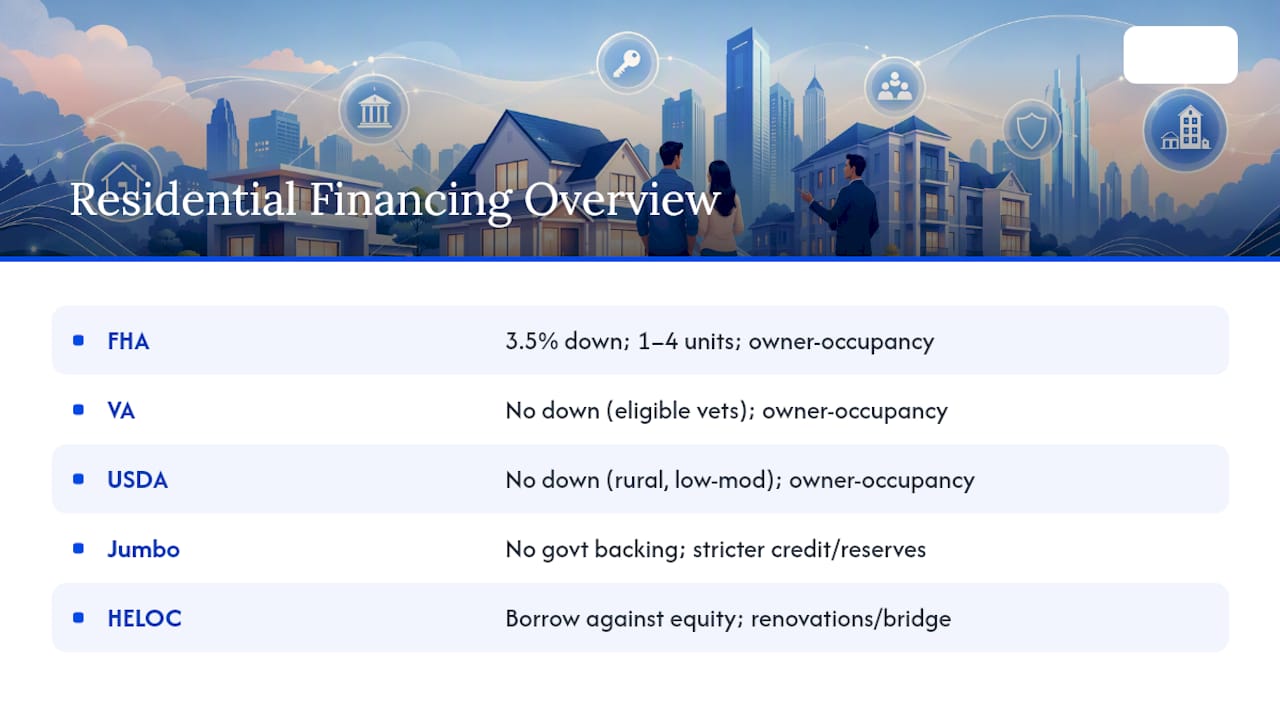
VA loans, guaranteed by the Department of Veterans Affairs, can require no down payment at all for eligible veterans, servicemembers, and certain surviving spouses, and often skip mortgage insurance entirely. USDA loans serve low-to-moderate income buyers in eligible rural areas, also with no down payment requirement in many cases. Jumbo loans exceed conforming loan limits and finance high-value homes, but expect stricter credit and reserve requirements since no government backing cushions the lender’s risk.
A HELOC or home equity loan lets a homeowner borrow against equity already built up, useful for renovations or bridging into a second property.
Occupancy rules matter here. FHA, VA, and USDA loans require you to live in the home, generally within 60 days of closing, and investors cannot use them to buy rental property. Conventional and jumbo loans occasionally finance second homes or investment property, but expect a higher down payment and a rate premium. Reviewers comparing FHA and conventional financing note the trade-off usually comes down to credit score versus upfront cash.
Commercial and Investment Loans: SBA, CMBS, DSCR, and More
Commercial financing is underwritten differently than residential debt. Lenders look at the property’s income potential, sometimes ahead of the borrower’s personal finances entirely.
SBA 7(a) and SBA 504 loans finance owner-occupied business real estate, combining a bank loan with certified development company funding under SBA’s program structure. Permanent commercial mortgages fund stabilized, income-producing buildings with 10 to 30 year amortization schedules. CMBS loans pool commercial mortgages into bonds sold to investors, often offering competitive fixed rates but rigid, sometimes non-negotiable terms once closed.

DSCR loans qualify a borrower based on the property’s rental cashflow rather than personal income, which makes them popular with self-employed investors and portfolio builders. Multifamily and agency loans through Fannie Mae, Freddie Mac, or HUD programs offer some of the lowest long-term rates for apartment buildings. Construction-to-permanent loans fund ground-up development, then convert automatically into permanent financing once the certificate of occupancy is issued.
Financing an investment property differs meaningfully from financing a primary residence: expect higher down payments, tighter debt-service coverage requirements, and a narrower product menu. An owner-occupied medical office fits SBA 504. A stabilized 40-unit apartment building fits an agency loan. A ground-up mixed-use project needs construction-to-perm, not a permanent mortgage from day one. Reviewing the full menu of commercial real estate loan types helps you narrow the field before you approach a lender.
Bridge Loans, Hard Money, and Other Fast-Close Options
When speed or an unconventional property rules out a bank, non-traditional financing fills the gap. Bridge loans cover the time between buying a property and securing permanent financing or selling it. Hard money and private lending rely on collateral, not your income statement, and close in days rather than weeks. Construction loans disburse in draws as a project progresses. Seller financing lets the property owner act as the lender. Crowdfunding pools smaller investor contributions into a single deal.
These options cost more than a bank loan, often several percentage points higher, plus origination points, but they close in days to a couple of weeks instead of 30 to 45 days.
- Bridge/hard money: exit via refinance into permanent debt or sale of the asset
- Construction loans: exit via conversion to permanent financing or a cash-out refinance
- Seller financing: exit via traditional refinance once you qualify conventionally
- Crowdfunding: exit tied to the sponsor’s stated hold period and sale timeline
The main risk across all five: borrowing short-term capital without a firm exit plan already lined up.
How to Match Financing to Your Deal and Get It Closed
Start with your own profile before you shop lenders.
- Define your timeline. A 6-month flip needs different capital than a 10-year hold.
- Check your credit and cash reserves. Government-backed residential loans want documented income; DSCR and hard money weigh the property or your collateral more heavily.
- Confirm occupancy. FHA, VA, and USDA require you to live in the home; investment loans do not.
- Estimate your leverage target. Higher loan-to-value usually means a higher rate and stricter reserves.
- Match the loan term to your exit. Don’t finance a 12-month flip with a 30-year mortgage or a long-term rental with a 6-month bridge loan.
Ask any lender directly about prepayment penalties, recourse versus non-recourse terms, and occupancy restrictions before you sign a term sheet. Banks have also tightened lending standards in recent cycles, which pushes many borrowers toward private capital or CMBS debt when conventional underwriting gets restrictive.
Document prep varies by loan type. Conventional and FHA loans want two years of tax returns, pay stubs, and bank statements. Construction loans need a scope of work, budget, and builder contract. Private lending typically needs far less: property details, your exit plan, and proof of funds for the down payment or rehab budget. A loan checklist built around your specific loan type saves weeks of back-and-forth.
When Private Lending Is the Pragmatic Choice
Private lending earns its place when a deal needs speed a bank cannot match, when the collateral itself does not fit a conventional box (a fire-damaged rehab, a $12 million estate), or when a rehab timeline outruns standard underwriting.
Pro Tip: Line up your exit, a refinance commitment or a listing date, before you borrow. Private capital is affordable when it’s temporary and expensive when it lingers.
How Capital Funding Structures a Fast Close
Private lenders price hard money and bridge loans by risk on the asset, not your tax returns, which is why approval moves in days rather than weeks. Rates typically run higher than a bank loan, plus one to a few points in origination fees, with pricing tied closely to loan-to-value. Underwriting focuses on the property and your exit strategy rather than debt-to-income ratios.
Consider a $400,000 fix-and-flip: a private lender might fund the purchase plus rehab budget on a 12-month term, with the borrower’s plan being a sale or cash-out refinance at completion. The lender’s checklist centers on after-repair value, the renovation scope, and proof the borrower can carry holding costs until the exit.
Get Financing Moving With Capital Funding
If speed matters more than a slow bank process, Capital Funding closes hard money and bridge loans in days, not weeks, backed by a family office rather than a committee of loan officers. Whether you need a fix-and-flip loan, ground-up construction financing, or a commercial bridge loan for a multifamily or retail deal, the approval process weighs your property and exit plan first.

To speed up your approval, have these ready before you call:
- Loan purpose (purchase, refinance, or construction)
- Property address and basic details
- Estimated rehab or construction budget
- Your exit strategy (sale, refinance, or hold)
- Recent bank statements and a basic credit summary
Explore the full range of loan programs available, including options for non-traditional and ultra-high-value properties other lenders won’t touch, and get a term sheet started today.
Where to Verify Program Details
- HUD/FHA for current FHA loan limits and insurance requirements
- VA for veteran eligibility and entitlement rules
- SBA for 7(a) and 504 program terms
- CFPB for general loan comparison guidance
- Investopedia for investment property financing explainers
Program rules and limits change, so confirm current terms directly with the issuing agency before applying.
This article is general information, not a substitute for advice from a qualified financial advisor. Consult a qualified financial professional about your own circumstances before acting on anything here.
Sources
- Understand the different kinds of loans available | Consumer Financial Protection Bureau
- HUD — FHA loan information
- VA Home Loans | U.S. Department of Veterans Affairs
- SBA — Funding programs: loans
FAQ
What are the financing options for real estate?
Options fall into three groups: residential loans (conventional, FHA, VA, USDA, jumbo, HELOC), commercial and investment loans (SBA, CMBS, DSCR, agency, construction-to-perm), and short-term or specialty financing (bridge loans, hard money, seller financing, crowdfunding).
What is the difference between a fixed-rate and an adjustable-rate loan?
A fixed-rate loan keeps the same interest rate for the entire term, while an adjustable-rate mortgage starts lower then resets periodically based on a market index.
How fast can a hard money or bridge loan close?
Private lenders like Capital Funding can often close in days because underwriting focuses on the property and exit plan rather than income documentation.
Do I need a down payment for a VA or USDA loan?
Both programs can require no down payment for eligible borrowers, though credit, income, and property eligibility rules still apply.
What is a DSCR loan and who uses it?
A DSCR loan qualifies borrowers using the property’s rental income rather than personal income, making it popular with investors and self-employed buyers.
