

A broker price opinion works for quick market checks, pre-listing pricing, and some internal servicer decisions. A mortgage lender, a court, or a PMI removal request almost always requires a licensed appraisal because it follows the Uniform Standards of Professional Appraisal Practice (USPAP), which gives it legal weight a BPO doesn’t carry. Before paying for either one, ask the requesting party in writing which report they’ll actually accept.
TL;DR:
- A BPO costs between $50 and $150 and delivers a quick estimate, suitable for internal decisions or narrow use cases like foreclosure or pre-listing pricing.
- An appraisal costs $300 to $800, takes 7 to 21 days, and is required by lenders or courts due to its USPAP compliance and full inspection process.
- Many servicers may accept a BPO for PMI removal or certain short decisions, but a formal appraisal is usually necessary for legal or financial matters.
- For unique or complex properties, the gap between BPO and appraisal estimates widens because appraisers apply multiple methods and thorough documentation.
- Always confirm in writing which report is accepted before ordering to avoid paying for an unnecessary or insufficient valuation.
Table of Contents
- BPO vs Appraisal: A Side-by-Side Comparison
- What Is a Broker Price Opinion?
- Why Appraisal Standards Matter for Lenders and Courts
- How to Decide: A Four-Step Checklist
- How Valuation Choice Affects Your Financing Timeline
- Need Financing While an Appraisal Is Pending?
- Where These Numbers Come From
- Sources
- FAQ
BPO vs Appraisal: A Side-by-Side Comparison
The two reports look similar on paper. They diverge sharply in who prepares them, how much scrutiny they survive, and who will actually rely on the number at the bottom.
| Factor | Broker Price Opinion (BPO) | Appraisal |
|---|---|---|
| Prepared by | Licensed real estate broker or agent | State-licensed or certified appraiser |
| Typical cost | $50 to $150 | $300 to $800 |
| Turnaround | 1 to 4 days | 7 to 21 days |
| Inspection depth | Drive-by or limited interior walkthrough | Full interior and exterior inspection |
| Regulatory standard | State real estate commission rules, disclosure required | USPAP compliance |
| Who accepts it | Loan servicers (for narrow decisions), investors, some pre-listing uses | Lenders, courts, tax authorities, estate and divorce proceedings |
| Typical use | Foreclosure triage, quick investor read, pricing strategy | Mortgage underwriting, PMI removal, legal disputes |
A few practical trade-offs sit underneath that table:
- Speed and price favor the BPO, but that advantage disappears the moment a lender or court is the one reading the report.
- Some servicers will accept an interior BPO or an automated valuation model for a narrow PMI removal request, but this varies by servicer and should never be assumed.
- For a typical single-family home in a stable market, a well-done BPO and a full appraisal often land within a few percentage points of each other, according to RealAnalytica’s comparison. That gap widens fast for unusual properties.
What Is a Broker Price Opinion?
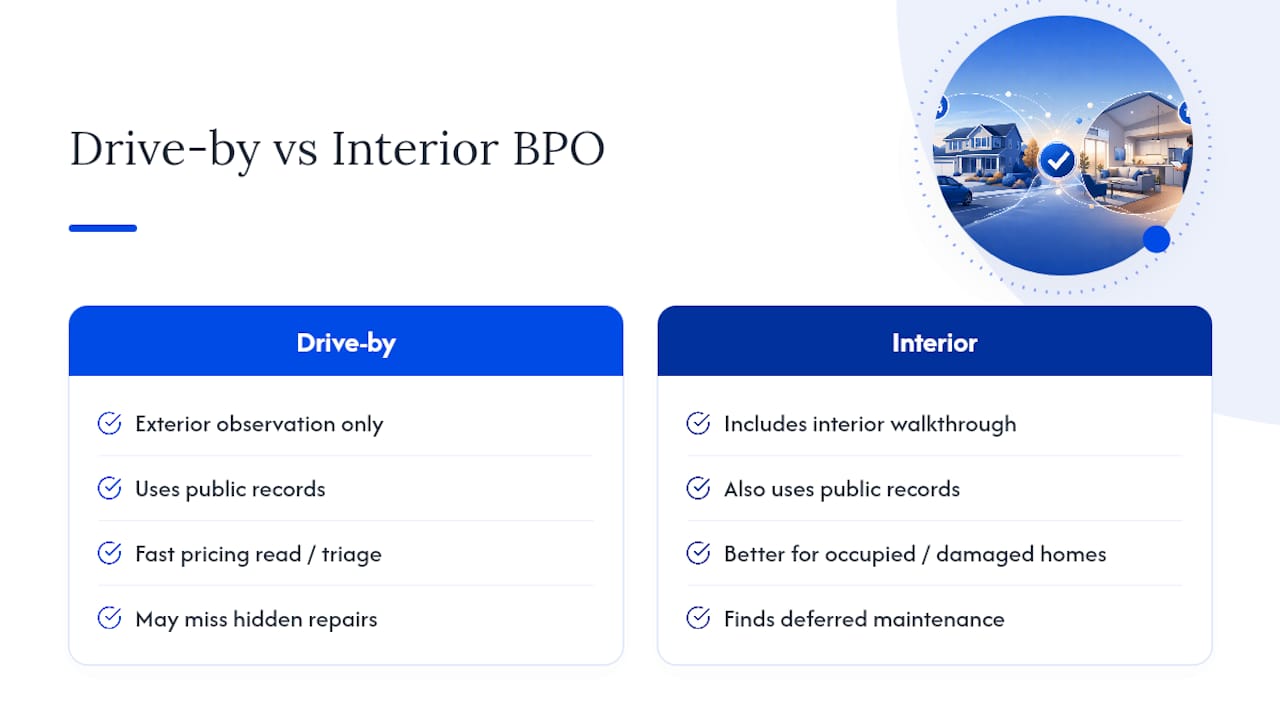
A broker price opinion is an informal estimate of a property’s likely sale price, prepared by a licensed real estate broker or agent rather than a state-certified appraiser, as shown in an example report tool that illustrates report formats for valuation. It comes in two common formats: a drive-by BPO, based on exterior observation and public records, and an interior BPO, which includes a walkthrough of the property.
Banks and loan servicers order most BPOs, often to triage distressed assets, decide whether to approve a short sale, or get a fast pricing read before listing a foreclosed property. Investors also use them for a quick gut check on a potential deal. Fees typically run $50 to $150, and the ordering party, usually a lender or servicer, covers the cost.
The catch is bias risk. A broker preparing a BPO may also want the listing if the property sells, which creates a built-in conflict of interest that a truly independent appraiser doesn’t face. State regulators like TALCB require every BPO to carry a disclosure stating it is an estimated sale price, not an appraisal.
Pro Tip: If you’re ordering a BPO yourself as an investor, ask for an interior version whenever the property is occupied or has any deferred maintenance. A drive-by BPO on a home with hidden repair issues can miss thousands of dollars in value swings.
Why Appraisal Standards Matter for Lenders and Courts
An appraisal is a formal opinion of market value produced by a state-licensed or certified appraiser, built on a full interior and exterior inspection, documented comparable sales, and a written report that typically runs many pages longer than a BPO. That length isn’t padding. It’s the adjustment grid, the comparable sales analysis, and the reconciliation of value methods that make the number defensible.
The reason lenders, courts, and tax authorities accept appraisals over BPOs comes down to one standard: USPAP. Every licensed appraiser in the country must follow it, and it requires the kind of impartiality a commissioned broker doesn’t have to meet.
A few practical realities follow from that:
- Appraisals typically cost $300 to $800 and take 7 to 21 days, depending on property complexity and appraiser availability.
- Lenders insist on an appraisal for nearly every purchase and refinance loan, and the appraised value directly determines your loan-to-value ratio, which in turn affects your rate and how much you can borrow.
- For PMI removal, most servicers require a full appraisal rather than a BPO once you’re requesting a formal reassessment of equity, though some will consider a BPO or AVM for a preliminary check.
How to Decide: A Four-Step Checklist
Pick the wrong report and you’ll pay twice, once for the BPO or appraisal you didn’t need, and again for the one you actually had to order. Work through these four steps before you spend a dollar.
- Identify who relies on the report. A lender underwriting a mortgage, a court dividing marital assets, or a servicer deciding on a loan modification each has different requirements. Internal planning, like deciding whether to list a rental property, has the lowest bar.
- Confirm acceptance in writing. Call the lender, servicer, or court and ask directly: will they accept a BPO, or do they require a USPAP-compliant appraisal? Documenting that answer before you order anything is the single step that prevents wasted fees.
- Vet the preparer and the scope. Ask whether the person is impartial to the outcome, what comparable data they’re using, whether the property gets an interior inspection, and whether the report states a clear effective date.
For unique properties, waterfront lots, historic homes, custom luxury builds, the gap between a BPO and an appraisal tends to widen. Appraisers apply multi-method reconciliation and document every adjustment, while a BPO’s limited comparable set can miss what actually drives value on a one-of-a-kind property, per NJ Appraisal Insights.
Pro Tip: When in doubt, order the BPO first for a fast, cheap read on where you stand. If the outcome will be relied on formally, by a lender, a court, or a title company, budget for the appraisal from the start instead of hoping the BPO will be enough.
How Valuation Choice Affects Your Financing Timeline
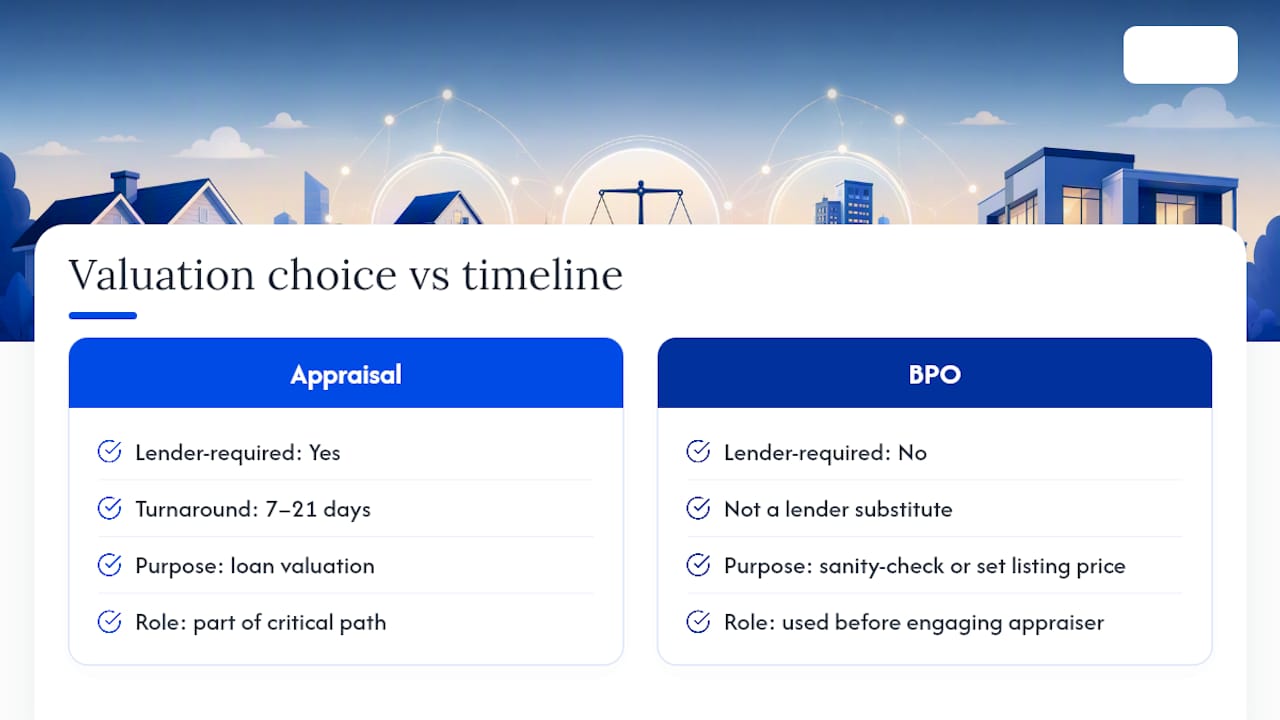
Investors and borrowers underestimate how much a valuation choice can slow down a closing. If you’re refinancing, removing PMI, or securing a bridge loan against a property’s after-repair value, the lender’s appraisal requirement isn’t negotiable, and the 7 to 21 day turnaround becomes part of your project’s critical path.
A BPO can still be useful here, just not as a substitute. Investors often order one internally to sanity-check a deal or set a listing price before ever engaging an appraiser for the loan itself. When you’re preparing for a lender’s evaluation, documentation matters as much as timing. Our guide on how lenders evaluate flip projects walks through what underwriters actually want to see, and our ARV loan playbook covers how to get a project lender-ready before the appraisal even lands.
The bottom line: waiting on an appraisal costs real money when a project’s timeline is fixed. Faster funding options exist precisely because that waiting period creates risk for borrowers.
Need Financing While an Appraisal Is Pending?
Some direct private lenders close hard money loans in days, not the weeks a traditional bank timeline demands, so a pending appraisal doesn’t have to stall your project.

If you’re waiting on a formal appraisal for a purchase, refinance, or construction draw, our Hard Money Loan Program and Fix and Flip Program are built around fast underwriting rather than the multi-week bank cycle. As a direct private lender backed by a family office, we work with appraisals during our own underwriting process, but we don’t let a lender’s backlog dictate your closing date. Investors breaking ground on new builds can also look at our Ground Up Construction Program for the same speed advantage. If your project timeline is tied to a valuation deadline, review our services page or reach out directly for guidance specific to your deal.
Where These Numbers Come From
Sources
- Broker price opinion (BPO) — Investopedia
- Appraisal, Evaluation, Brokers Price Opinion: What’s the Difference? — TALCB
- Property appraisal vs. broker price opinion: 2026 guide — NJ Appraisal Insights
FAQ
Which Is Better, BPO or Appraisal, to Remove PMI?
An appraisal is usually required for formal PMI removal because servicers need a USPAP-compliant report to justify releasing insurance. Some servicers will accept a BPO or automated valuation model for a preliminary check, but always confirm this in writing before paying.
Are BPO and CMA the Same Thing?
No. A comparative market analysis (CMA) is typically an informal, free estimate an agent prepares for a potential seller, while a BPO is a paid report ordered by a lender or servicer that often follows a more structured format with required disclosures.
Can Any Realtor Do a BPO?
A BPO must be prepared by a licensed real estate broker or agent, but not every agent accepts BPO assignments. Many companies that order BPOs require the agent to register with a specific vendor management platform and meet minimum experience requirements first.
What Is the BPO Appraisal Cost?
A BPO typically costs $50 to $150, while a full appraisal usually runs $300 to $800 depending on the property’s size and complexity. If you need financing while waiting on either report, Capitalfunding’s loan pricing and terms are listed directly on each program page.
