- The ten most common Palm Beach development financing pitfalls are underbudgeting, mismatched loan structures, late financing, weak risk management, overleveraging, permitting and environmental surprises, condo and HOA complications, insurance and flood exposure, seasonal timing errors, and community opposition. Each one is predictable. Each one is avoidable.
Your 72-hour action checklist:
- Confirm lender appetite for your project type, LTV/LTC range, and contingency expectations before you bid.
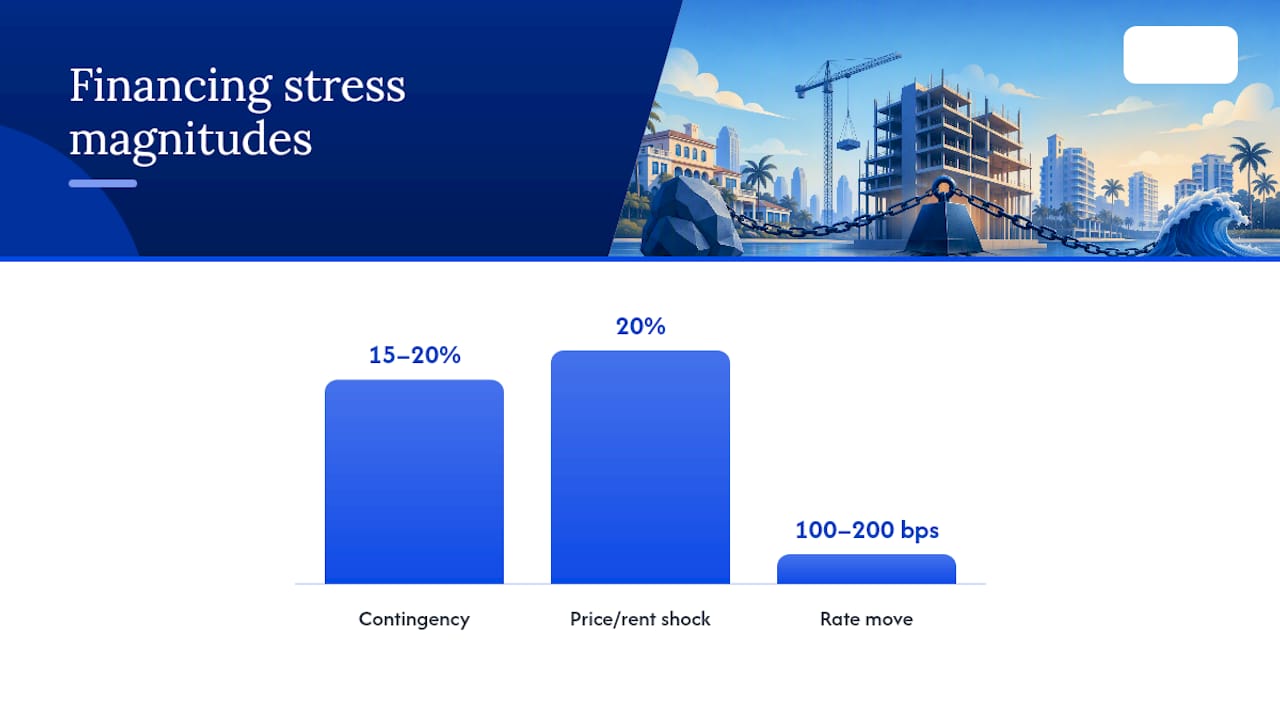
- Verify your contingency budget meets the current South Florida lender standard of 15%–20% on complex vertical builds.
- Pull your permitting roadmap and confirm no environmental flags exist on the site.
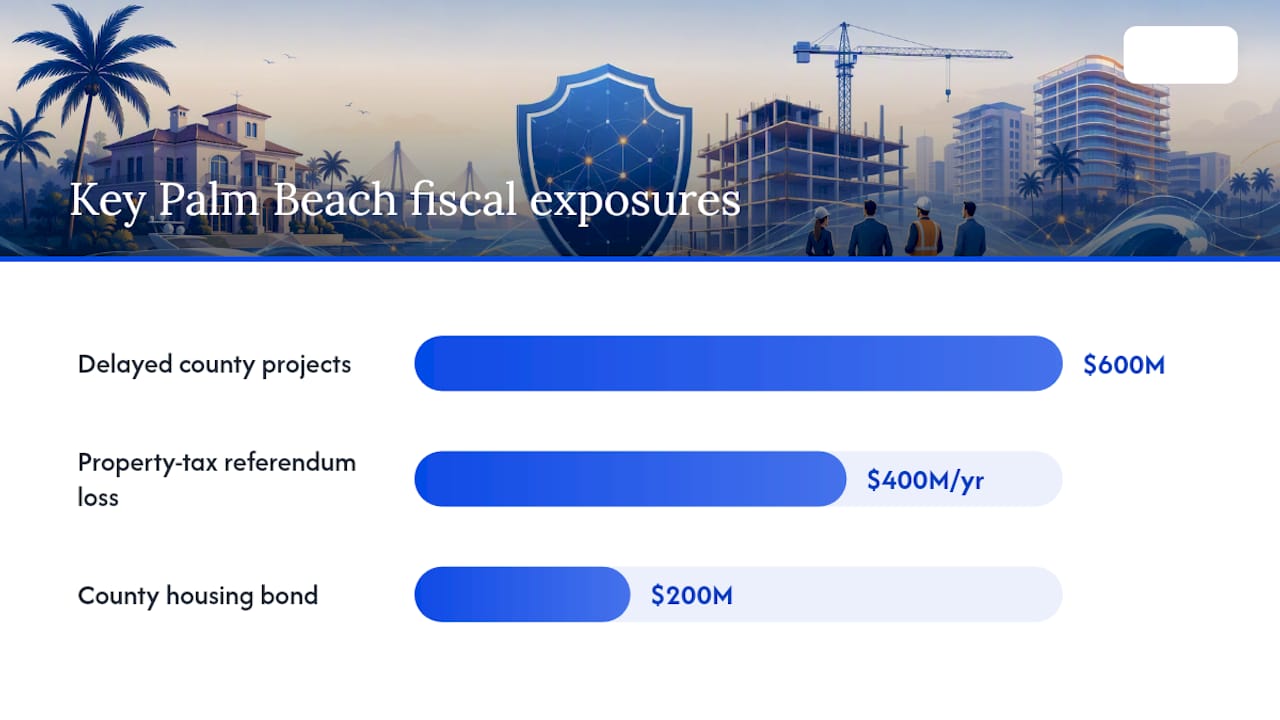
Local warning: Palm Beach County has paused more than $600 million in capital projects while awaiting a property-tax referendum that could cut county revenue by nearly $400 million annually. Factor that fiscal uncertainty into your pro forma and your municipal approval timeline before you sign anything.
Key Takeaways
Point Details Contingency standard South Florida lenders now require 15%–20% contingency on complex vertical projects; budget below that triggers equity calls. LTC vs. LTV clarity Confusing loan-to-cost with loan-to-value leads to equity shortfalls; confirm which metric your lender uses to size the loan. Local policy risk Palm Beach County has paused over $600M in capital projects; factor that fiscal uncertainty into your permitting timeline and pro forma. Stress-test your exit Model a 20% price/rent decline, a 100–200 bps rate move, and a 6–12 month delay before committing to your leverage level. Capitalfunding advantage Capitalfunding closes hard money and construction loans in days, with flexible structures for complex Palm Beach projects conventional lenders decline. 
Table of Contents
- 1. You’re probably underestimating your total project costs
- 2. Mismatching your loan structure to your project stage costs you money
- 3. Late financing and mis-sequenced deliverables kill deals
- 4. Weak risk management gives lenders a reason to reprice or pull your loan
- 5. Overleveraging without a tested exit plan leads to forced sales
- 6. Palm Beach–specific policy and market risks you need to price in right now
- 7. Use this checklist with your lenders, contractors, and partners
- Working with a local private lender reduces timing friction
- Capitalfunding offers Palm Beach developers a faster, more flexible path
- Sources
- FAQ
1. You’re probably underestimating your total project costs
Underestimating line-item costs and contingencies is the single most common cause of mid-build financing stress in Palm Beach. Lenders see it constantly, and it is the fastest way to trigger a loan covenant breach or a forced equity call.
The cost categories lenders scrutinize most closely:
- Hard costs: foundation, structure, MEP, finishes, site work
- Soft costs: architecture, engineering, legal, permitting fees, surveys
- Financing costs: origination fees, interest reserve, extension fees
- Escalation: material and labor cost increases over the build period
- Permits and entitlements: impact fees, zoning applications, variance costs
- Insurance: builder’s risk, general liability, flood, and wind coverage
- Environmental testing: Phase I and Phase II assessments
- Owner contingency: a separate line item, not folded into GC contingency
Construction lenders in South Florida now commonly require 15%–20% contingency on complex vertical projects, up from the pre-2022 norm of roughly 10%. If your budget shows less, expect lenders to resize the loan or require additional equity at closing.
Phase II callout: If a site has prior agricultural or industrial use, a Phase I assessment will almost certainly trigger a Phase II recommendation. Phase II testing can add weeks to your timeline and tens of thousands of dollars to your budget. First-time Florida developers face heightened regulatory and environmental lender scrutiny that can increase costs and liability if not addressed early. Budget for it before you go to term sheet, not after.
Pre-bid verification checklist:
- Obtain an independent cost review tied to executed or near-executed subcontracts
- Confirm Phase I status and flag any prior land use that could trigger Phase II
- Separate GC contingency from owner contingency in your budget
- Verify insurance cost assumptions with a Florida-licensed broker before underwriting
Pro Tip: Require an independent cost review before you submit to any lender. Lenders who see a budget backed by executed subcontracts and a third-party cost opinion move faster and price better.
2. Mismatching your loan structure to your project stage costs you money
Choosing the wrong financing structure for your project stage or exit plan creates unnecessary cost, covenant friction, or timing risk. The fix is simple: match the loan product to your actual hold period, presale position, and liquidity.
Common structures and their tradeoffs:
- Ground-up construction loan: highest lender scrutiny, draw-based funding, requires GC contract, permits, and insurance at close; best for fully entitled projects with clear exit
- Bridge loan: faster to close, interest-only, shorter term; suited for pre-stabilization or light repositioning before permanent financing
- Hard money loan: fastest execution, asset-based underwriting, higher rate; best for time-sensitive acquisitions or projects conventional lenders won’t touch
- Mezzanine financing: fills the gap between senior debt and equity; adds complexity and intercreditor agreements
- Permanent / DSCR loan: long-term hold financing sized to net operating income; requires stabilized occupancy
Understanding loan-to-cost (LTC) versus loan-to-value (LTV) is not optional. LTC sizes construction financing against total project cost; LTV sizes permanent financing against appraised value. Confusing the two leads to equity shortfalls or unexpected lender adjustments at closing.
Pro Tip: Align your loan tenor to your realistic exit, not your optimistic one. Build in extension options at term sheet.
3. Late financing and mis-sequenced deliverables kill deals
Late financing or mis-sequenced lender deliverables are predictable deal killers. Lenders have specific conditions that must be satisfied at each project milestone, and missing one can delay closing by weeks or trigger a commitment expiration.
What to lock at each stage:
- Pre-bid: term sheet, lender’s key conditions list, preliminary title review, and confirmation of lender appetite for your project type and size
- Pre-close: permits in hand (or confirmed issuance timeline), executed GC contract, builder’s risk insurance bound, title insurance commitment, updated survey, and contractor bonding confirmation
- During construction: draw schedule agreed upon, independent inspector engaged, interest reserve funded, and extension trigger conditions documented
Document checklist to accelerate underwriting:
- ALTA survey (current, within 90 days)
- Title commitment with all exceptions reviewed
- Executed GC contract with payment and performance bond
- Updated cost report tied to subcontracts
- Builder’s risk and flood insurance binders
- Permits or confirmed permit issuance letter
- Environmental reports (Phase I, Phase II if applicable)
- Contractor bonding capacity letter
Pre-construction financing requires clear deposit schedules, escrow protections, and refundable clauses. Negotiate refund provisions and tiered deposit structures before you commit capital.
Pro Tip: Deliver a pre-close packet to your lender before they ask for it. An organized packet with every document indexed reduces independent review time and signals the kind of operational discipline lenders want to see in a borrower.
4. Weak risk management gives lenders a reason to reprice or pull your loan
Inadequate risk controls lead lenders to pull or reprice loans. Insurance gaps, unvetted contractors, and thin reserves are the three most common triggers. Florida’s environment makes each one more consequential than in most other markets.
Lender-focused risk items to address before closing:
- Named-storm deductibles: Florida policies often carry 2%–5% of insured value as a wind/hurricane deductible; lenders want to see this modeled in your budget
- Flood exposure: confirm FEMA flood zone designation and whether NFIP coverage is required or if private flood is acceptable to the lender
- Builder’s risk: confirm the policy covers the full replacement cost of the project at peak construction value
- Performance and payment bonds: required by most institutional lenders on projects above a certain threshold; confirm GC bonding capacity early
- GC financial health: an overleveraged or overloaded GC is a primary underwriting concern; lenders increasingly treat general contractor financial health as a core underwriting item
- Subcontractor lien exposure: confirm lien waiver procedures are built into your draw process
Contractor diligence checklist lenders want to see:
- Current bonding capacity letter (not older than 60 days)
- Backlog report showing available capacity for your project
- Payment history with prior subcontractors
- Two to three verifiable project references of comparable scope
- Change-order controls and approval process documentation
Pro Tip: Florida’s named-storm insurance binding moratoria can activate with 48 hours’ notice. If you are closing near hurricane season (June through November), bind your builder’s risk policy well in advance. A lender cannot close without it, and a moratorium can hold your deal for weeks.
5. Overleveraging without a tested exit plan leads to forced sales
High leverage without a stress-tested exit is a common path to forced sales or extended holding costs in Palm Beach. Markets shift, rates move, and presale timelines slip. Your exit plan needs to survive all three.
Exit strategies and when each fits:
- Presales / condo presales: reduces lender risk and often unlocks better LTC; requires sufficient presale threshold before construction funding
- Forward sale: locks in a buyer at a fixed price; reduces upside but eliminates absorption risk
- Refinance to permanent / DSCR loan: requires stabilized occupancy and a debt-service coverage ratio (DSCR) that supports the permanent loan amount under conservative rent assumptions
- Bulk sale: fastest exit but typically at a discount; useful when market conditions deteriorate
- Rental conversion: extends hold period; requires operating reserves and a lender willing to extend or refinance
Stress-test your exit before you commit:
- Apply a 20% decline in projected rents or sale prices
- Model a 100–200 basis point increase in the refinance rate
- Extend your projected completion date by 6–12 months
- Recalculate DSCR and LTC under each scenario
If the deal breaks under any of those conditions, your leverage is too high or your exit is too thin. Prepayment penalties can also materially change refinancing flexibility; understand the payoff mechanics before you sign.
Pro Tip: Lenders commonly expect to see 6–12 months of operating and contingency reserves documented at closing. Prepare a liquidity schedule showing reserve sources, not just a bank statement balance.
6. Palm Beach–specific policy and market risks you need to price in right now
Local fiscal and policy moves can change county funding availability and permitting pace in ways that directly affect your underwriting assumptions and municipal approval timeline.
Key data point: Palm Beach County has delayed more than $600 million in capital projects while awaiting a statewide property-tax referendum that could reduce county revenue by nearly $400 million annually beginning in 2028. Projects that depend on county infrastructure improvements or public funding coordination face real schedule risk.
Local risks to fold into your pro forma sensitivity:
- Property tax referendum: a revenue reduction of nearly $400 million annually would constrain county capital budgets, slow infrastructure approvals, and potentially delay utility connections or road improvements tied to your project
- Housing bond limits: Palm Beach County’s $200 million housing bond has produced fewer projects than expected; relying on bond proceeds as primary financing creates design and approval tension with county commissioners
- Permitting timelines: Palm Beach County permitting for complex vertical projects can run 6–18 months; build that range into your construction schedule and interest reserve
- Environmental and entitlement risk: prior agricultural or industrial land use is common in Palm Beach County’s development pipeline; Phase II requirements can add 60–90 days and significant cost
- Condo and HOA complications: condo lending in Palm Beach County is frequently affected by HOA litigation, special assessments, reserve levels, and named-storm deductibles; lenders evaluate these factors closely and may reduce LTV or decline financing if concerns exist
- Seasonal market fluctuations: Palm Beach’s luxury market peaks between November and April; launching sales or refinancing outside that window can compress pricing and extend absorption timelines
- Community opposition: high-profile projects in Palm Beach face organized opposition that can delay entitlements, trigger additional environmental review, or cause lenders to pause commitments pending resolution
Experienced Florida counsel and local operator partnerships materially improve financing outcomes by smoothing entitlement, environmental, and insurance issues that out-of-state developers routinely miss. Engaging reliable real estate investment partners early in the process reduces the risk of costly surprises at underwriting.
7. Use this checklist with your lenders, contractors, and partners
A repeatable checklist standardizes diligence across projects and gives you a consistent framework for evaluating lender quality, contractor readiness, and deal structure before you commit capital.
Pre-term-sheet:
- Confirm lender’s appetite for your project type, size, and location
- Request the lender’s standard contingency requirement and LTC range
- Verify lender’s track record with comparable Palm Beach projects
- Confirm lender’s draw process, inspection requirements, and extension mechanics
- Review personal completion guarantee and bad-boy carve-out triggers with local counsel
Pre-close:
- Deliver organized pre-close packet (survey, title, permits, GC contract, insurance binders)
- Confirm interest reserve is sized for your realistic construction timeline, not the optimistic one
- Verify contractor bonding capacity and backlog
- Order HOA documents and insurance review early for condo transactions
- Confirm flood zone designation and lender’s flood insurance requirements
Early construction:
- Confirm draw schedule and independent inspector engagement
- Verify lien waiver procedures are in place before first draw
- Confirm insurance binding is current and covers peak construction value
Mid-construction monitoring:
- Track contingency consumption against budget monthly
- Monitor GC subcontractor payment status to catch lien exposure early
- Confirm interest reserve balance against remaining construction timeline
Questions to ask every lender:
- What are your underwriting assumptions for this project type and market?
- How do you treat contingency: is it funded upfront or drawn as needed?
- What triggers an interest reserve top-up, and who funds it?
- What are your prepayment penalty structure and extension conditions?
- What insurance coverages do you require, and do you have preferred carriers?
- Will you accept an independent cost review in lieu of your own cost consultant?
Red flags to watch for:
- Lender unwillingness to require proof of GC capacity or bonding
- Vague or missing completion guarantee language
- Refusal to accept an independent cost review
- Presale assumptions that rely on thin or unverified buyer commitments
- No clear process for draw inspections or disbursement controls
Trust signals to request from any lender:
- Proof of recent comparable closings in Palm Beach County
- Borrower references from projects of similar scope
- Sample loan documents and flow-of-funds process
- Clear explanation of cure mechanics for covenant breaches
Pro Tip: Sequence your diligence requests strategically. Ask for sample loan docs and references early, before you spend on appraisals or environmental reports. A lender who resists basic transparency at the front end will not get easier to work with at closing.
For a deeper look at Florida construction lending compliance and capital structure, the due diligence framework extends well beyond the checklist above.
Working with a local private lender reduces timing friction
Working with a locally aligned private lender can shorten approval time, offer flexible covenant structures, and simplify cure mechanics in ways that institutional lenders rarely match. When a Palm Beach project hits a permitting delay or an insurance binding issue, a private lender with direct local knowledge can adjust draw timing, top up an interest reserve, or restructure a milestone condition without routing the decision through a committee in another state.
The practical difference shows up in specific mechanics: staged funding tied to independent inspections rather than calendar draws, interest-reserve structures sized to Florida’s actual permitting timelines, and flood and insurance assumptions calibrated to Palm Beach County’s specific exposure profile rather than a national template. Personal completion guarantees and bad-boy carve-outs are standard in Florida construction loan documents; a lender who understands local weather-delay provisions and entitlement timelines will write those triggers more fairly than one who does not.
When evaluating any private lender, surface their trust signals in diligence: closed loan volume, BBB rating, borrower references from comparable Palm Beach projects, and a clear explanation of their draw and cure process.
Capitalfunding offers Palm Beach developers a faster, more flexible path
Palm Beach development deals move fast, and the common financing mistakes outlined above share a root cause: misalignment between lender expectations and project realities. Capitalfunding is a direct private lender backed by a family office, which means faster decisions, tailored structures, and the ability to finance projects that institutional lenders won’t touch.

For Palm Beach developers, that translates directly to solutions for the pitfalls covered here:
- Ground-up construction loans with draw mechanics and contingency structures calibrated to South Florida’s actual build environment
- Hard money and bridge loans that close in days, not weeks, preserving deal timing when conventional lenders stall
- Ultra-luxury financing for single-family projects above $10 million that most lenders decline outright
- Flexible underwriting for complex entitlement timelines, environmental conditions, and non-standard project types
Capitalfunding has closed over $1 billion in loans and holds an A+ BBB rating. For developers navigating Palm Beach’s private capital environment, that track record matters at the term sheet stage. Request a no-obligation pre-close review to confirm your deal structure, contingency adequacy, and lender fit before you commit to a timeline.
Sources
- Five Things First-Time Florida Multifamily Developers Should Know: Shutts & Bowen LLP
- Palm Beach County delays $600M in projects amid property tax referendum uncertainty — Palm Beach Post
- How Construction Lenders Are Evaluating Risk in South Florida Real Estate Projects in 2026 – Square Edge Inc.
This article is general information, not a substitute for advice from a qualified financial advisor. Consult a qualified financial professional about your own circumstances before acting on anything here.
FAQ
What contingency percentage do Palm Beach construction lenders require?
Budgets below that threshold typically trigger an equity call or loan resizing at closing.
How does Palm Beach County’s property tax referendum affect development financing?
The county has paused more than $600 million in capital projects while awaiting a referendum that could reduce county revenue by nearly $400 million annually. Developers should factor potential delays in infrastructure approvals and public funding coordination into their pro formas and permitting timelines.
What is the difference between LTC and LTV in Palm Beach construction loans?
Loan-to-cost (LTC) sizes construction financing against total project cost; loan-to-value (LTV) sizes permanent financing against appraised value. Confusing the two can lead to unexpected equity shortfalls or lender-required adjustments at closing.
When should a Palm Beach developer use a hard money loan instead of a construction loan?
Hard money loans are best for time-sensitive acquisitions, projects with complex entitlement timelines, or deals that conventional lenders decline. Capitalfunding closes hard money loans in days, making them a practical option when deal timing or project type rules out institutional financing.
What HOA and condo issues most commonly affect lender approval in Palm Beach County?
Lenders evaluate reserve funding levels, pending litigation, special assessments, owner delinquency rates, and named-storm deductibles before approving condo project financing. Ordering HOA documents and an insurance review early in the process prevents costly surprises at underwriting.
Recommended