- Experienced, specialized lenders materially increase credit availability and structural flexibility for luxury projects — but they price that advantage into the deal. The practical rule: when speed, bespoke covenants, or ultra-jumbo sizing above $10 million matter, prioritize a specialized or private direct lender. When the lowest coupon is the overriding goal and the project is conventional, a regional or institutional bank may serve you better. Metrics like loan-to-cost (LTC), debt service coverage ratio (DSCR), and the track record of your lending partner all shift meaningfully depending on which path you choose. Capitalfunding, with over $1 billion in closed loans and an A+ BBB rating, is one of the few direct private lenders that finances ultra-luxury projects other lenders won’t touch.
Table of Contents
- Why do luxury projects demand lenders with sector experience?
- How does lender experience change loan terms and pricing?
- What do underwriters actually review for luxury construction loans?
- How do draw schedules and project monitoring affect your cash flow?
- What timelines and contingencies should you plan for?
- What does research show about lender specialization and project outcomes?
- What questions should you ask lenders, and what are the red flags?
- When is a private direct lender the right fit for your luxury project?
- Key Takeaways
- The tradeoff no one talks about clearly enough
- Capitalfunding’s approach to luxury project financing
- Useful sources and further reading
- FAQ
Why do luxury projects demand lenders with sector experience?
Standard construction lending underwriting was not built for a $15 million spec home with a 24-month marketing window, a custom stone façade sourced from Italy, and a single-buyer exit. Luxury projects carry a distinct set of risks that generic lenders routinely underestimate.
Operational complexity is the first layer. Specialty subcontractors, long-lead finish materials, and bespoke amenities create draw timing that does not fit a standard schedule of values. A lender unfamiliar with this reality will either underfund early draws or flag change orders as red flags rather than routine adjustments.
Market and valuation complexity compounds the problem. Ultra-luxury units have limited comparable sales, which makes appraisals contentious and loan-to-value calculations imprecise. For luxury condominiums, HOA documents, condo association financials, and pre-sale absorption rates add another layer of review that inexperienced underwriters often handle slowly or incorrectly.
Underwriting and execution complexity is where deals most often break down. Larger individual draws, heavier change-order risk, longer contingency windows, and uncertain exit timelines — whether a single-buyer sale or a branded-residence takeout — require a lender who has seen these scenarios before and structured around them.
Experienced lenders address these risks directly:
- Bespoke draw schedules that account for shell completion, fit-out phases, and long-lead material deposits
- Meaningful interest reserves sized to realistic marketing windows, not optimistic ones
- Tailored covenants that reflect actual project milestones rather than generic construction benchmarks
- Third-party project monitors with luxury-build experience, not generalist inspectors
- Institutional relationships that support takeout financing when the construction term ends
Research on market-specific bank specialization confirms that specialized lenders hold a structural advantage: they are more likely to lend when a project falls within their area of expertise, and their presence can actually amplify credit availability during tighter market conditions.
Pro Tip: Before you approach any lender, ask for a list of comparable luxury projects they have financed in the past 24 months. The quality of that list tells you more than any marketing brochure.
How does lender experience change loan terms and pricing?
The impact of lender expertise on projects shows up most clearly in the term sheet. Experienced lenders do not just approve loans that others decline — they structure them differently, and those structural differences have real cash-flow consequences.
A practical term comparison
An inexperienced lender on a $12 million luxury spec build might cap the interest reserve at six months and require full payoff before releasing any collateral. An experienced specialist lender on the same deal would size the reserve to 14 months, include a partial release formula tied to unit sales at 115% of allocated loan balance, and allow mezzanine capital behind the senior position. The difference in developer cash flow over the construction and lease-up period can be substantial.
Research on arranger and advisory roles shows that lenders who also provide arranging or advisory services tend to charge higher spreads and extend larger debt levels — but borrowers benefit from greater credit availability and lower refinancing risk. That tradeoff is worth understanding before you negotiate.
Negotiation levers developers can use:
- Offer additional equity to buy down the coupon when speed is less critical
- Propose a larger contingency reserve to reduce the lender’s change-order risk and earn covenant flexibility
- Agree to staged releases tied to verified milestones to unlock higher initial LTC
- Bring a co-sponsor with a relevant track record if yours is limited in this asset class
Pro Tip: Ask for a sample term sheet before you submit a full application. A lender who won’t share one is either inexperienced or hiding fees. Either way, that’s useful information.
What do underwriters actually review for luxury construction loans?
Luxury construction underwriting follows the same core axes as conventional development lending, but the weight assigned to each factor shifts. Understanding what lenders prioritize lets you prepare a package that shortens the underwriting timeline and improves your terms.
Core underwriting checklist
Underwriting Requirement What Satisfies It Sponsor track record Comparable closed projects with documented exits; professional team quality can partially substitute GC capacity Licensed contractor with luxury-build experience, bonding capacity, and relevant subcontractor relationships Pro forma yield-on-cost vs. exit cap rate Detailed budget, revenue assumptions tied to comps, and a conservative absorption schedule Entitlement status Approved permits, zoning confirmation, and any HOA or condo document approvals Pre-sales or commitments Executed purchase agreements or letters of intent for a defined percentage of units Contingency and equity in place Typically 10–15% hard cost contingency; equity verified and committed before closing Takeout plan Identified takeout lender, pre-approval letter, or documented exit strategy (sale, refi, or construction-to-perm) Documents to have ready
- Contractor schedules, GC resume, and subcontractor list
- Architect and engineering plans with stamped drawings
- Detailed budget and schedule of values (SOV) with contingency line items broken out
- Title report and ALTA survey
- Appraisal (as-is and as-completed, from a MAI-certified appraiser with luxury comp experience)
- Organizational documents for the borrowing entity
- Personal financial statements and credit authorization for all guarantors
Track record research confirms that two sponsors with similar projects can receive materially different terms based solely on their delivery history. Experienced lenders, however, often accept a strong professional team, substantial personal capital, and conservative leverage as partial substitutes when direct track record is thin.
How do draw schedules and project monitoring affect your cash flow?
Draw mechanics are where luxury projects most often run into friction. A lender who has never funded a $2 million kitchen fit-out or a custom elevator installation will create bottlenecks that cost you time and money.

Standard draw mechanics
Every construction draw follows a basic sequence: the borrower submits a draw request tied to the SOV, a third-party project monitor or architect verifies completion, lien waivers are collected from contractors and subs, and the lender releases funds. Retainage — typically 5–10% of each draw — is held until substantial completion.
Where luxury builds diverge is in the detail. Long-lead items like custom millwork, imported stone, or specialty mechanical systems often require deposits months before installation. An experienced lender will include stored materials provisions that allow funding against verified purchase orders, not just installed work.
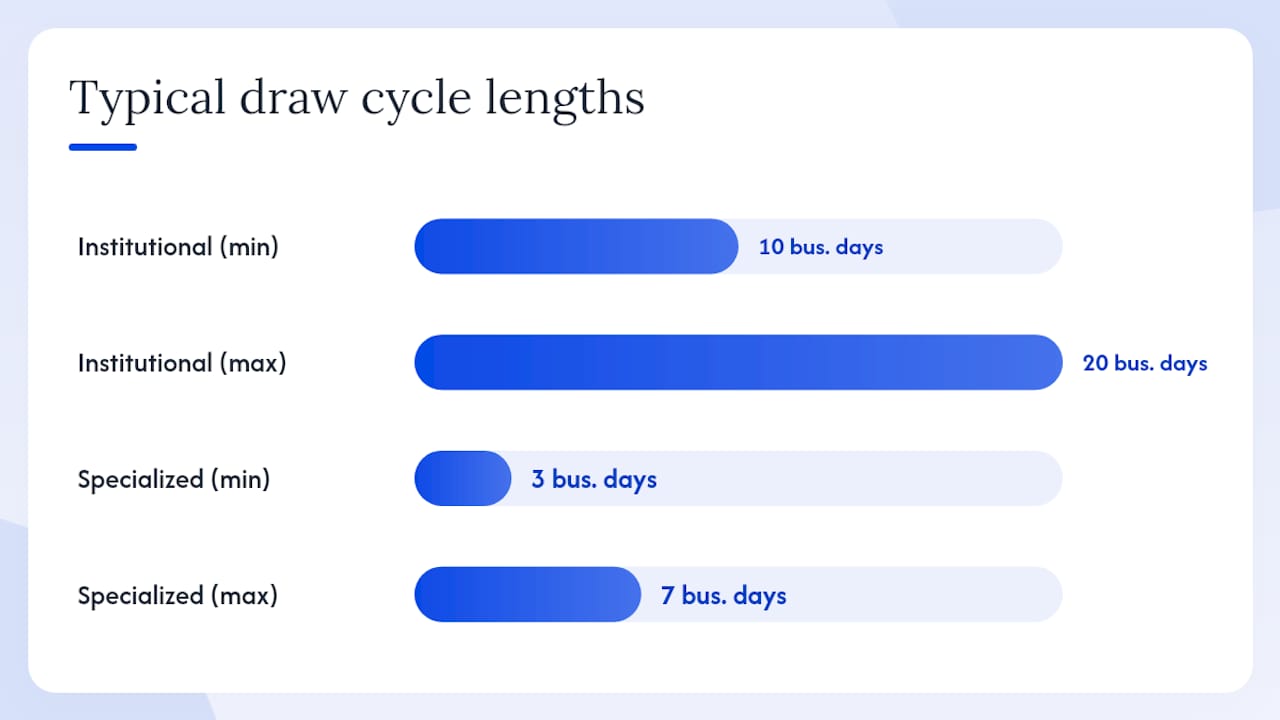
Feature Institutional / Regional Bank Specialized / Private Lender Typical draw cycle 10–20 business days 3–7 business days Stored materials funding Rarely permitted Often permitted with verified POs Monitor selection Lender-assigned generalist Luxury-experienced monitor, sometimes borrower-nominated Partial release provisions Uncommon Standard in experienced lender term sheets 
Commercial construction finance guidance notes that draw verification cycles and project monitor costs are a critical soft cost category. When mismanaged, they cause cash-flow bottlenecks and schedule slippage that compound across the construction timeline.
Documentation to prepare at each draw:
- Updated SOV showing percentage complete by line item
- Architect or monitor inspection report confirming completion
- Conditional and unconditional lien waivers from all contractors and subs
- Stored materials invoices and proof of delivery or secure storage (when applicable)
- Updated construction schedule showing any variance from baseline
Pro Tip: Build your draw request package before the draw date, not on it. A complete, clean submission cuts verification time in half and keeps your interest reserve from burning unnecessarily.
What timelines and contingencies should you plan for?
Luxury project financing moves on a different clock than conventional construction lending. Setting realistic expectations at the outset prevents the kind of contingency failures that kill deals at the worst possible moment.
Typical project calendar
Pre-development and entitlement: 3–18 months depending on jurisdiction, zoning complexity, and condo document requirements. Lenders will not commit until entitlements are substantially complete.
Underwriting and closing:
- Private/specialized lenders (e.g., hard money, direct bridge): 14–30 days from complete application to close
- Regional banks with construction experience: 45–75 days
- Institutional lenders and agency programs: 90–120 days or longer for complex luxury assets
Construction term: Typically 12–24 months for luxury single-family; 18–36 months for luxury condo or mixed-use. Extensions are common and should be negotiated upfront.
Sale or lease-up: Luxury absorption timelines vary widely. A single-buyer spec home in a hot market may close in 60 days; a 20-unit luxury condo tower may require 12–24 months of active marketing.
Financing contingency mechanics
In purchase contracts for luxury land or existing structures, financing contingencies carry more weight than in conventional deals. Appraisal gaps are common when comps are thin. Condo document review periods add 10–30 days to closing timelines. HOA financial review can trigger renegotiation or contract termination if the association’s reserves are inadequate.
- Remove contingencies only when you have a firm lender commitment, not just a term sheet
- Build appraisal gap coverage into your equity stack before you go under contract
- For condo conversions, have your attorney review HOA documents before the contingency deadline, not after
Private capital’s faster closing windows — cited at 21–30 days versus 90–120 days for traditional banks — give developers a meaningful advantage when sellers demand certainty or when a competing offer is on the table. That speed premium is real, and it is worth paying for in the right situation.
What does research show about lender specialization and project outcomes?
The academic evidence on lender specialization is consistent: specialized lenders improve credit availability and reduce refinancing risk, but they extract a pricing premium where they hold market power.
Research on bank specialization demonstrates that specialized banks are more likely to lend when a project falls within their market of expertise, and that their presence can amplify credit supply shocks in both directions — more credit when conditions are favorable, sharper contraction when they tighten.
Lenders that combine arranging and advisory roles tend to charge higher spreads and extend larger debt levels — but borrowers benefit from greater credit availability and meaningfully lower refinancing risk. The tradeoff is structural, not incidental.
Source: Should lenders also advise? Evidence from project loans
On the pricing side, research on domestic arranger certification finds that certification by a prestigious domestic lead arranger reduces overall loan spreads compared to less experienced arrangers, with the effect strongest during periods of market stress. A parallel study on arranger prestige confirms that lead arranger reputation correlates with lower spreads in syndicated project finance, and that participants effectively price in that certification.
The practical implication: arranger or lender prestige is not just a marketing claim. It has measurable pricing value, particularly when credit markets tighten and your project needs a lender who can hold the position.
Pro Tip: When evaluating lenders, ask about their experience during the 2020 and 2022–2023 credit tightening periods. A lender who held their commitments and closed deals during those windows has demonstrated exactly the kind of institutional stability that matters for a 24-month luxury build.
What questions should you ask lenders, and what are the red flags?
Vetting a lender for a luxury project is not the same as vetting one for a standard fix-and-flip. The stakes are higher, the structures are more complex, and the cost of choosing the wrong partner compounds over a multi-year timeline. Use this checklist as your starting framework.
Essential questions to ask
- How many luxury construction loans above $5 million have you closed in the past 24 months?
- What is your average time from complete application to closing commitment?
- Can you provide a sample term sheet for a project of similar size and type?
- Who selects and manages the project monitor, and what are the typical fees?
- What is your policy on stored materials funding and long-lead item deposits?
- Do your term sheets include partial release provisions, and on what formula?
- What equity and contingency levels do you require, and are they negotiable?
- What takeout sources do you work with, and do you offer construction-to-perm conversion?
Initial outreach structure
When you contact a lender for the first time, your message should cover:
- Project type, location, and total cost (hard and soft)
- Requested loan amount and target LTC
- Your equity sources and any co-sponsor track record
- Entitlement status and construction start date
- Desired closing timeline and any contingency constraints
Pro Tip: Send the same structured outreach to three or four lenders simultaneously. The quality and speed of their responses will tell you as much as the terms they eventually offer.
When is a private direct lender the right fit for your luxury project?
Not every luxury project belongs with a private lender, but certain scenarios make the case clearly. Understanding where private lenders in luxury financing hold a structural advantage helps you allocate your financing effort efficiently.
Situations that favor a direct private lender:
- Ultra-jumbo deals above $10 million where institutional underwriting criteria exclude the asset
- Complex condo or branded-residence takeouts requiring phased releases and hospitality-style mini-perm structures
- Projects where speed is decisive — a seller demanding a 21-day close, a competing offer, or a construction start tied to a permit expiration
- Developers with strong equity and professional teams but limited track record on comparable builds, where a case-study approach can substitute for direct experience
When a project’s complexity, size, or timeline falls outside what institutional lenders will underwrite, a direct private lender with sector experience is not a fallback option — it is the primary solution.
Capitalfunding finances projects that conventional lenders decline, including ultra-luxury single-family homes above $10 million. With over $1 billion in closed loans and an A+ BBB rating, Capitalfunding’s ground-up construction program is built for exactly these scenarios. The process is direct: application to term sheet in days, not weeks; underwriting that evaluates the full picture of sponsor equity, professional team, and project fundamentals; and draw management designed for the realities of high-end construction.
For developers working in high-demand coastal markets, private capital execution in luxury markets demonstrates how fast, flexible financing preserves deal velocity when institutional timelines would cost you the opportunity.
A case study from CrowdProperty illustrates the principle: a first-time ground-up luxury build was funded because the borrowers presented extensive professional expertise, land ownership, and a strong equity commitment. Track record matters, but it is not the only path to approval when the rest of the package is compelling.
Key Takeaways
Experienced, specialized lenders change financing outcomes for luxury projects across every dimension that matters: credit availability, structural flexibility, draw timing, and refinancing risk.
Point Details Specialized lenders improve credit access They are more likely to approve complex luxury deals and maintain commitments during credit tightening. Senior debt has tightened to 50–60% LTC Gap capital via preferred equity or mezzanine (often priced at 12–16%) fills the stack in most $10M+ deals. Speed has a measurable cost Private lenders close in 21–30 days versus 90–120 days for institutional lenders; that premium is worth paying when timing is decisive. Track record is negotiable with the right package Strong equity, professional team quality, and conservative leverage can substitute for direct experience on comparable builds. Capitalfunding for ultra-jumbo deals Capitalfunding finances luxury projects above $10M that institutional lenders decline, with over $1B in closed loans and an A+ BBB rating. The tradeoff no one talks about clearly enough
There is a version of this conversation that gets oversimplified: “private lenders are expensive, banks are cheap, use a bank when you can.” That framing misses the actual decision. The coupon is one line item in a project budget. The cost of a delayed close, a botched draw cycle, or a lender who freezes during a credit event is not one line item — it is the entire project.
The developers who consistently execute luxury builds on time and on budget are not the ones who found the cheapest debt. They are the ones who matched their lender to their project’s specific risk profile from the start. A $14 million spec home with a 20-month marketing window needs a lender who has seen that scenario before, sized the interest reserve correctly, and structured partial releases that let the exit happen in stages. A regional bank with a 90-day underwriting process and a generalist project monitor is not the right tool for that job, regardless of the rate.
What I find underappreciated is how much lender experience affects the negotiation itself. An experienced lender knows which covenants are standard and which are negotiable. They know when a change order is routine and when it signals a problem. That knowledge creates a working relationship that is genuinely collaborative rather than adversarial — and on a 24-month luxury build, that difference compounds.
Capitalfunding’s approach to luxury project financing
For developers and investors working on high-value construction or acquisition projects, Capitalfunding offers a direct path to capital that institutional lenders cannot match on speed or flexibility. The concrete advantage: closing in days rather than months, with underwriting that evaluates the full project picture rather than applying a rigid checklist.

Capitalfunding’s hard money and bridge loan programs cover ground-up construction, commercial bridge, and high-value fix-and-flip — including ultra-luxury single-family homes above $10 million that other lenders decline. The process starts with a straightforward outreach: prepare a one-page executive summary, your schedule of values, GC resume, and equity source documentation. From there, Capitalfunding moves to a preliminary term read quickly, with no unnecessary delays in the underwriting process.
To start a conversation about your project, visit capitalfunding.com or reach out directly through the program pages. The team reviews every inquiry and responds with a clear, honest assessment of what’s possible.
Useful sources and further reading
The sources below support the analysis in this guide and offer additional depth on specific topics.
Source What It Covers Should lenders also advise? (JFNRES) Arranger/advisory roles, spread tradeoffs, and credit availability in project loans Market-specific bank specialization (PSchnabl) How specialization creates lending advantages and amplifies credit shocks Commercial construction finance Draw mechanics, monitor costs, and private capital closing timelines Capital stack for $10M+ deals Senior debt sizing, preferred equity, and mezzanine roles in large deals Track record in development finance How delivery history shapes lender terms and required mitigants Looking beyond experience (CrowdProperty) Case study on funding a first-time luxury build with strong equity and expertise Domestic arranger certification (Wiley) How arranger prestige reduces loan spreads in project finance Lead arranger prestige and pricing (Wiley) Syndicated project finance pricing and the certification effect Internal resources from Capitalfunding:
- Should lenders also advise? Evidence from project loans
- Market-specific bank specialization research (PSchnabl)
FAQ
What are the 4 C’s that lenders evaluate for luxury construction loans?
Lenders typically assess capacity (income and cash flow to service debt), capital (equity in the deal), collateral (the asset and its as-completed value), and credit (sponsor history and track record). For luxury projects, collateral valuation and capital are weighted most heavily because of limited comps and larger individual draw sizes.
How does lender experience affect financing timelines for luxury projects?
Experienced private lenders close in 14–30 days from a complete application; regional banks typically take 45–75 days; institutional lenders often require 90–120 days or more for complex luxury assets. Choosing the right lender type for your timeline is one of the most consequential decisions in luxury project financing.
What are red flags when evaluating a lender for a high-value project?
Opaque fee schedules, refusal to share sample term sheets, bans on partial releases, and slow draw verification cycles are the most significant red flags for luxury project lenders. Any lender demanding unrealistically low sponsor equity on a complex build should also prompt a careful review of the fine print.
What should you not tell a lender during initial outreach?
Avoid disclosing that you have no alternative financing options or that your timeline is inflexible without explaining why. Present your equity sources, team credentials, and project fundamentals confidently — lenders respond to strength, and a well-prepared outreach package sets the tone for every subsequent negotiation.
When should a developer choose Capitalfunding over a traditional bank?
Capitalfunding is the stronger choice when the project exceeds $10 million, requires closing in under 30 days, or falls outside institutional underwriting criteria due to asset type or sponsor profile. With over $1 billion in closed loans and an A+ BBB rating, Capitalfunding provides the speed and flexibility that complex luxury projects require.
This article is for general informational purposes only and does not constitute financial, legal, or investment advice. Confirm current lending terms, rates, and program eligibility directly with your lender or a qualified financial professional.
Recommended