- The fastest way to cover the cash and timing gap between closing on a new home and selling your current one is a residential bridge loan, sometimes called interim financing. If you already have a home equity line of credit (HELOC) open, draw from it first — it will cost less. If neither applies, negotiate contract solutions: a home sale contingency, a seller rent-back, or an extended closing date. Your best immediate move is to call your lender today, confirm your available equity, and ask your agent to draft flexible possession terms into your next offer.
Your three right-now actions:
- Call your lender or mortgage broker and ask for a quick equity estimate on your current home (you need to know your approximate loan-to-value ratio before any financing conversation goes further).
- Ask your agent to include a post-closing possession clause or sale contingency in your offer draft so you have a contract-level fallback while financing is arranged.
- Pull your existing HELOC statement, if you have one, and confirm your available credit line and draw timeline.
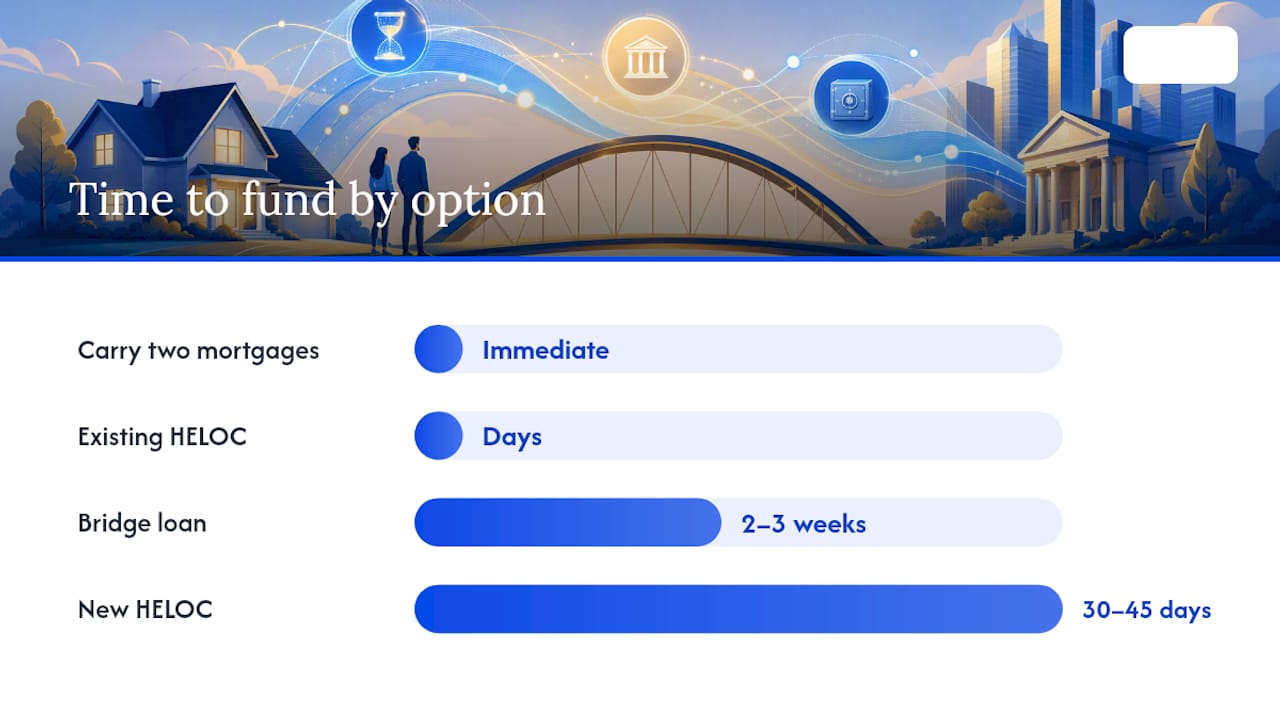
Pro Tip: If your equity is strong and your timeline is tight — say, three to four weeks — a private bridge loan is almost always faster than opening a new HELOC, which typically takes 30–45 days to fund.
Table of Contents
- What creates a closing gap and why it matters
- Primary financing options to cover the gap
- Non-loan solutions: contingencies, rent-backs, and negotiation
- Real costs and risks of short-term financing
- How do you decide which option is right for you?
- Questions to ask before you commit to any financing path
- Your step-by-step plan from offer to close
- How private bridge lending works in practice
- Key Takeaways
- When the math works — and when it does not
- Capitalfunding’s direct private bridge loans for fast closings
- Useful resources and programs to check
- FAQ
What creates a closing gap and why it matters
The closing gap is two problems layered on top of each other: a timing gap and a cash gap. The timing gap occurs when your purchase closing date arrives before your sale proceeds land in your account. The cash gap is the shortfall that results — you need funds for the down payment and closing costs on the new home, but those funds are locked in your current property’s equity.
Several forces create this situation simultaneously. Purchase contracts have fixed closing dates that lenders, title companies, and escrow agents must all honor. Title searches can surface last-minute encumbrances. Appraisals on the sale side can come in low, triggering renegotiation. Wire transfers between financial institutions routinely add one to two business days to any settlement. Experienced closing coordinators note that even well-planned dual closings commonly see 1–2 day delays from banking or title processing alone.
A successful outcome looks like this: you close the new purchase on schedule using planned financing, your current home sells at or near your target price within the lender’s bridge term, and you exit the interim loan cleanly at settlement without carrying two full mortgage payments longer than budgeted. That finish line is achievable with the right preparation. The sections that follow show you exactly how to get there.
Primary financing options to cover the gap
Residential bridge loans
A bridge loan is a short-term loan secured by your current home’s equity, designed to fund your new purchase before your sale closes. Terms typically run several months, and most structures involve interest-only payments with a balloon payment due when the old home sells. Rates are materially higher than conventional mortgages, reflecting a premium for speed and flexibility.
Lenders underwrite bridge loans on an equity basis. The standard formula: lenders advance 70–80% of your current home’s appraised value, then subtract your outstanding mortgage balance. What remains is your maximum bridge amount.
Sample math: Your current home appraises at $600,000. You owe $250,000. At 75% LTV, the lender advances $450,000. Subtract the $250,000 payoff and you have up to $200,000 available as a bridge. That $200,000 can fund your down payment and closing costs on the new property.
HELOC and cash-out refinance
If you already have a HELOC open, it is almost always the cheapest fast option. Rates are typically lower than bridge loans, and you draw only what you need. The catch: opening a new HELOC takes 30–45 days for underwriting and funding, which makes it too slow for many purchase timelines. A cash-out refinance is even slower and replaces your existing mortgage, which rarely makes sense as a short-term solution.
Fannie Mae’s HomeReady and HFA Preferred programs also allow various sources for down payment and closing costs, including HFA-partnered assistance, which can reduce the cash you need to pull from equity in the first place.
Carrying two mortgages
Some buyers simply qualify to carry both mortgages simultaneously for a short period. This works when your debt-to-income ratio stays within lender guidelines after adding the new payment, and when you hold sufficient reserves to cover both payments for two to four months. The monthly carrying cost can be substantial — two full principal-and-interest payments, property taxes, and insurance on both properties. It requires realistic reserve planning and a clear exit date tied to the sale of the current home.
Comparison: which option fits your situation
Option Time to Fund Typical Cost Collateral / Qualification Best For Bridge loan 2–3 weeks Higher rate + origination points Current home equity (70–80% LTV less mortgage) Tight timeline, strong equity, non-contingent offer needed Existing HELOC Days (if open) Lower rate, draw as needed Current home equity, already underwritten Fastest and cheapest if already in place New HELOC 30–45 days Lower rate than bridge Current home equity, full underwriting Works if purchase timeline allows Carry two mortgages Immediate (if qualified) Full dual payments + carrying costs Income, DTI, and reserves Strong income, short expected overlap Sale contingency No financing cost Possible price concession Seller acceptance Buyer’s market, flexible seller 
Non-loan solutions: contingencies, rent-backs, and negotiation
Not every gap requires a loan. Contract-level solutions can eliminate or reduce the financing need entirely, at the cost of offer competitiveness or negotiating leverage.
Home sale contingencies
A home sale contingency makes your purchase offer conditional on selling your current home first. It protects you from carrying two mortgages but weakens your offer in competitive markets — sellers prefer buyers who are not dependent on a separate transaction closing. You can make a contingency more acceptable by shortening the contingency period, waiving inspection contingencies on the new home (where appropriate and after careful consideration), or offering a higher earnest money deposit to signal commitment.
Seller rent-back arrangements
A rent-back (also called a sale-leaseback or stay-on request) lets the seller remain in the home after closing for a defined period, typically 30–60 days. From your perspective as the buyer, this is a timing tool: you close the purchase, the seller pays you daily rent, and both parties gain time to coordinate their respective moves. Daily rent rates are typically calculated based on the buyer’s carrying cost (PITI divided by 30), and a security deposit held in escrow protects against property damage during the occupancy period.
Pro Tip: Always document a rent-back in a formal post-closing occupancy agreement that specifies the daily rate, security deposit amount, termination conditions, and who carries insurance during the occupancy period. A handshake arrangement creates title and liability exposure for both parties.
Seller financing
In some transactions, the seller agrees to carry a short-term note instead of receiving full proceeds at closing. This is most common in off-market deals or when the seller has no immediate need for cash. Seller financing can replace a formal bridge loan entirely, but it requires a willing seller and careful legal documentation. It is rare in standard MLS transactions.
Negotiating extended closing dates
Ask your agent to negotiate a 45–60 day closing window on the purchase rather than the standard 30 days. That extra time gives you room to list your current home, accept an offer, and coordinate both closings without interim financing. Sellers in slower markets often accept extended timelines in exchange for a slightly higher price or a larger earnest money deposit.
Real costs and risks of short-term financing
What you will actually pay
Bridge loan costs stack up across several line items. A typical transaction includes:
- Closing costs: — Title, escrow, and lender fees on the bridge loan itself, separate from your purchase closing costs.
Sample total cost example: On a $200,000 bridge loan at 2 origination points, you pay $4,000 upfront. At a 10% annualized interest rate on an interest-only structure, a four-month bridge costs roughly $6,667 in interest. Total out-of-pocket before extension fees: approximately $10,667. Compare that to accepting a 3% price concession on a $600,000 home ($18,000) to make a contingent offer more attractive — the bridge loan is often cheaper.
Typical cost ranges
Cost Component Typical Range Notes Bridge loan interest rate Higher than conventional mortgage Varies by lender and equity position Origination points 1–3% of loan amount Paid at closing HELOC rate Lower than bridge loans Tied to prime rate; existing HELOC is cheapest Bridge loan term 6–12 months Extensions available, usually at added cost Extension fee 0.5–1% per period Triggered if home does not sell in time Red flags to avoid
- No clear repayment trigger defined in the loan documents.
- Insufficient equity to cover the bridge amount plus your existing mortgage payoff.
- A lender requiring you to use them for both the bridge and the new purchase mortgage without transparent terms for each.
- Balloon payments with no sale contingency or extension option in the loan agreement.
- Entering a bridge loan when your current home needs significant repairs before it can sell at the price your math requires.
How do you decide which option is right for you?
Work through these decision factors in order before committing to any financing path.
- Equity position: Calculate 75% of your current home’s appraised value minus your mortgage balance. If the result covers your down payment and closing costs, a bridge loan is viable. Use the bridge loan qualification checklist to confirm your numbers before applying.
- Expected time on market: If your local market moves in under 30 days, a bridge loan’s 6–12 month term gives you ample runway. If homes in your area sit for 90+ days, the carrying cost risk rises sharply.
- Credit and income: Can you qualify for dual mortgage payments on your income and credit profile? If yes, carrying two mortgages may be the simplest path. If no, you need a bridge loan or a contract solution.
- Existing HELOC: If you have one open with available credit, draw from it first. It is almost always cheaper than opening a new bridge loan.
- Cash reserves: Do you have 60–90 days of dual carrying costs in liquid reserves? If not, a contingency or sell-first approach reduces your risk exposure.
- Offer competitiveness: In a hot market, a non-contingent offer backed by a bridge loan wins deals that contingent offers lose. In a balanced or buyer’s market, a contingency costs you little.
Situation-to-option map:
- High equity, tight timeline, competitive market: Bridge loan as primary; HELOC draw as fallback if already open.
- High equity, flexible timeline: Sell first or contingency; use bridge only if a specific property requires speed.
- Existing HELOC open: Draw from HELOC first; bridge loan as backup if HELOC credit is insufficient.
- Low equity or high debt-to-income ratio: Sell first, contingency, or explore down payment assistance programs to reduce the cash needed at closing.
- Strong income, short expected overlap: Carry two mortgages if DTI qualifies; no interim loan needed.
Questions to ask before you commit to any financing path
Questions for your lender
- What is the exact repayment trigger — sale closing, a specific date, or both?
- Does interest accrue daily or monthly, and how is it calculated on an interest-only structure?
- What are the origination points, and are they negotiable based on loan size or relationship?
- What is the extension policy and fee if my home does not sell within the initial term?
- Are you requiring me to use your institution for the new purchase mortgage as a condition of the bridge?
Questions for your agent and escrow officer
- What is the typical escrow wire timing in this market — same-day or next-day funding after signing?
- Does this title company have a history of last-minute title corrections, and how long do they typically take to cure?
- How many days from accepted offer to close has this escrow office averaged in the past six months?
- How does your office process rent-back agreements, and what documentation do you use?
Sample email to your lender
Sending this in writing creates a paper trail and signals to the lender that you are a prepared borrower — which often results in better terms.
Your step-by-step plan from offer to close
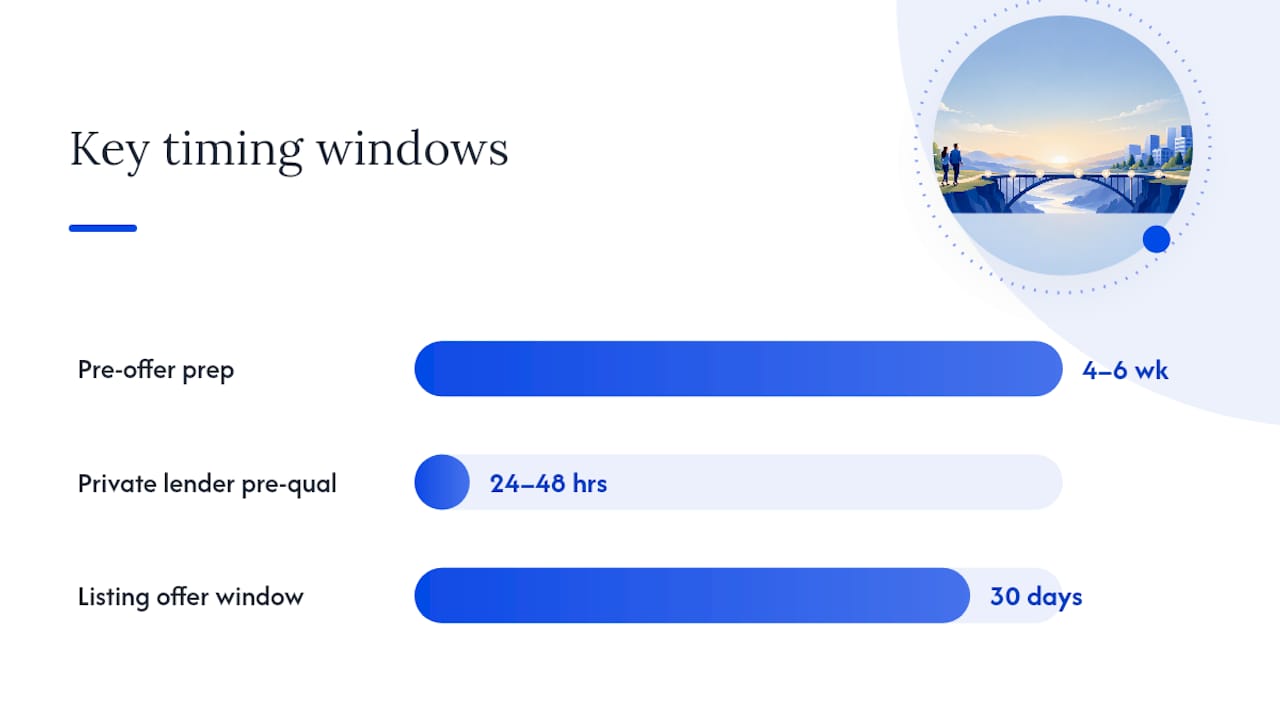
- Pre-offer preparation (4–6 weeks before target purchase close): Get pre-approved for the new purchase mortgage. Request an equity estimate from your current lender. Check your HELOC balance and available credit. Confirm your current home’s list-ready condition and target price with your agent.
- Structure the offer: Decide whether to go non-contingent (backed by bridge financing) or contingent based on your equity, timeline, and market conditions. Include flexible possession terms — either a rent-back request or an extended closing date — to give yourself operational room.
- Apply for bridge financing simultaneously: Submit your bridge loan application the same week you go under contract on the new purchase. Provide the appraisal on your current home, your mortgage statement, and the new purchase contract. Private lenders can often pre-qualify within 24–48 hours.
- List your current home: Put your current home on the market immediately after going under contract on the new purchase. Pricing it correctly from day one is the single most important risk-management step in the entire process.
- Coordinate dual closings: Work with your agent and escrow officer to schedule both closings as close together as possible. Confirm wire timing with both title companies at least five business days before each closing date. Build a 2-day buffer into your cash reserve plan.
- Close the purchase: Fund the bridge loan or draw from your HELOC. Close the new purchase. If a rent-back is in place, execute the post-closing occupancy agreement at the same time.
- Close the sale and pay off the bridge: At your sale closing, the title company wires the payoff amount directly to your bridge lender. Confirm the payoff figure with your lender at least three business days before the sale closing date to avoid last-minute discrepancies.
Responsibility matrix:
- Borrower: Provide all financial documents, maintain both properties, confirm payoff figures, fund reserves.
- Agent: Draft offer terms, coordinate possession clauses, manage listing timeline, communicate between both escrow offices.
- Lender: Issue pre-approval, process bridge application, provide payoff statement, confirm wire instructions.
- Title/Escrow: Conduct title search, coordinate wire timing, process payoff, issue closing disclosures.
Key contingency triggers: If your home has not received an offer within 30 days of listing, request a bridge loan extension and reassess your list price. If the sale falls through after going under contract, notify your bridge lender immediately and discuss extension or alternative exit options.
How private bridge lending works in practice
Consider a buyer with a $700,000 home, a $300,000 mortgage balance, and a 30-day window to close on a new $850,000 property. At 75% LTV, the available bridge amount is $225,000 — enough to cover a 20% down payment plus closing costs on the new purchase. A conventional lender would take 45–60 days to process a HELOC. A private bridge lender can fund in days.
The process with a direct private lender like Capitalfunding follows a clear sequence: pre-qualify (often within 24 hours based on equity and property value), order an appraisal or broker price opinion, receive a term sheet, sign loan documents, and fund. The buyer closes the new purchase non-contingently, lists the current home, and repays the bridge at sale. No extended waiting period, no income-documentation marathon.
Capitalfunding is a direct private lender backed by a family office, with a strong track record in bridge lending. That track record matters when you are coordinating a time-sensitive dual closing and need a lender who can commit and fund without last-minute conditions. Learn more about how bridge loans solve timing gaps or review the hard money bridge loan program details directly.
Pro Tip: Ask your private lender for a sample closing statement before you sign. A lender who funds regularly will have one ready. If they cannot produce one, that is a signal to keep looking.
Key Takeaways
A bridge loan, an existing HELOC, or a well-structured sale contingency covers the financing gap between buying a new home and closing on your current one — the right choice depends on your equity, timeline, and risk tolerance.
Point Details Bridge loan math Lenders advance 70–80% of your home’s appraised value minus your mortgage; that net figure is your maximum bridge amount. HELOC timing An existing HELOC funds in days and costs less than a bridge loan; opening a new one takes 30–45 days. Buffer your timeline Budget for a small buffer of a couple of days to cover wire processing or title corrections on dual closings. Assistance programs Down payment assistance programs can reduce the cash you need at closing; many eligible buyers never apply. Capitalfunding option Capitalfunding’s direct private bridge loans fund in days, making them the practical choice when your timeline is too tight for conventional financing.
When the math works — and when it does not
The conventional wisdom on bridge loans is that they are expensive and risky. That framing is incomplete. A bridge loan is expensive relative to a 30-year fixed mortgage — but that is the wrong comparison. The right comparison is: bridge loan cost versus the cost of losing the deal, accepting a price concession to make a contingent offer competitive, or carrying two full mortgages for an extended period because you could not coordinate the closings.
On that basis, a bridge loan often wins. A 3% price concession on an $800,000 home is $24,000. A four-month bridge loan on $200,000 at market rates typically costs a fraction of that. The buyers who get hurt by bridge loans are not the ones who use them strategically — they are the ones who enter them without a realistic exit. A home priced too high on day one, a market that shifts after listing, or a buyer who lacks reserves for an extended overlap: those are the real risks. The loan itself is a tool. The plan around it is what determines the outcome.
What I see consistently is that buyers underestimate the coordination piece. Financing is solvable. Timing is where transactions fall apart. The buyers who close cleanly are the ones who have confirmed wire timing with both title companies, have a written rent-back or possession agreement in place, and have a payoff figure from their bridge lender before the sale closing date arrives. That level of preparation is not complicated. It just requires doing it in advance rather than the week of closing.
The sell-first path is genuinely the safer choice for buyers with low equity, uncertain timelines, or limited reserves. There is no shame in it. A contingent offer in a balanced market, priced right, closes more often than buyers expect. The bridge loan is the right tool when speed and non-contingency are the deciding factors — not as a default for every transaction.
Capitalfunding’s direct private bridge loans for fast closings
When your purchase timeline is measured in weeks rather than months, conventional financing channels rarely move fast enough. Capitalfunding operates as a direct private lender backed by a family office, which means no committee approvals, no extended income-documentation cycles, and no dependency on secondary market timelines. For buyers with clear equity and a defined exit, that speed is the practical difference between closing the deal and losing it.

Capitalfunding’s bridge loan program is designed for buyers who need to close non-contingently, move quickly on a high-value property, or coordinate a dual closing where conventional lender timelines create a gap. The program covers primary and secondary residences, investment properties, and high-value homes — including properties over $10 million that most lenders will not touch. With over $1 billion in closed loans and an A+ BBB rating, Capitalfunding brings both the capital and the track record to execute under pressure.
To get started, have your current home’s estimated value, your mortgage payoff statement, and your new purchase contract ready. Submit a loan inquiry at capitalfunding.com and expect a pre-qualification response within 24 hours. The faster you initiate the process, the more options you have on timing.
This article provides general information about real estate financing options and is not professional financial, legal, or tax advice. Confirm current program terms, eligibility, and rates with a qualified lender or financial advisor before making financing decisions.
Useful resources and programs to check
Verifying lender licensing, finding assistance programs, and understanding agency rules takes less time than most buyers expect. These are the authoritative starting points.
Federal and regulatory resources:
- What Is A Bridge Loan And How Does It Work? | Bankrate
- Bridge Loans: How They Work and When to Use Them | Herring Bank
- Syncing Close Coordination guidance | The Briley Team
- Down payment assistance gap | HousingWire
- C.A.R. Housing Affordability Fund closing cost grant program
- Virginia Housing Closing Cost Assistance Grant
- Down Payment and Closing Cost Assistance | Fannie Mae
- #1 Hard Money Lender – Fast and Reliable Hard Money Loans
State and local assistance programs:
- Virginia Housing Closing Cost Assistance Grant: Up to 2% of the purchase price for eligible buyers using RD or VA loans; funds are tied to the first mortgage rate lock.
- C.A.R. Pathway to Home Closing Cost Assistance Grant: Up to $5,000 for eligible first-time buyers in California’s underserved communities; applications must be submitted at least 21 days before escrow closes.
- State HFAs: Every state has a Housing Finance Agency with its own DPA and closing cost programs. Many buyers who qualify never apply. Analysis from HousingWire found that down payment assistance can reduce a borrower’s loan-to-value ratio by an average of 8.8% — a material improvement in equity position at closing.
Bridge loan and HELOC explainers:
Resource What It Covers Bankrate — Bridge Loan Guide Definitions, typical terms, rates, and risk overview Herring Bank — Bridge Loan Explainer Equity-based underwriting, sample math, carrying costs Capitalfunding — Bridge Loan Program Direct private bridge lending, fast funding, program details Capitalfunding — Bridge Loan Between Two Properties Detailed how-to for residential dual-property transactions
FAQ
How do you cover the gap between selling and buying a house?
The most practical options are a bridge loan (secured by your current home’s equity), drawing from an existing HELOC, carrying both mortgages if your income qualifies, or using contract solutions like a sale contingency or seller rent-back to align the timing without additional debt.
What is the 3-day rule for closing?
The 3-day rule refers to the federal requirement under TRID (the TILA-RESPA Integrated Disclosure rule) that lenders must deliver your Closing Disclosure at least three business days before closing. This gives you time to review final loan terms and costs before signing.
What is a $10,000 appraisal gap?
An appraisal gap is the difference between a home’s appraised value and the agreed purchase price. An appraisal gap means the appraisal came in below the contract price; the buyer typically must cover that difference in cash or renegotiate the price, since most lenders will only lend against the appraised value.
How quickly can a private bridge loan fund?
A direct private lender like Capitalfunding can fund a bridge loan in days once the appraisal and documentation are complete, compared to 30–45 days for a new HELOC or 45–60 days for a cash-out refinance through a conventional lender.
Can down payment assistance programs help cover closing gaps?
Yes. State and local HFA programs, such as Virginia Housing’s Closing Cost Assistance Grant (up to 2% of purchase price) and California’s C.A.R. grant (up to $5,000), can reduce the cash you need at closing. Fannie Mae’s HFA Preferred program also pairs with local assistance. Check your state HFA and HUD’s approved counselor list for programs available in your market.
Recommended