
A non-recourse loan is debt secured only by the property pledged as collateral, so the lender can seize that asset if you default but cannot come after your other holdings for the shortfall. In non-recourse loan real estate financing, that protection is the whole appeal. The trade-off is real: expect tighter underwriting, lower leverage, and a higher rate than a comparable recourse loan.
TL;DR:
- Non-recourse loans are primarily available for stabilized, income-generating commercial real estate and are rarely suited for land, construction, or distressed properties.
- Carve-outs known as “bad-boy” provisions can convert a non-recourse loan into recourse if the borrower commits fraud, fails to pay taxes or insurance, or engages in misconduct.
- LTV ratios for non-recourse loans typically range from 50% to 70%, with higher interest rates and larger reserves to compensate for the limited lender remedy.
- These loans impact taxes by treating foreclosure as a sale and may trigger UBIT or taxable income if used within retirement accounts or if deficiencies are forgiven.
- Expect longer approval times and stricter underwriting from agency, CMBS, or insurance lenders, while private lenders can offer faster, flexible financing for non-standard deals.
Table of Contents
- What Is a Non-Recourse Loan in Real Estate?
- Where Can You Get a Non-Recourse Commercial Loan?
- Bad-Boy Carve-Outs: The Fine Print That Changes Everything
- How Do Lenders Underwrite Non-Recourse Loans?
- Do Non-Recourse Loans Affect Your Taxes?
- How Do You Actually Get a Non-Recourse Loan?
- When a Direct Private Lender Makes Sense
- Get Financing That Fits Your Deal, Not a Formula
- Sources
- FAQ
What Is a Non-Recourse Loan in Real Estate?
A non-recourse loan limits the lender to one remedy: taking back the pledged collateral. If foreclosure doesn’t cover the outstanding balance, the IRS treats the lender’s recovery as capped at the collateral, and the lender cannot pursue you for the difference through a personal judgment.
Recourse debt works differently. If the sale price after foreclosure doesn’t cover what you owe, the lender can pursue a deficiency judgment against your other assets, garnish wages, or freeze bank accounts, depending on state law. That single distinction is the heart of every “recourse vs nonrecourse” conversation you’ll have with a lender or attorney.
Contract language decides the outcome, not intuition. Courts look directly at the credit agreement to determine whether a debt is truly nonrecourse, and state statutes shift the baseline:
- Some states grant residential borrowers anti-deficiency protection by default, effectively making certain purchase-money mortgages nonrecourse.
- Commercial loans almost always require explicit nonrecourse language in the note and deed of trust.
- A single carve-out clause can override the nonrecourse label entirely, which is why sponsors read every page before signing.
Where Can You Get a Non-Recourse Commercial Loan?
Non-recourse loans concentrate in stabilized, income-producing commercial real estate rather than fix-and-flip or ground-up construction, where lenders want a guarantor standing behind execution risk. Knowing which channel fits your deal saves months of dead-end applications.
The main non-recourse sources include:
- Agency multifamily programs through Fannie Mae and Freddie Mac, which offer some of the most consistent non-recourse terms for apartment properties with stable occupancy.
- HUD-insured loans, which carry long amortization and non-recourse structure but demand a lengthy approval process.
- CMBS (conduit) loans, pooled and sold to bondholders, standardized around non-recourse terms with strict carve-outs.
- Life insurance company loans, reserved for low-leverage, top-tier assets and sponsors with strong track records.
- Private direct lenders, who can structure non-recourse or limited-recourse bridge and rental loans faster than institutional channels, often for deals that don’t fit an agency box.
- Self-directed IRA and solo 401(k) lenders, who specialize in retirement-account financing where personal guarantees aren’t legally permitted.
Raw land, spec construction, and distressed properties rarely qualify. Lenders want income history, occupancy, or at minimum a clear path to stabilization before they’ll take collateral-only risk.
Bad-Boy Carve-Outs: The Fine Print That Changes Everything
Every non-recourse loan carries carve-outs that convert it to recourse the moment a borrower crosses a specific line. These “bad-boy” provisions are near-universal, and lenders enforce them without much sympathy for good intentions gone wrong.
Common triggers include:
- Fraud or intentional misrepresentation in loan applications, financial statements, or rent rolls.
- Failure to pay property taxes or maintain required insurance, which shifts casualty risk back onto the lender’s collateral.
- Unauthorized transfers of ownership or additional liens placed on the property without lender consent.
- Voluntary bankruptcy filings intended to delay foreclosure.
- Waste or intentional damage to the collateral, including stripping fixtures or equipment.
- Environmental contamination the borrower caused or failed to disclose, often paired with a separate indemnity clause that survives even if the loan itself stays non-recourse.
These clauses exist because lenders won’t absorb losses caused by borrower misconduct, even inside a non-recourse structure. Negotiate the carve-out list before closing, not after: some lenders will narrow “waste” to exclude ordinary wear, or cap environmental indemnity at a defined dollar figure instead of leaving it open-ended.
Pro Tip: Ask your attorney to redline carve-outs against the lender’s standard form before you sign a term sheet. Many lenders will negotiate carve-out scope, but almost never after the loan documents are drafted.
How Do Lenders Underwrite Non-Recourse Loans?
Because the lender’s only remedy is the property itself, underwriting gets conservative fast. Expect a lower loan-to-value ceiling than you’d get with a recourse structure, plus deeper reserve requirements to cushion against vacancy or rate shocks.
Practitioner data on investor-focused non-recourse programs shows LTVs commonly running 50% to 70% depending on the product, with debt service coverage ratio minimums typically landing between 1.00 and 1.25 for investment property. That DSCR band means net operating income needs to exceed debt payments by a meaningful margin before a lender will even consider the file.
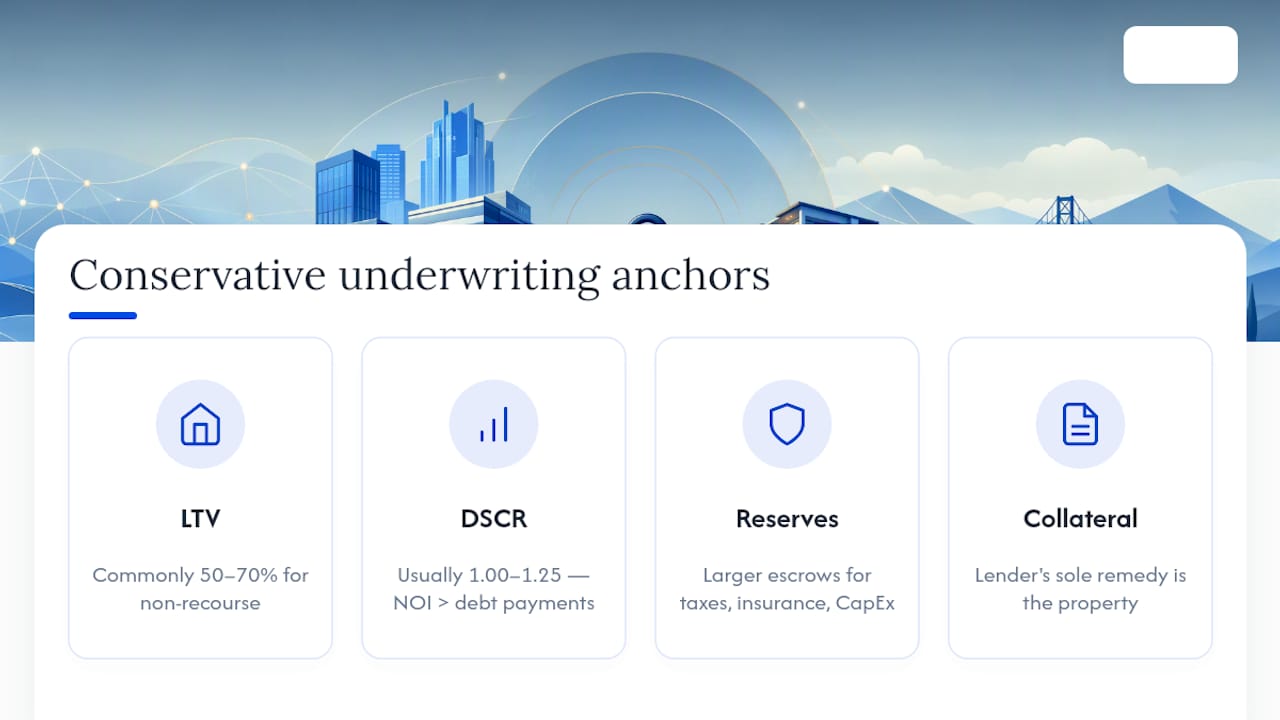
The pricing premium is the real cost of the protection. Consumer guidance from the FTC confirms non-recourse loans carry higher interest rates because lenders price a risk premium for giving up deficiency rights. That premium shows up as a higher note rate, added origination points, or both, plus larger required reserves for taxes, insurance, and capital expenditures held in escrow.
Do Non-Recourse Loans Affect Your Taxes?
Non-recourse debt gets distinct tax treatment, and the rules matter most when a property is heading toward foreclosure or sitting inside a retirement account.
- Foreclosure or abandonment of property secured by a non-recourse loan is treated as a sale for tax purposes, with the amount realized equal to the outstanding loan balance, regardless of the property’s actual market value at the time.
- Retirement accounts that own real estate, such as self-directed IRAs, must use non-recourse financing because IRS Notice N-12-02 prohibits personal guarantees on qualified-plan debt.
- Leveraged IRA-owned property can trigger Unrelated Business Income Tax (UBIT) on the debt-financed portion of income, a wrinkle that doesn’t apply the same way inside a solo 401(k).
- A canceled or forgiven deficiency (rare with true non-recourse debt, but relevant if a carve-out converts the loan) may generate a Form 1099-C, which counts as taxable income in the year received.
Nonrecourse liabilities inside partnerships and LLCs also carry their own allocation rules under IRS guidance on recourse versus nonrecourse liabilities, which affects how risk of loss gets divided among partners. Talk to a tax professional before assuming any of this applies uniformly to your entity structure.
How Do You Actually Get a Non-Recourse Loan?
Start by matching your property type to the right lender category: agency and CMBS shops for stabilized multifamily and commercial assets, specialty custodians for IRA-owned property, and private direct lenders for anything that doesn’t fit a standardized box.
- Confirm your entity structure first. Most non-recourse commercial loans require a single-purpose entity (SPE), and lenders will review your operating agreement line by line to confirm bankruptcy-remoteness.
- Assemble your document package early, including rent rolls, trailing financials, insurance certificates, and a Phase I environmental report where required. A loan checklist built for investors can keep this organized before you approach a lender.
- Negotiate carve-outs and reserve terms before signing a term sheet, and treat a rushed timeline as a signal the lender holds more leverage than you do.
When a Direct Private Lender Makes Sense
Agency and CMBS non-recourse programs work well for stabilized, cash-flowing assets with time to spare. They don’t work for a sponsor who needs to close in days, or who’s financing a property type outside the standard box, like an ultra-luxury home well above conventional agency limits.
That’s the gap a direct private lender fills. There are direct private lenders who have closed significant volumes in fix-and-flip, bridge, ground-up construction, and rental programs, including deals other lenders turn away. When speed or structure matters more than the lowest possible rate, that’s the moment to call a direct lender instead of waiting on an agency file.
— Daly Kay DiNatale
Get Financing That Fits Your Deal, Not a Formula
If your project doesn’t fit the stabilized-asset mold that agency non-recourse programs demand, Capitalfunding closes hard money and bridge loans in days, not months, backed by a family office instead of a committee.

Whether you’re financing a fix-and-flip, a ground-up build, or an ultra-luxury property above $10 million that traditional lenders won’t touch, Capitalfunding structures loan programs around your project instead of forcing it into a standardized box. That flexibility matters most when timing decides whether you close the deal or lose it to a faster buyer. Explore the hard money and bridge loan program to see current terms, or review the full menu of lending programs if construction financing or a commercial bridge loan fits your situation better. Start by getting a quote on your specific property and timeline.
Sources
For deeper research, start with the IRS’s guidance on recourse and nonrecourse liabilities and Notice N-12-02 for retirement-account rules. The Cornell Legal Information Institute and Corporate Finance Institute offer solid legal and lending primers, and landlords managing income-producing assets may find this office landlord guide useful for the operational side of underwriting.
FAQ
What Is a Nonrecourse Loan in Real Estate?
It’s a loan secured only by the property itself, meaning the lender’s only remedy after default is seizing that collateral, with no claim against the borrower’s other assets.
Which States Have Non-Recourse Mortgages?
Non-recourse commercial loans are structured by contract nationwide, but a minority of states also provide anti-deficiency statutes that give residential purchase-money mortgages non-recourse protection by default, so the applicable rule depends on both your state and your loan documents.
How Hard Is It to Get a Non-Recourse Loan?
It’s harder than qualifying for recourse debt because lenders demand lower LTVs, often in the 50% to 70% range, stronger DSCR minimums, and larger reserves to offset the risk of limited recovery.
Who Offers Non-Recourse Loans?
Agency programs through Fannie Mae, Freddie Mac, and HUD, CMBS conduits, life insurance companies, and private direct lenders like Capitalfunding all offer non-recourse or limited-recourse structures, each suited to different property types and closing timelines.
