
What Is a Bridge Loan? Your 2026 Real Estate Guide

Investor reviewing bridge loan paperwork at home

A bridge loan is defined as a short-term, secured loan that provides immediate capital during a real estate transition, using your existing property as collateral until permanent financing or a sale closes. Also called interim financing, this product fills the cash flow gap between buying a new property and completing the sale of your current one. Bridge loans typically run 6 to 12 months, though some lenders extend terms up to 3 years. For homebuyers, investors, and developers operating in fast-moving markets, speed and flexibility are the defining advantages of this financing type.


What is a bridge loan and how does it work in real estate?

A bridge loan works by converting the equity in your current property into usable capital before that property sells. The lender places a lien on your existing home, then advances funds you can use as a down payment or full purchase price on a new property. You carry both obligations simultaneously until your original home sells and the loan is repaid.

Bridge loans are structured in two primary ways:

  • Equity extraction: The lender advances a portion of your current home’s equity as a down payment on the new purchase. You carry a separate mortgage on the new property.
  • Blended purchase: The lender combines the bridge advance and the new mortgage into a single loan package, simplifying the payment structure.

Most bridge loans are interest-only during the loan term, with the full principal due when your existing property sells. That structure keeps monthly payments manageable while you carry two properties.

Pro Tip: Request a written payoff schedule from your lender before closing. Knowing exactly what triggers repayment and what the penalties are for late payoff prevents costly surprises.

Professionals discussing bridge loan payoff schedule

Owner-occupied loans carry an additional timing constraint. Federal TRID disclosure rules require mandatory waiting periods, making it impossible to close in under two weeks regardless of how fast your lender moves. Investment property loans face no such restriction. Investment bridge loans can close in as few as 5 to 7 days, which is a decisive advantage in competitive markets.


How much does a bridge loan cost?

Bridge loan costs run higher than conventional mortgages, and you should plan for that gap from the start. Interest rates in 2026 typically range from 8% to 14% APR, reflecting the elevated risk and speed lenders absorb. A conventional 30-year mortgage currently prices well below that range, so the premium is real.

Beyond the interest rate, expect the following fees:

  • Origination fees: 1% to 3% of the loan principal
  • Closing costs: 1% to 5% of the loan amount, covering title, escrow, and lender fees
  • Appraisal and legal fees: Typically $2,000 to $5,000 in additional closing costs

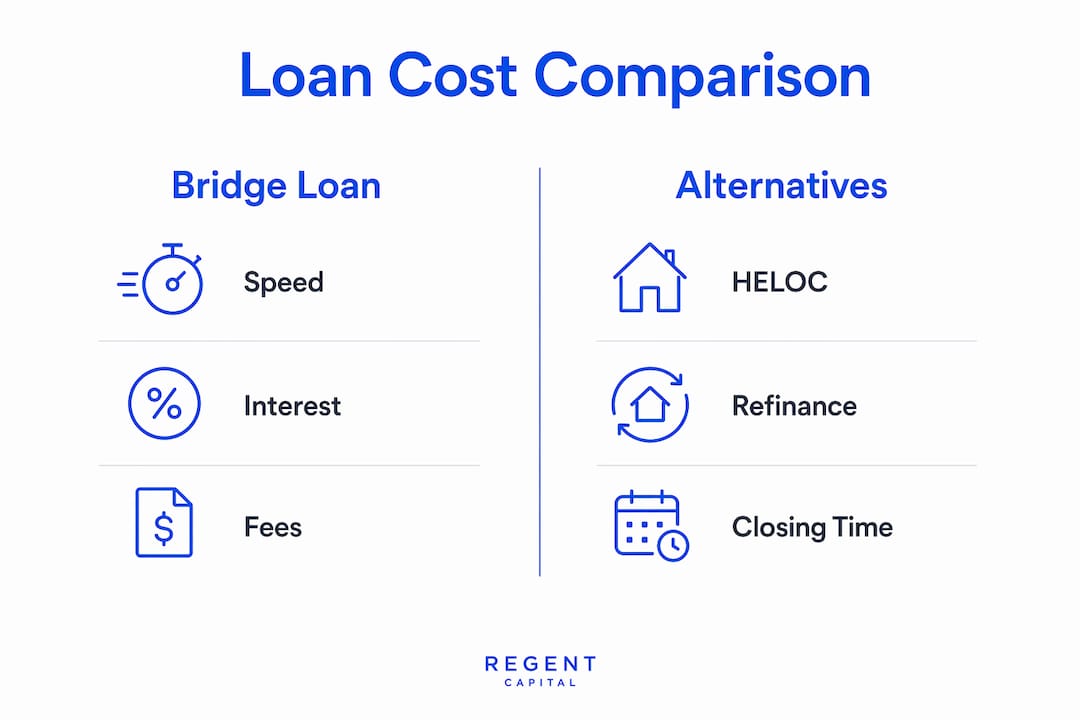
The table below compares a bridge loan against two common alternatives for homeowners who need short-term access to equity.

Feature Bridge loan HELOC Cash-out refinance
Speed to close 5–14 days 2–6 weeks 3–6 weeks
Interest rate 8%–14% APR Variable, lower Fixed or variable, lower
Repayment trigger Sale of property Monthly draws Monthly payment
Collateral Current home Current home Current home
Best for Simultaneous closings Ongoing access to equity Long-term cost reduction

Infographic comparing bridge loan costs with alternatives

The higher cost of a bridge loan is the price of speed and certainty. If you need to close on a new property before your current home sells, a HELOC or cash-out refinance simply cannot move fast enough. The cost comparison only makes sense when you factor in the competitive advantage you gain.


What are the benefits and risks of using a bridge loan?

The primary benefit of a bridge loan is buying power. Bridge loans let buyers make non-contingent offers in fast-moving markets, removing the sale contingency that sellers find unattractive. A non-contingent offer is often the difference between winning and losing a deal in a competitive market.

Additional benefits include:

  • No move twice: You can close on your new home before vacating your current one, avoiding temporary housing costs.
  • Negotiating position: Sellers prefer buyers who are not dependent on a contingent sale closing on time.
  • Flexible terms: Private lenders can structure repayment around your specific timeline and exit plan.

The risks are equally concrete and should not be minimized.

  • Foreclosure exposure: Failure to sell your current home within the loan term puts that property at risk of foreclosure. This is the most serious downside.
  • Carrying costs: Paying interest on two properties simultaneously strains cash flow, especially if your current home sits on the market longer than expected.
  • Market dependency: Your exit depends on selling conditions you cannot fully control.

“Financial advisors consistently emphasize that a clear, realistic exit strategy matters more than the interest rate when evaluating a bridge loan.” — Northwestern Mutual

Pro Tip: Before applying, get a realistic market analysis from a licensed real estate agent. If your current home would take more than 90 days to sell in your market, a bridge loan carries meaningful risk.

Explore short-term loan alternatives if your timeline is uncertain. Having a backup plan is not pessimism. It is sound financial practice.


Who qualifies for a bridge loan and how do you apply?

Bridge loan qualification differs significantly from conventional mortgage underwriting. Private lenders evaluate applications primarily on property equity and exit strategy, not solely on income or debt-to-income ratio. That distinction matters for self-employed borrowers, investors with complex income structures, and developers who would not qualify under traditional bank criteria.

The typical qualification process follows these steps:

  1. Assess your equity position. Most lenders require meaningful equity in your current property. The more equity you hold, the stronger your application.
  2. Define your exit strategy. Lenders want to see a credible plan for repayment. A signed listing agreement or a pending sale contract strengthens your file considerably.
  3. Gather documentation. Expect to provide property valuations, a current mortgage statement, proof of the new purchase contract, and basic financial disclosures.
  4. Choose your lender type. Banks rarely offer bridge loans, and when they do, their timelines are slow. Private lenders and hard money lenders specialize in this product and can move in days.
  5. Review the loan terms carefully. Confirm the interest rate, origination fee, repayment trigger, and any prepayment penalties before signing.
  6. Close and fund. Investment property loans can close in 5 to 7 business days. Owner-occupied loans require at least two weeks due to federal disclosure waiting periods.

For developers and investors, the right bridge lender can make or break a project timeline. Banks move on their schedule. Private lenders move on yours. That difference is especially critical when a purchase contract has a hard closing deadline.

When comparing lenders, look beyond the interest rate. Evaluate track record, speed, and whether the lender has experience with your specific property type. A lender who has closed luxury single-family homes or ground-up construction projects understands the nuances that a generalist lender does not.


Key Takeaways

A bridge loan is the most effective short-term financing tool for real estate buyers and investors who need to act before their current property sells, provided they have a clear exit strategy and sufficient equity.

Point Details
Definition and term A bridge loan is short-term interim financing, typically lasting 6 to 12 months, secured by existing property equity.
Cost range Expect 8%–14% APR plus origination fees of 1%–3% and closing costs of 1%–5% of the loan amount.
Speed advantage Investment property bridge loans can close in 5 to 7 days; owner-occupied loans require at least two weeks under TRID rules.
Biggest risk Failure to sell your current home within the loan term can trigger foreclosure on that property.
Qualification focus Private lenders underwrite on equity and exit strategy, making bridge loans accessible to self-employed and complex-income borrowers.

When a bridge loan is the right call and when it isn’t

By Daly Kay DiNatale

After working in real estate finance for years, the question I hear most often is not “how does a bridge loan work?” It is “should I actually use one?” My honest answer is: it depends entirely on your exit plan, not your enthusiasm for the new property.

The buyers and investors I have seen succeed with bridge loans share one trait. They had a realistic, conservative estimate of how long their current property would take to sell, and they built a buffer into that estimate. They did not assume best-case timing. They planned for a slower market and were pleasantly surprised when it moved faster.

The ones who struggled made the opposite mistake. They assumed their home would sell in two weeks because their neighbor’s did. When it took three months, the carrying costs and the stress were significant. One client told me the experience felt like running a race with a weight tied to each ankle.

My advice: if your current home is in a market where days on market average more than 60, think carefully before committing to a bridge loan. The cost premium is justifiable when speed gives you a genuine competitive edge. It is harder to justify when the market is slow and the urgency is self-imposed.

Consult a licensed financial advisor before signing. The equity in your current home is likely your largest asset. A bridge loan puts that asset to work, but it also puts it at risk. Treat that tradeoff with the seriousness it deserves.

— Daly Kay DiNatale


Fast, flexible bridge financing from Capitalfunding

Capitalfunding is a direct private lender backed by a family office, with over $1 billion in closed loans and an A+ BBB rating. When a deal requires speed and certainty, Capitalfunding closes hard money bridge loans in days, not weeks.

https://capitalfunding.com

Whether you are a homebuyer navigating a simultaneous closing, an investor acquiring a distressed asset, or a developer funding ground-up construction, Capitalfunding structures financing around your project, not a bank’s checklist. Capitalfunding finances transactions that traditional lenders decline, including ultra-luxury single-family homes above $10 million. For borrowers in Florida, Capitalfunding’s private lending solutions offer the local expertise and rapid execution that competitive markets demand. Contact Capitalfunding directly to discuss your financing needs and get a term sheet fast.


FAQ

What is the bridge loan definition in simple terms?

A bridge loan is a short-term loan secured by your current property that provides immediate funds to buy a new property before your existing one sells. It typically lasts 6 to 12 months and is repaid when the original property closes.

How much does a bridge loan cost compared to a mortgage?

Bridge loan interest rates range from 8% to 14% APR, significantly higher than conventional mortgages. Origination fees add 1% to 3%, and total closing costs can reach 1% to 5% of the loan principal.

Who needs a bridge loan?

Homebuyers who want to purchase before selling, real estate investors acquiring time-sensitive deals, and developers needing interim construction capital are the primary users of bridge loans.

Can self-employed borrowers qualify for a bridge loan?

Yes. Private lenders underwrite bridge loans based on property equity and exit strategy rather than traditional income verification, making them accessible to self-employed borrowers and investors with non-standard income.

How fast can a bridge loan close?

Investment property bridge loans can close in 5 to 7 business days with a private lender. Owner-occupied loans require at least two weeks due to mandatory federal TRID disclosure waiting periods.

What Is a Bridge Loan? Your 2026 Real Estate Guide

A bridge loan is defined as a short-term, secured loan that provides immediate capital during a real estate transition, using your existing property as collateral until permanent financing or a sale closes. Also called interim financing, this product fills the cash flow gap between buying a new property and completing the sale of your current one. Bridge loans typically run 6 to 12 months, though some lenders extend terms up to 3 years. For homebuyers, investors, and developers operating in fast-moving markets, speed and flexibility are the defining advantages of this financing type.


What is a bridge loan and how does it work in real estate?

A bridge loan works by converting the equity in your current property into usable capital before that property sells. The lender places a lien on your existing home, then advances funds you can use as a down payment or full purchase price on a new property. You carry both obligations simultaneously until your original home sells and the loan is repaid.

Bridge loans are structured in two primary ways:

  • Equity extraction: The lender advances a portion of your current home’s equity as a down payment on the new purchase. You carry a separate mortgage on the new property.
  • Blended purchase: The lender combines the bridge advance and the new mortgage into a single loan package, simplifying the payment structure.

Most bridge loans are interest-only during the loan term, with the full principal due when your existing property sells. That structure keeps monthly payments manageable while you carry two properties.

Pro Tip: Request a written payoff schedule from your lender before closing. Knowing exactly what triggers repayment and what the penalties are for late payoff prevents costly surprises.

Professionals discussing bridge loan payoff schedule

Owner-occupied loans carry an additional timing constraint. Federal TRID disclosure rules require mandatory waiting periods, making it impossible to close in under two weeks regardless of how fast your lender moves. Investment property loans face no such restriction. Investment bridge loans can close in as few as 5 to 7 days, which is a decisive advantage in competitive markets.


How much does a bridge loan cost?

Bridge loan costs run higher than conventional mortgages, and you should plan for that gap from the start. Interest rates in 2026 typically range from 8% to 14% APR, reflecting the elevated risk and speed lenders absorb. A conventional 30-year mortgage currently prices well below that range, so the premium is real.

Beyond the interest rate, expect the following fees:

  • Origination fees: 1% to 3% of the loan principal
  • Closing costs: 1% to 5% of the loan amount, covering title, escrow, and lender fees
  • Appraisal and legal fees: Typically $2,000 to $5,000 in additional closing costs

The table below compares a bridge loan against two common alternatives for homeowners who need short-term access to equity.

Feature Bridge loan HELOC Cash-out refinance
Speed to close 5–14 days 2–6 weeks 3–6 weeks
Interest rate 8%–14% APR Variable, lower Fixed or variable, lower
Repayment trigger Sale of property Monthly draws Monthly payment
Collateral Current home Current home Current home
Best for Simultaneous closings Ongoing access to equity Long-term cost reduction


The higher cost of a bridge loan is the price of speed and certainty. If you need to close on a new property before your current home sells, a HELOC or cash-out refinance simply cannot move fast enough. The cost comparison only makes sense when you factor in the competitive advantage you gain.


What are the benefits and risks of using a bridge loan?

The primary benefit of a bridge loan is buying power. Bridge loans let buyers make non-contingent offers in fast-moving markets, removing the sale contingency that sellers find unattractive. A non-contingent offer is often the difference between winning and losing a deal in a competitive market.

Additional benefits include:

  • No move twice: You can close on your new home before vacating your current one, avoiding temporary housing costs.
  • Negotiating position: Sellers prefer buyers who are not dependent on a contingent sale closing on time.
  • Flexible terms: Private lenders can structure repayment around your specific timeline and exit plan.

The risks are equally concrete and should not be minimized.

  • Foreclosure exposure: Failure to sell your current home within the loan term puts that property at risk of foreclosure. This is the most serious downside.
  • Carrying costs: Paying interest on two properties simultaneously strains cash flow, especially if your current home sits on the market longer than expected.
  • Market dependency: Your exit depends on selling conditions you cannot fully control.

“Financial advisors consistently emphasize that a clear, realistic exit strategy matters more than the interest rate when evaluating a bridge loan.” — Northwestern Mutual

Pro Tip: Before applying, get a realistic market analysis from a licensed real estate agent. If your current home would take more than 90 days to sell in your market, a bridge loan carries meaningful risk.

Explore short-term loan alternatives if your timeline is uncertain. Having a backup plan is not pessimism. It is sound financial practice.


Who qualifies for a bridge loan and how do you apply?

Bridge loan qualification differs significantly from conventional mortgage underwriting. Private lenders evaluate applications primarily on property equity and exit strategy, not solely on income or debt-to-income ratio. That distinction matters for self-employed borrowers, investors with complex income structures, and developers who would not qualify under traditional bank criteria.

The typical qualification process follows these steps:

  1. Assess your equity position. Most lenders require meaningful equity in your current property. The more equity you hold, the stronger your application.
  2. Define your exit strategy. Lenders want to see a credible plan for repayment. A signed listing agreement or a pending sale contract strengthens your file considerably.
  3. Gather documentation. Expect to provide property valuations, a current mortgage statement, proof of the new purchase contract, and basic financial disclosures.
  4. Choose your lender type. Banks rarely offer bridge loans, and when they do, their timelines are slow. Private lenders and hard money lenders specialize in this product and can move in days.
  5. Review the loan terms carefully. Confirm the interest rate, origination fee, repayment trigger, and any prepayment penalties before signing.
  6. Close and fund. Investment property loans can close in 5 to 7 business days. Owner-occupied loans require at least two weeks due to federal disclosure waiting periods.

For developers and investors, the right bridge lender can make or break a project timeline. Banks move on their schedule. Private lenders move on yours. That difference is especially critical when a purchase contract has a hard closing deadline.

When comparing lenders, look beyond the interest rate. Evaluate track record, speed, and whether the lender has experience with your specific property type. A lender who has closed luxury single-family homes or ground-up construction projects understands the nuances that a generalist lender does not.


Key Takeaways

A bridge loan is the most effective short-term financing tool for real estate buyers and investors who need to act before their current property sells, provided they have a clear exit strategy and sufficient equity.

Point Details
Definition and term A bridge loan is short-term interim financing, typically lasting 6 to 12 months, secured by existing property equity.
Cost range Expect 8%–14% APR plus origination fees of 1%–3% and closing costs of 1%–5% of the loan amount.
Speed advantage Investment property bridge loans can close in 5 to 7 days; owner-occupied loans require at least two weeks under TRID rules.
Biggest risk Failure to sell your current home within the loan term can trigger foreclosure on that property.
Qualification focus Private lenders underwrite on equity and exit strategy, making bridge loans accessible to self-employed and complex-income borrowers.

When a bridge loan is the right call and when it isn’t

By Daly Kay DiNatale

After working in real estate finance for years, the question I hear most often is not “how does a bridge loan work?” It is “should I actually use one?” My honest answer is: it depends entirely on your exit plan, not your enthusiasm for the new property.

The buyers and investors I have seen succeed with bridge loans share one trait. They had a realistic, conservative estimate of how long their current property would take to sell, and they built a buffer into that estimate. They did not assume best-case timing. They planned for a slower market and were pleasantly surprised when it moved faster.

The ones who struggled made the opposite mistake. They assumed their home would sell in two weeks because their neighbor’s did. When it took three months, the carrying costs and the stress were significant. One client told me the experience felt like running a race with a weight tied to each ankle.

My advice: if your current home is in a market where days on market average more than 60, think carefully before committing to a bridge loan. The cost premium is justifiable when speed gives you a genuine competitive edge. It is harder to justify when the market is slow and the urgency is self-imposed.

Consult a licensed financial advisor before signing. The equity in your current home is likely your largest asset. A bridge loan puts that asset to work, but it also puts it at risk. Treat that tradeoff with the seriousness it deserves.

— Daly Kay DiNatale


Fast, flexible bridge financing from Capitalfunding

Capitalfunding is a direct private lender backed by a family office, with over $1 billion in closed loans and an A+ BBB rating. When a deal requires speed and certainty, Capitalfunding closes hard money bridge loans in days, not weeks.

https://capitalfunding.com

Whether you are a homebuyer navigating a simultaneous closing, an investor acquiring a distressed asset, or a developer funding ground-up construction, Capitalfunding structures financing around your project, not a bank’s checklist. Capitalfunding finances transactions that traditional lenders decline, including ultra-luxury single-family homes above $10 million. For borrowers in Florida, Capitalfunding’s private lending solutions offer the local expertise and rapid execution that competitive markets demand. Contact Capitalfunding directly to discuss your financing needs and get a term sheet fast.


FAQ

What is the bridge loan definition in simple terms?

A bridge loan is a short-term loan secured by your current property that provides immediate funds to buy a new property before your existing one sells. It typically lasts 6 to 12 months and is repaid when the original property closes.

How much does a bridge loan cost compared to a mortgage?

Bridge loan interest rates range from 8% to 14% APR, significantly higher than conventional mortgages. Origination fees add 1% to 3%, and total closing costs can reach 1% to 5% of the loan principal.

Who needs a bridge loan?

Homebuyers who want to purchase before selling, real estate investors acquiring time-sensitive deals, and developers needing interim construction capital are the primary users of bridge loans.

Can self-employed borrowers qualify for a bridge loan?

Yes. Private lenders underwrite bridge loans based on property equity and exit strategy rather than traditional income verification, making them accessible to self-employed borrowers and investors with non-standard income.

How fast can a bridge loan close?

Investment property bridge loans can close in 5 to 7 business days with a private lender. Owner-occupied loans require at least two weeks due to mandatory federal TRID disclosure waiting periods.

About the author