

Man reviewing construction loan documents at desk

A construction loan is a short-term financing product designed specifically to fund the building or significant renovation of a home, disbursing funds in stages rather than as a single lump sum. Unlike a traditional mortgage, which pays for an existing property at closing, a construction loan releases capital in draws tied to verified milestones throughout the build. This structure reflects the higher risk lenders take on when financing a property that does not yet exist. Understanding how these loans work, what they require, and how they compare to conventional mortgages gives you a clear path to financing your project with confidence.
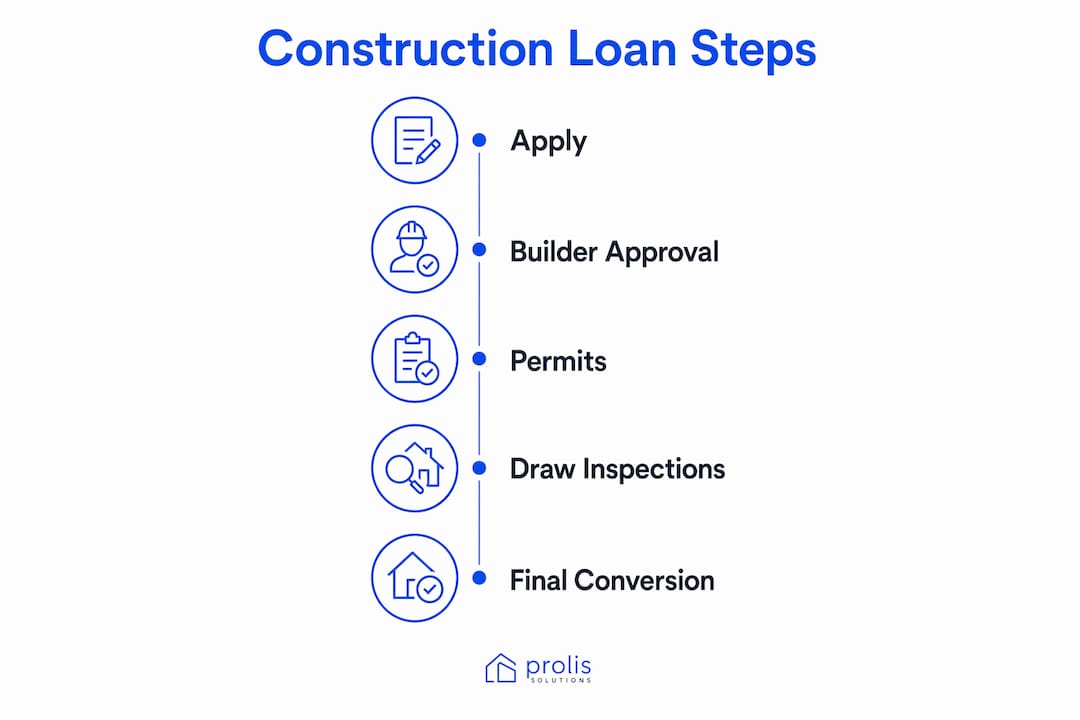
Infographic showing steps of construction loan requirements

What is a construction loan and how does it work?

A construction loan is defined as interim financing that covers the cost of building or substantially remodeling a home, with terms typically lasting 6 to 18 months and draw-based disbursements tied to construction progress. That short duration matters because it keeps your interest exposure limited to the active build period rather than the full life of a permanent mortgage.

Funds are released in a series of draws, each triggered by a completed construction milestone. A typical draw schedule follows this sequence:

  1. Land preparation and foundation — the first draw releases once site work and the foundation are verified complete.
  2. Framing — structural walls, roof framing, and rough openings are inspected before the second draw.
  3. Mechanical rough-in — plumbing, electrical, and HVAC rough work must pass inspection.
  4. Insulation and drywall — interior work is confirmed before the next release.
  5. Finish work and certificate of occupancy — the final draw releases once the home passes final inspection.

Between each draw, a third-party inspector visits the site to confirm milestone completion. Draw inspections typically require 5 to 10 business days per step, which means every funding cycle can introduce a one to two week delay. Builders and borrowers who ignore this in their project schedule often find themselves short on cash mid-construction.

During the build, you pay interest only on the amount already drawn, not the full loan amount. This keeps monthly carrying costs manageable while construction is underway. Once the home is complete, the loan either converts to a permanent mortgage or is paid off through a separate mortgage application, depending on the loan type you chose.

Pro Tip: Build a contingency reserve of at least 10% of your total construction budget before you close. Draw delays and inspection lags are routine, and personal cash reserves prevent construction from stalling while you wait for the next disbursement.

Draw Stage Milestone Required Typical Timing
Draw 1 Foundation complete Weeks 1-4
Draw 2 Framing complete Weeks 5-10
Draw 3 Mechanical rough-in Weeks 11-16
Draw 4 Drywall and insulation Weeks 17-22
Draw 5 Final inspection and CO Weeks 23-30+

What are the main types of construction loans?

Three primary construction financing options exist, and the right choice depends on your priorities around cost, convenience, and rate flexibility.

Hands holding construction loan brochures at café table

Construction-only loans provide funding solely for the build phase. Once construction ends, you apply for a separate permanent mortgage to pay off the construction loan. This two-closing structure gives you the freedom to shop for the best mortgage rate after your home is complete, which can be a real advantage if rates drop during your build. The trade-off is two sets of closing costs and the risk that your financial situation changes before you qualify for the permanent mortgage.

Construction-to-permanent loans, also called one-time close loans, combine both phases into a single closing. The loan funds construction, then automatically converts to a permanent mortgage when the certificate of occupancy is issued. One-time close loans save on closing costs and lock in your rate upfront, but they offer less flexibility if market rates fall significantly during your build.

Renovation loans cover the cost of remodeling an existing property, with the renovation costs rolled into either a new loan or an existing mortgage. Programs like the FHA 203(k) or Fannie Mae HomeStyle Renovation loan are common options in this category. These work well for buyers purchasing a fixer-upper or homeowners upgrading an existing property.

Here is a direct comparison of the three types:

  • Construction-only: Two closings, two sets of fees, rate flexibility post-build, higher qualification risk at second closing.
  • Construction-to-permanent: One closing, predictable rate, lower total closing costs, less rate flexibility.
  • Renovation: Tied to existing property value, simpler draw structure, limited to remodel scope.

Choosing between one-time and two-time close loans ultimately comes down to whether convenience or potential mortgage rate savings is your priority. If you expect rates to fall during a 12-month build, a two-time close structure may save more than it costs.

What are the construction loan requirements in 2026?

Qualifying for a construction loan in 2026 is more demanding than qualifying for a standard mortgage, because lenders are financing a property that does not yet exist and cannot be used as traditional collateral.

Lenders generally require a credit score of 620 or higher, a debt-to-income ratio below 45%, and a down payment starting at 20%. That 20% minimum reflects the elevated risk lenders carry when the collateral is a projected value rather than a standing structure. Documentation requirements are also more extensive than a conventional mortgage application.

To qualify, you will typically need to provide:

  • Architectural plans and blueprints prepared by a licensed architect or designer.
  • A detailed construction budget itemizing all materials, labor, and contingency costs.
  • A construction timeline showing projected start and completion dates.
  • Builder credentials including contractor licensing, insurance, and financial references.
  • Proof of land ownership or a purchase contract if the lot is not yet acquired.

The builder approval process deserves particular attention. Lenders vet contractor qualifications and financial stability rigorously because the loan’s success depends on the builder completing the project on time and within budget. A contractor who is unfamiliar with lender draw processes can cause approval delays that cost you weeks. Selecting a builder with documented experience in draw-financed construction is as important as your own credit profile.

Pro Tip: Ask your builder directly whether they have worked with construction lenders before and how many draw-financed projects they have completed. A builder who understands the inspection and disbursement cycle will keep your project moving far more efficiently than one learning the process on your job.

The pre-construction phase typically takes 30 to 60 days for permits, approvals, and builder vetting. Borrowers who underestimate this window often push their project start date back by months, which compresses the build timeline and increases the risk of running over the loan term.

For a deeper look at construction loan qualification criteria including documentation and contractor selection, Capitalfunding’s developer guide covers the full picture.

Construction loan vs mortgage: what is the real difference?

A construction loan and a traditional mortgage serve fundamentally different purposes, and confusing the two leads to misaligned expectations about payments, timelines, and costs.

The core differences are:

  • Disbursement structure: A mortgage releases the full loan amount at closing to purchase an existing home. A construction loan releases funds incrementally as milestones are completed.
  • Payment structure: During construction, you pay interest only on the drawn balance. A traditional mortgage requires principal and interest payments from day one.
  • Loan duration: Construction loans last 6 to 18 months. A conventional mortgage runs 15 to 30 years.
  • Down payment: Construction loans require at least 20% down, compared to conventional mortgages that can require as little as 3% for qualified buyers. That gap reflects the difference in lender risk between a finished asset and a project in progress.
  • Collateral: A mortgage is secured by the completed home. A construction loan is secured by the projected “as-completed” value, which is inherently less certain.

After construction ends, you either convert the construction loan to a permanent mortgage through a one-time close structure or apply for a new mortgage separately. Either path results in a traditional mortgage as the long-term financing vehicle. The construction loan is always a temporary instrument, not a permanent solution.

For investors and developers exploring ground-up construction financing, the distinction between interim and permanent financing is especially critical to project cost modeling.

Key takeaways

A construction loan is the right financing tool when you are building or significantly renovating a property, but it requires stronger qualifications, more documentation, and more active management than a standard mortgage.

Point Details
Draw-based disbursement Funds release in stages tied to verified milestones, not as a lump sum at closing.
Interest-only during build You pay interest only on drawn amounts, keeping carrying costs lower during construction.
Stronger qualification bar Expect a 620+ credit score, 45% max DTI, and a 20% minimum down payment.
Builder vetting is critical Lenders audit contractor credentials; an inexperienced builder can delay your entire draw schedule.
Pre-construction takes time Allow 30 to 60 days for permits, approvals, and documentation before breaking ground.

What I have learned about construction loans after years in real estate finance

The single most underestimated risk in construction lending is not the borrower’s credit profile. It is the builder’s familiarity with the draw process.

I have seen well-qualified borrowers with strong credit and solid budgets watch their projects stall because their contractor had never worked with a lender draw schedule before. The builder submits incomplete milestone documentation, the inspector cannot approve the draw, and suddenly two weeks pass with no funds released and subcontractors waiting to be paid. That scenario is entirely preventable with the right contractor selection upfront.

The second thing most borrowers get wrong is treating the pre-construction phase as administrative overhead. Those 30 to 60 days for permits and approvals are not a formality. They set the entire rhythm of the project. Rushing them or underestimating them compresses your build window and puts you at risk of exceeding your loan term, which triggers extension fees or forced refinancing.

My honest advice: choose the one-time close structure if predictability matters more to you than chasing a potentially lower mortgage rate. The savings from rate shopping after construction rarely offset the complexity and risk of a second qualification process, especially if your financial situation shifts during the build. Convenience has real monetary value in construction finance, and most borrowers only recognize that after the fact.

— Daly Kay DiNatale

How Capitalfunding supports your construction financing

https://capitalfunding.com

Capitalfunding is a direct private lender with over $1 billion in closed loans and an A+ BBB rating, specializing in construction financing for investors and developers who need capital fast. As a family office-backed lender, Capitalfunding closes loans in days rather than weeks, which matters when project timelines are tight and opportunities do not wait.

Whether you are financing a ground-up construction project or need a tailored solution for a high-value build, Capitalfunding structures loans around your project’s specific needs. Capitalfunding also finances projects that traditional lenders decline, including ultra-luxury single-family homes valued above $10 million. Connect with Capitalfunding’s team at capitalfunding.com to discuss your construction financing options today.

FAQ

What does a construction loan cover?

A construction loan covers land preparation, materials, labor, contractor fees, permits, and related building costs. Funds are released in draws as each construction milestone is completed and verified by a third-party inspector.

How long does a construction loan last?

Construction loans are short-term instruments that typically last 6 to 18 months. After construction ends, the loan either converts to a permanent mortgage or is paid off through a separate mortgage application.

What credit score do you need for a construction loan?

Most lenders require a minimum credit score of 620, along with a debt-to-income ratio below 45% and a down payment of at least 20%. Requirements may be stricter for larger or higher-risk projects.

What is the difference between a construction loan and a construction-to-permanent loan?

A standard construction loan requires a separate mortgage application after the build is complete, resulting in two closings. A construction-to-permanent loan combines both phases into one closing, automatically converting to a mortgage when construction finishes.

Can you get a construction loan for a renovation?

Yes. Renovation loans are a category of construction financing that covers remodeling costs on an existing property. Programs like the FHA 203(k) and Fannie Mae HomeStyle Renovation loan roll renovation costs into a single loan secured by the property’s projected post-renovation value.

What Is a Construction Loan? Your 2026 Guide

A construction loan is a short-term financing product designed specifically to fund the building or significant renovation of a home, disbursing funds in stages rather than as a single lump sum. Unlike a traditional mortgage, which pays for an existing property at closing, a construction loan releases capital in draws tied to verified milestones throughout the build. This structure reflects the higher risk lenders take on when financing a property that does not yet exist. Understanding how these loans work, what they require, and how they compare to conventional mortgages gives you a clear path to financing your project with confidence.


What is a construction loan and how does it work?

A construction loan is defined as interim financing that covers the cost of building or substantially remodeling a home, with terms typically lasting 6 to 18 months and draw-based disbursements tied to construction progress. That short duration matters because it keeps your interest exposure limited to the active build period rather than the full life of a permanent mortgage.

Funds are released in a series of draws, each triggered by a completed construction milestone. A typical draw schedule follows this sequence:

  1. Land preparation and foundation — the first draw releases once site work and the foundation are verified complete.
  2. Framing — structural walls, roof framing, and rough openings are inspected before the second draw.
  3. Mechanical rough-in — plumbing, electrical, and HVAC rough work must pass inspection.
  4. Insulation and drywall — interior work is confirmed before the next release.
  5. Finish work and certificate of occupancy — the final draw releases once the home passes final inspection.

Between each draw, a third-party inspector visits the site to confirm milestone completion. Draw inspections typically require 5 to 10 business days per step, which means every funding cycle can introduce a one to two week delay. Builders and borrowers who ignore this in their project schedule often find themselves short on cash mid-construction.

During the build, you pay interest only on the amount already drawn, not the full loan amount. This keeps monthly carrying costs manageable while construction is underway. Once the home is complete, the loan either converts to a permanent mortgage or is paid off through a separate mortgage application, depending on the loan type you chose.

Pro Tip: Build a contingency reserve of at least 10% of your total construction budget before you close. Draw delays and inspection lags are routine, and personal cash reserves prevent construction from stalling while you wait for the next disbursement.

Draw Stage Milestone Required Typical Timing
Draw 1 Foundation complete Weeks 1-4
Draw 2 Framing complete Weeks 5-10
Draw 3 Mechanical rough-in Weeks 11-16
Draw 4 Drywall and insulation Weeks 17-22
Draw 5 Final inspection and CO Weeks 23-30+

What are the main types of construction loans?

Three primary construction financing options exist, and the right choice depends on your priorities around cost, convenience, and rate flexibility.

Hands holding construction loan brochures at café table

Construction-only loans provide funding solely for the build phase. Once construction ends, you apply for a separate permanent mortgage to pay off the construction loan. This two-closing structure gives you the freedom to shop for the best mortgage rate after your home is complete, which can be a real advantage if rates drop during your build. The trade-off is two sets of closing costs and the risk that your financial situation changes before you qualify for the permanent mortgage.

Construction-to-permanent loans, also called one-time close loans, combine both phases into a single closing. The loan funds construction, then automatically converts to a permanent mortgage when the certificate of occupancy is issued. One-time close loans save on closing costs and lock in your rate upfront, but they offer less flexibility if market rates fall significantly during your build.

Renovation loans cover the cost of remodeling an existing property, with the renovation costs rolled into either a new loan or an existing mortgage. Programs like the FHA 203(k) or Fannie Mae HomeStyle Renovation loan are common options in this category. These work well for buyers purchasing a fixer-upper or homeowners upgrading an existing property.

Here is a direct comparison of the three types:

  • Construction-only: Two closings, two sets of fees, rate flexibility post-build, higher qualification risk at second closing.
  • Construction-to-permanent: One closing, predictable rate, lower total closing costs, less rate flexibility.
  • Renovation: Tied to existing property value, simpler draw structure, limited to remodel scope.

Choosing between one-time and two-time close loans ultimately comes down to whether convenience or potential mortgage rate savings is your priority. If you expect rates to fall during a 12-month build, a two-time close structure may save more than it costs.

What are the construction loan requirements in 2026?

Qualifying for a construction loan in 2026 is more demanding than qualifying for a standard mortgage, because lenders are financing a property that does not yet exist and cannot be used as traditional collateral.

Lenders generally require a credit score of 620 or higher, a debt-to-income ratio below 45%, and a down payment starting at 20%. That 20% minimum reflects the elevated risk lenders carry when the collateral is a projected value rather than a standing structure. Documentation requirements are also more extensive than a conventional mortgage application.

To qualify, you will typically need to provide:

  • Architectural plans and blueprints prepared by a licensed architect or designer.
  • A detailed construction budget itemizing all materials, labor, and contingency costs.
  • A construction timeline showing projected start and completion dates.
  • Builder credentials including contractor licensing, insurance, and financial references.
  • Proof of land ownership or a purchase contract if the lot is not yet acquired.

The builder approval process deserves particular attention. Lenders vet contractor qualifications and financial stability rigorously because the loan’s success depends on the builder completing the project on time and within budget. A contractor who is unfamiliar with lender draw processes can cause approval delays that cost you weeks. Selecting a builder with documented experience in draw-financed construction is as important as your own credit profile.

Pro Tip: Ask your builder directly whether they have worked with construction lenders before and how many draw-financed projects they have completed. A builder who understands the inspection and disbursement cycle will keep your project moving far more efficiently than one learning the process on your job.

The pre-construction phase typically takes 30 to 60 days for permits, approvals, and builder vetting. Borrowers who underestimate this window often push their project start date back by months, which compresses the build timeline and increases the risk of running over the loan term.

For a deeper look at construction loan qualification criteria including documentation and contractor selection, Capitalfunding’s developer guide covers the full picture.

Construction loan vs mortgage: what is the real difference?

A construction loan and a traditional mortgage serve fundamentally different purposes, and confusing the two leads to misaligned expectations about payments, timelines, and costs.

The core differences are:

  • Disbursement structure: A mortgage releases the full loan amount at closing to purchase an existing home. A construction loan releases funds incrementally as milestones are completed.
  • Payment structure: During construction, you pay interest only on the drawn balance. A traditional mortgage requires principal and interest payments from day one.
  • Loan duration: Construction loans last 6 to 18 months. A conventional mortgage runs 15 to 30 years.
  • Down payment: Construction loans require at least 20% down, compared to conventional mortgages that can require as little as 3% for qualified buyers. That gap reflects the difference in lender risk between a finished asset and a project in progress.
  • Collateral: A mortgage is secured by the completed home. A construction loan is secured by the projected “as-completed” value, which is inherently less certain.

After construction ends, you either convert the construction loan to a permanent mortgage through a one-time close structure or apply for a new mortgage separately. Either path results in a traditional mortgage as the long-term financing vehicle. The construction loan is always a temporary instrument, not a permanent solution.

For investors and developers exploring ground-up construction financing, the distinction between interim and permanent financing is especially critical to project cost modeling.

Key takeaways

A construction loan is the right financing tool when you are building or significantly renovating a property, but it requires stronger qualifications, more documentation, and more active management than a standard mortgage.

Point Details
Draw-based disbursement Funds release in stages tied to verified milestones, not as a lump sum at closing.
Interest-only during build You pay interest only on drawn amounts, keeping carrying costs lower during construction.
Stronger qualification bar Expect a 620+ credit score, 45% max DTI, and a 20% minimum down payment.
Builder vetting is critical Lenders audit contractor credentials; an inexperienced builder can delay your entire draw schedule.
Pre-construction takes time Allow 30 to 60 days for permits, approvals, and documentation before breaking ground.

What I have learned about construction loans after years in real estate finance

The single most underestimated risk in construction lending is not the borrower’s credit profile. It is the builder’s familiarity with the draw process.

I have seen well-qualified borrowers with strong credit and solid budgets watch their projects stall because their contractor had never worked with a lender draw schedule before. The builder submits incomplete milestone documentation, the inspector cannot approve the draw, and suddenly two weeks pass with no funds released and subcontractors waiting to be paid. That scenario is entirely preventable with the right contractor selection upfront.

The second thing most borrowers get wrong is treating the pre-construction phase as administrative overhead. Those 30 to 60 days for permits and approvals are not a formality. They set the entire rhythm of the project. Rushing them or underestimating them compresses your build window and puts you at risk of exceeding your loan term, which triggers extension fees or forced refinancing.

My honest advice: choose the one-time close structure if predictability matters more to you than chasing a potentially lower mortgage rate. The savings from rate shopping after construction rarely offset the complexity and risk of a second qualification process, especially if your financial situation shifts during the build. Convenience has real monetary value in construction finance, and most borrowers only recognize that after the fact.

— Daly Kay DiNatale

How Capitalfunding supports your construction financing

https://capitalfunding.com

Capitalfunding is a direct private lender with over $1 billion in closed loans and an A+ BBB rating, specializing in construction financing for investors and developers who need capital fast. As a family office-backed lender, Capitalfunding closes loans in days rather than weeks, which matters when project timelines are tight and opportunities do not wait.

Whether you are financing a ground-up construction project or need a tailored solution for a high-value build, Capitalfunding structures loans around your project’s specific needs. Capitalfunding also finances projects that traditional lenders decline, including ultra-luxury single-family homes valued above $10 million. Connect with Capitalfunding’s team at capitalfunding.com to discuss your construction financing options today.

FAQ

What does a construction loan cover?

A construction loan covers land preparation, materials, labor, contractor fees, permits, and related building costs. Funds are released in draws as each construction milestone is completed and verified by a third-party inspector.

How long does a construction loan last?

Construction loans are short-term instruments that typically last 6 to 18 months. After construction ends, the loan either converts to a permanent mortgage or is paid off through a separate mortgage application.

What credit score do you need for a construction loan?

Most lenders require a minimum credit score of 620, along with a debt-to-income ratio below 45% and a down payment of at least 20%. Requirements may be stricter for larger or higher-risk projects.

What is the difference between a construction loan and a construction-to-permanent loan?

A standard construction loan requires a separate mortgage application after the build is complete, resulting in two closings. A construction-to-permanent loan combines both phases into one closing, automatically converting to a mortgage when construction finishes.

Can you get a construction loan for a renovation?

Yes. Renovation loans are a category of construction financing that covers remodeling costs on an existing property. Programs like the FHA 203(k) and Fannie Mae HomeStyle Renovation loan roll renovation costs into a single loan secured by the property’s projected post-renovation value.

About the author