

Homeowner reviewing bridge loan documents at table

A bridge loan between two properties is defined as short-term interim financing secured against your current home’s equity, designed to fund the purchase of a new property before your existing home sells. Also called a swing loan or gap loan in industry practice, this product solves one of real estate’s most persistent timing problems: you’ve found the right home, but your capital is locked in the one you haven’t sold yet. Understanding how this financing works, what it costs, and when alternatives make more sense is the difference between a confident transition and a costly mistake.

How does a bridge loan work between two properties?

A bridge loan works by converting your existing home equity into immediate purchasing power, giving you the funds to close on a new property without waiting for your current home to sell. The mechanics are straightforward once you understand the three-phase lifecycle.

Here is how the process typically unfolds:


  1. Application and approval. You apply with a lender who evaluates your equity position, credit profile, and ability to carry multiple payments. Funds are disbursed quickly, usually within 5 to 14 days of approval, which is far faster than a conventional mortgage refinance.


  2. Loan amount calculation. The lender calculates your available equity and determines the loan amount. Up to 80% of your home’s value minus your existing mortgage balance sets the ceiling. If your home is worth $600,000 and you owe $200,000, your maximum bridge proceeds would be roughly $280,000 after the lender’s risk cushion.


  3. Closing on the new property. You use the bridge proceeds to fund your down payment and closing costs on the new home. This lets you submit a non-contingent offer, which signals to sellers that your purchase does not depend on another transaction closing first.


  4. Carrying the overlap period. During the loan term, you make interest-only payments on the bridge loan while also paying your existing mortgage and your new mortgage. This three-payment overlap is the most financially demanding phase of the process.


  5. Repayment at sale. Once your current home sells, the proceeds pay off the bridge loan in full. Repayment is expected within 6 to 12 months in most cases, making this a genuinely short-term obligation rather than a long-term debt.


Pro Tip: Ask your lender whether the bridge loan is structured in first or second lien position on your departing property. First lien position typically offers lower pricing, but second lien may be required if you carry an existing mortgage. Lien structure directly affects your rate and eligibility.

What are the costs and qualifications for bridge loans?

Financial advisor consulting clients on bridge loans

Bridge loans carry a higher price tag than conventional mortgages, and that cost is intentional. Lenders take on concentrated short-term risk, and the pricing reflects it.

What you will pay

Interest rates typically range from 8.5% to 11%, with origination fees between 1% and 2.5% of the loan amount. On a $300,000 bridge loan, that means $3,000 to $7,500 in upfront fees alone, before appraisal, title, and closing costs. The total cost of a bridge loan is real, but it must be weighed against the cost of missing the right property in a competitive market.
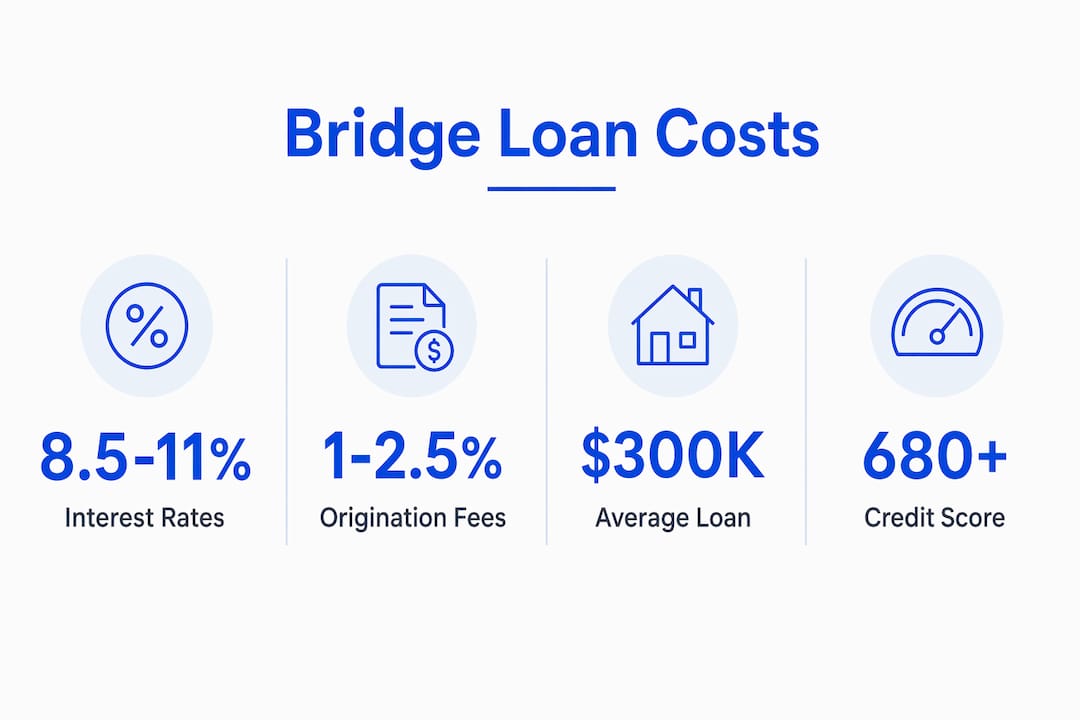
Infographic summarizing bridge loan rates and qualifications

What lenders require

Qualifying for a bridge loan is more demanding than qualifying for a single mortgage. Lenders evaluate:

  • Credit score of 680 or higher. Strong credit and equity are the two primary approval drivers. Scores below 680 significantly narrow your lender options.
  • Sufficient equity in your current home. Most lenders require at least 20% equity after the bridge loan is issued, which means your combined loan-to-value ratio across both properties stays at or below 80%.
  • Ability to carry three simultaneous payments. Lenders require your debt-to-income ratio to account for your existing mortgage, the bridge loan interest payment, and your new mortgage principal and interest. This is the qualification hurdle most homeowners underestimate.
  • Documented income and assets. Private lenders like Capitalfunding move faster than banks, but they still verify that you have the income and reserves to manage the overlap period without distress.

The risks you need to plan for

The most underestimated risk in bridge lending is not the rate. It is the scenario where your current home does not sell within the loan term. If that happens, you face extension fees, potential refinancing at higher rates, or a pressured sale at a discount. Having a contingency plan is not optional. It is the foundation of responsible bridge loan use.

Extension terms vary by lender. Some offer 3 to 6 month extensions with additional fees. Others require full payoff or refinancing into a longer-term product. Know your exit options before you sign.

What alternatives exist to bridge loans when financing between two homes?

Real estate bridge financing is not the only path forward. Three alternatives deserve serious consideration, each with distinct tradeoffs.

OptionBest forKey advantageKey limitation
Bridge loanCompetitive markets, fast timelinesNon-contingent offer strength, fast fundingHigher cost, triple payment burden
HELOCBorrowers with time and existing equityLower rates, flexible draw scheduleRequires 30 to 45 days to establish; contingent on home value
Contingent offerSlower markets, lower-risk buyersNo additional debt requiredOften rejected in fast markets; weakens negotiating position
Buy-before-sell programsSellers wanting certaintyGuaranteed purchase of current homeProgram fees can rival bridge loan costs; limited to participating markets

A Home Equity Line of Credit (HELOC) functions similarly to a bridge loan in that it draws on your existing equity, but the setup timeline makes it impractical when you need to move quickly. Fintech-backed buy-before-sell programs, offered by companies like Knock and Orchard, provide a guaranteed purchase of your current home so you can buy freely. The convenience comes at a cost, though, and program fees often match or exceed what you would pay in bridge loan interest.

A contingent offer, where your purchase depends on your current home selling first, costs nothing extra but signals weakness to sellers. Non-contingent buyers win more negotiations because sellers value transaction certainty over marginally higher offers. In a market where multiple offers are common, a contingency can eliminate you from consideration entirely.

Pro Tip: If your current home is already under contract and you need funds for just 30 to 60 days, a HELOC draw may cost less than a bridge loan. If you are still preparing to list, a bridge loan gives you the speed and offer strength that a HELOC cannot match.

How to prepare and succeed with a bridge loan between two properties

Preparation separates homeowners who use bridge loans confidently from those who end up in a financial bind. Follow these steps before you apply.


  1. Calculate your true equity position. Pull your most recent mortgage statement and get a current market valuation from a licensed appraiser or your real estate agent. Subtract your mortgage balance from 80% of the home’s value. That figure is your realistic bridge loan ceiling, not your full equity.


  2. Check your credit score and debt-to-income ratio. Run your numbers as if you were carrying all three payments simultaneously. Your existing mortgage, the bridge loan interest payment, and your new mortgage principal and interest must all fit within your lender’s DTI threshold, typically 43% to 50% depending on the lender.


  3. Set a realistic sale timeline. Research average days on market in your neighborhood for comparable homes. If your market averages 45 days to contract and 30 days to close, budget for a 90-day overlap at minimum. Build in a 30-day buffer before your bridge loan term expires.


  4. Identify your backup plan before closing. Decide in advance what you will do if your home has not sold within 60 days of listing. Options include a price reduction, a short-term rental of the departing property, or a loan extension. Lenders respond better to borrowers who have already thought through these scenarios.


  5. Work with a lender who specializes in this structure. A right bridge lender understands the nuances of overlap period underwriting and can structure terms that give you the flexibility you need. Not all lenders are equipped to move at the speed this type of financing requires.


Key takeaways

A bridge loan between two properties succeeds when you combine strong equity, realistic sale timing, and a clear repayment plan before you close.

PointDetails
Loan amount ceilingLenders cap proceeds at roughly 80% of current home value minus your existing mortgage balance.
Triple payment burdenYou must qualify to carry your existing mortgage, bridge interest, and new mortgage simultaneously.
Cost rangeExpect interest rates of 8.5% to 11% and origination fees of 1% to 2.5% of the loan amount.
Repayment timelineMost bridge loans are repaid within 6 to 12 months using proceeds from the sale of your current home.
Backup planningIf your home does not sell within the loan term, extensions, refinancing, or a price reduction become necessary.

Why bridge loans deserve more respect than they get

Most financial content treats bridge loans as a last resort for impatient buyers. That framing is wrong, and it leads homeowners to underuse one of the most effective tools in real estate finance.

I have seen clients walk away from properties they genuinely wanted because they were told to “wait and see” whether their current home would sell first. In competitive markets, waiting is not a neutral choice. It is a decision to lose. The homeowners who move with confidence are the ones who understood their equity position, ran their numbers honestly, and secured financing that let them act without hesitation.

That said, I have also seen bridge loans used recklessly. The most common mistake is not the rate or the fees. It is the failure to underwrite the overlap period cash flow with any rigor. Managing the overlap period is the real discipline this product demands. Borrowers who treat the bridge loan as a formality and assume their home will sell in two weeks are the ones who end up in extension territory.

My practical advice: price your home aggressively from day one. A bridge loan gives you the freedom to buy without contingency, but that freedom has a clock attached. Every week your home sits on the market costs you money in bridge interest. The best use of a bridge loan is a short one. For high-value properties, the luxury bridge loan structure adds additional nuance around lien position and lender consent that standard guides rarely address.

— David

How Capitalfunding can close your bridge loan fast

When timing is everything, Capitalfunding delivers. As a direct private lender backed by a family office, Capitalfunding closes hard money bridge loans in days, not weeks, giving you the capital access you need to move on the right property without waiting for a bank’s approval timeline.

https://capitalfunding.com

Capitalfunding has closed over $1 billion in loans and holds an A+ BBB rating, which means you are working with a lender who has seen every scenario this type of financing presents. Whether you are transitioning between two residential properties or managing a high-value acquisition above $10 million, Capitalfunding structures terms around your specific situation. Reach out to discuss your equity position, your timeline, and how we can put a tailor-made solution in place for your next move.

FAQ

What is a bridge loan between two properties?

A bridge loan between two properties is short-term interim financing secured by your current home’s equity, used to purchase a new property before your existing home sells. It is repaid, typically within 6 to 12 months, using the proceeds from your home sale.

How much can you borrow with a bridge loan?

Most lenders allow you to borrow up to 80% of your current home’s value minus your existing mortgage balance. On a $500,000 home with a $150,000 mortgage, your maximum bridge proceeds would be approximately $250,000.

What credit score do you need for a bridge loan?

Bridge loans generally require a credit score of 680 or higher, along with sufficient equity and documented income to carry multiple simultaneous payments.

Are bridge loans risky for homeowners?

The primary risk is that your current home does not sell within the loan term, which can trigger extension fees or a forced sale at a discount. Thorough sale timeline planning and a clear backup strategy reduce this risk significantly.

How is a bridge loan different from a HELOC?

A bridge loan funds immediately, typically within 5 to 14 days, and is structured for a defined short-term repayment. A HELOC takes 30 to 45 days to establish, carries lower rates, and offers a revolving draw structure, making it better suited for buyers who have more time before their purchase deadline.

Bridge Loan Between Two Properties: A 2026 Guide

A bridge loan between two properties is defined as short-term interim financing secured against your current home’s equity, designed to fund the purchase of a new property before your existing home sells. Also called a swing loan or gap loan in industry practice, this product solves one of real estate’s most persistent timing problems: you’ve found the right home, but your capital is locked in the one you haven’t sold yet. Understanding how this financing works, what it costs, and when alternatives make more sense is the difference between a confident transition and a costly mistake.

How does a bridge loan work between two properties?

A bridge loan works by converting your existing home equity into immediate purchasing power, giving you the funds to close on a new property without waiting for your current home to sell. The mechanics are straightforward once you understand the three-phase lifecycle.

Here is how the process typically unfolds:

  1. Application and approval. You apply with a lender who evaluates your equity position, credit profile, and ability to carry multiple payments. Funds are disbursed quickly, usually within 5 to 14 days of approval, which is far faster than a conventional mortgage refinance.

  2. Loan amount calculation. The lender calculates your available equity and determines the loan amount. Up to 80% of your home’s value minus your existing mortgage balance sets the ceiling. If your home is worth $600,000 and you owe $200,000, your maximum bridge proceeds would be roughly $280,000 after the lender’s risk cushion.

  3. Closing on the new property. You use the bridge proceeds to fund your down payment and closing costs on the new home. This lets you submit a non-contingent offer, which signals to sellers that your purchase does not depend on another transaction closing first.

  4. Carrying the overlap period. During the loan term, you make interest-only payments on the bridge loan while also paying your existing mortgage and your new mortgage. This three-payment overlap is the most financially demanding phase of the process.

  5. Repayment at sale. Once your current home sells, the proceeds pay off the bridge loan in full. Repayment is expected within 6 to 12 months in most cases, making this a genuinely short-term obligation rather than a long-term debt.

Pro Tip: Ask your lender whether the bridge loan is structured in first or second lien position on your departing property. First lien position typically offers lower pricing, but second lien may be required if you carry an existing mortgage. Lien structure directly affects your rate and eligibility.

What are the costs and qualifications for bridge loans?

Financial advisor consulting clients on bridge loans


Bridge loans carry a higher price tag than conventional mortgages, and that cost is intentional. Lenders take on concentrated short-term risk, and the pricing reflects it.

What you will pay

Interest rates typically range from 8.5% to 11%, with origination fees between 1% and 2.5% of the loan amount. On a $300,000 bridge loan, that means $3,000 to $7,500 in upfront fees alone, before appraisal, title, and closing costs. The total cost of a bridge loan is real, but it must be weighed against the cost of missing the right property in a competitive market.

Infographic summarizing bridge loan rates and qualifications


What lenders require

Qualifying for a bridge loan is more demanding than qualifying for a single mortgage. Lenders evaluate:

  • Credit score of 680 or higher. Strong credit and equity are the two primary approval drivers. Scores below 680 significantly narrow your lender options.
  • Sufficient equity in your current home. Most lenders require at least 20% equity after the bridge loan is issued, which means your combined loan-to-value ratio across both properties stays at or below 80%.
  • Ability to carry three simultaneous payments. Lenders require your debt-to-income ratio to account for your existing mortgage, the bridge loan interest payment, and your new mortgage principal and interest. This is the qualification hurdle most homeowners underestimate.
  • Documented income and assets. Private lenders like Capitalfunding move faster than banks, but they still verify that you have the income and reserves to manage the overlap period without distress.

The risks you need to plan for

The most underestimated risk in bridge lending is not the rate. It is the scenario where your current home does not sell within the loan term. If that happens, you face extension fees, potential refinancing at higher rates, or a pressured sale at a discount. Having a contingency plan is not optional. It is the foundation of responsible bridge loan use.

Extension terms vary by lender. Some offer 3 to 6 month extensions with additional fees. Others require full payoff or refinancing into a longer-term product. Know your exit options before you sign.

What alternatives exist to bridge loans when financing between two homes?

Real estate bridge financing is not the only path forward. Three alternatives deserve serious consideration, each with distinct tradeoffs.

Option Best for Key advantage Key limitation
Bridge loan Competitive markets, fast timelines Non-contingent offer strength, fast funding Higher cost, triple payment burden
HELOC Borrowers with time and existing equity Lower rates, flexible draw schedule Requires 30 to 45 days to establish; contingent on home value
Contingent offer Slower markets, lower-risk buyers No additional debt required Often rejected in fast markets; weakens negotiating position
Buy-before-sell programs Sellers wanting certainty Guaranteed purchase of current home Program fees can rival bridge loan costs; limited to participating markets

A Home Equity Line of Credit (HELOC) functions similarly to a bridge loan in that it draws on your existing equity, but the setup timeline makes it impractical when you need to move quickly. Fintech-backed buy-before-sell programs, offered by companies like Knock and Orchard, provide a guaranteed purchase of your current home so you can buy freely. The convenience comes at a cost, though, and program fees often match or exceed what you would pay in bridge loan interest.

A contingent offer, where your purchase depends on your current home selling first, costs nothing extra but signals weakness to sellers. Non-contingent buyers win more negotiations because sellers value transaction certainty over marginally higher offers. In a market where multiple offers are common, a contingency can eliminate you from consideration entirely.

Pro Tip: If your current home is already under contract and you need funds for just 30 to 60 days, a HELOC draw may cost less than a bridge loan. If you are still preparing to list, a bridge loan gives you the speed and offer strength that a HELOC cannot match.

How to prepare and succeed with a bridge loan between two properties

Preparation separates homeowners who use bridge loans confidently from those who end up in a financial bind. Follow these steps before you apply.

  1. Calculate your true equity position. Pull your most recent mortgage statement and get a current market valuation from a licensed appraiser or your real estate agent. Subtract your mortgage balance from 80% of the home’s value. That figure is your realistic bridge loan ceiling, not your full equity.

  2. Check your credit score and debt-to-income ratio. Run your numbers as if you were carrying all three payments simultaneously. Your existing mortgage, the bridge loan interest payment, and your new mortgage principal and interest must all fit within your lender’s DTI threshold, typically 43% to 50% depending on the lender.

  3. Set a realistic sale timeline. Research average days on market in your neighborhood for comparable homes. If your market averages 45 days to contract and 30 days to close, budget for a 90-day overlap at minimum. Build in a 30-day buffer before your bridge loan term expires.

  4. Identify your backup plan before closing. Decide in advance what you will do if your home has not sold within 60 days of listing. Options include a price reduction, a short-term rental of the departing property, or a loan extension. Lenders respond better to borrowers who have already thought through these scenarios.

  5. Work with a lender who specializes in this structure. A right bridge lender understands the nuances of overlap period underwriting and can structure terms that give you the flexibility you need. Not all lenders are equipped to move at the speed this type of financing requires.

Key takeaways

A bridge loan between two properties succeeds when you combine strong equity, realistic sale timing, and a clear repayment plan before you close.

Point Details
Loan amount ceiling Lenders cap proceeds at roughly 80% of current home value minus your existing mortgage balance.
Triple payment burden You must qualify to carry your existing mortgage, bridge interest, and new mortgage simultaneously.
Cost range Expect interest rates of 8.5% to 11% and origination fees of 1% to 2.5% of the loan amount.
Repayment timeline Most bridge loans are repaid within 6 to 12 months using proceeds from the sale of your current home.
Backup planning If your home does not sell within the loan term, extensions, refinancing, or a price reduction become necessary.

Why bridge loans deserve more respect than they get

Most financial content treats bridge loans as a last resort for impatient buyers. That framing is wrong, and it leads homeowners to underuse one of the most effective tools in real estate finance.

I have seen clients walk away from properties they genuinely wanted because they were told to “wait and see” whether their current home would sell first. In competitive markets, waiting is not a neutral choice. It is a decision to lose. The homeowners who move with confidence are the ones who understood their equity position, ran their numbers honestly, and secured financing that let them act without hesitation.

That said, I have also seen bridge loans used recklessly. The most common mistake is not the rate or the fees. It is the failure to underwrite the overlap period cash flow with any rigor. Managing the overlap period is the real discipline this product demands. Borrowers who treat the bridge loan as a formality and assume their home will sell in two weeks are the ones who end up in extension territory.

My practical advice: price your home aggressively from day one. A bridge loan gives you the freedom to buy without contingency, but that freedom has a clock attached. Every week your home sits on the market costs you money in bridge interest. The best use of a bridge loan is a short one. For high-value properties, the luxury bridge loan structure adds additional nuance around lien position and lender consent that standard guides rarely address.

How Capitalfunding can close your bridge loan fast

When timing is everything, Capitalfunding delivers. As a direct private lender backed by a family office, Capitalfunding closes hard money bridge loans in days, not weeks, giving you the capital access you need to move on the right property without waiting for a bank’s approval timeline.

https://capitalfunding.com


Capitalfunding has closed over $1 billion in loans and holds an A+ BBB rating, which means you are working with a lender who has seen every scenario this type of financing presents. Whether you are transitioning between two residential properties or managing a high-value acquisition above $10 million, Capitalfunding structures terms around your specific situation. Reach out to discuss your equity position, your timeline, and how we can put a tailor-made solution in place for your next move.

FAQ

What is a bridge loan between two properties?

A bridge loan between two properties is short-term interim financing secured by your current home’s equity, used to purchase a new property before your existing home sells. It is repaid, typically within 6 to 12 months, using the proceeds from your home sale.

How much can you borrow with a bridge loan?

Most lenders allow you to borrow up to 80% of your current home’s value minus your existing mortgage balance. On a $500,000 home with a $150,000 mortgage, your maximum bridge proceeds would be approximately $250,000.

What credit score do you need for a bridge loan?

Bridge loans generally require a credit score of 680 or higher, along with sufficient equity and documented income to carry multiple simultaneous payments.

Are bridge loans risky for homeowners?

The primary risk is that your current home does not sell within the loan term, which can trigger extension fees or a forced sale at a discount. Thorough sale timeline planning and a clear backup strategy reduce this risk significantly.

How is a bridge loan different from a HELOC?

A bridge loan funds immediately, typically within 5 to 14 days, and is structured for a defined short-term repayment. A HELOC takes 30 to 45 days to establish, carries lower rates, and offers a revolving draw structure, making it better suited for buyers who have more time before their purchase deadline.


About the author