

A bridge loan is a short-term, asset-backed financing instrument that fills capital gaps during real estate transitions, giving investors the speed to act before permanent financing is in place. Unlike conventional mortgages, which underwrite on borrower income and credit history, bridge loans are collateral-first products designed for property acquisitions, value-add renovations, and lease-up stabilization. If you are an investor who has ever lost a deal because your bank moved too slowly, understanding bridge loan mechanics in real estate is the single most practical skill you can develop this year.
A bridge loan functions as interim financing secured against real property, with interest-only monthly payments and the full principal repaid as a balloon at maturity. This structure preserves cash flow during the transition period, whether you are renovating a distressed asset or waiting for a tenant base to stabilize before refinancing into a permanent loan.

Lenders underwrite bridge loans primarily on property value, not your W-2 or debt-to-income ratio. LTV caps typically run 65% to 75% for straight acquisitions, and loan-to-cost ratios reach up to 75% to 80% on value-add deals. This means a $5 million property in good condition could support a bridge loan of $3.25 million to $3.75 million without a single pay stub required.
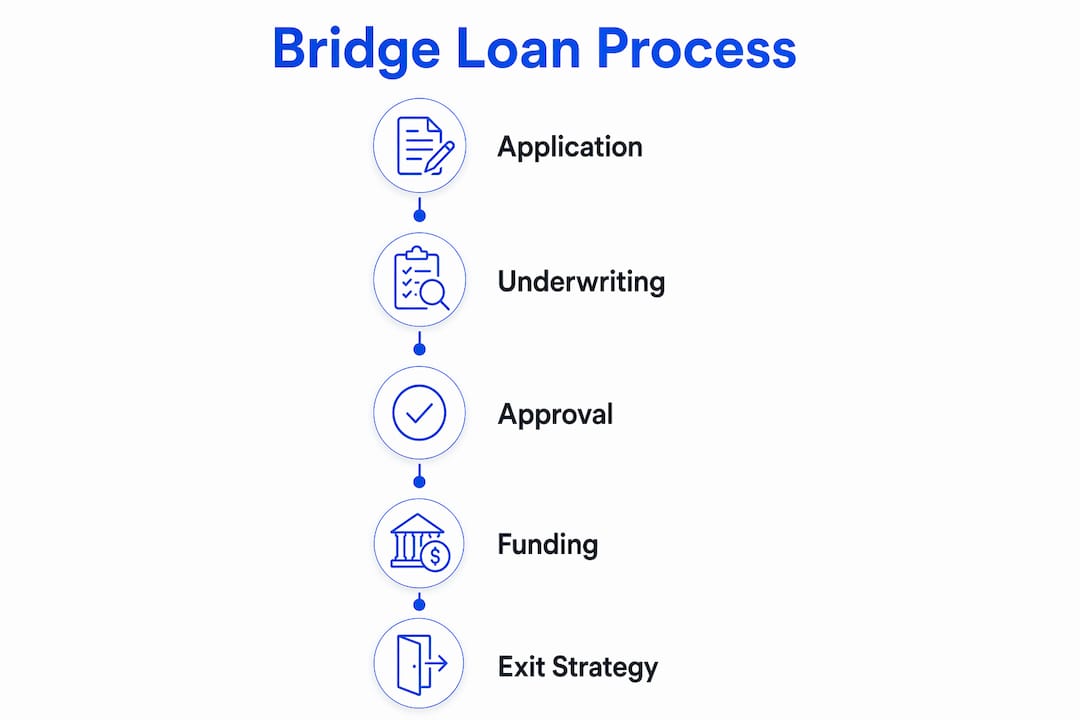
The defining characteristic of bridge financing is the requirement of a clear, credible exit plan mapped before closing. Lenders work backward from your permanent financing or sale scenario to confirm the bridge size is repayable even in a downside case. Vague plans like “I’ll refinance eventually” cause deal failures because lenders need a specific, time-bound repayment event to underwrite against.
Common exit strategies that lenders accept include:
Pro Tip: When presenting your exit to a lender, include the specific loan program you plan to refinance into, the lender type, the projected debt service coverage ratio at stabilization, and a realistic timeline. The more concrete your exit, the stronger your negotiating position on rate and leverage.
Bridge loan rates in 2026 range from 9% to 14%, depending on asset class, sponsor track record, and loan structure. That premium over conventional financing is the price of speed, flexibility, and transitional risk absorption. For most investors, paying 11% for 12 months on a deal that generates 25% equity upside is straightforward math.
Rates are priced as a spread over SOFR, currently around 4.3%, with spreads ranging from 470 to 970 basis points based on risk profile. A stabilized multifamily acquisition with a clean sponsor might price at SOFR plus 470 basis points, landing near 9%. A ground-up conversion with a first-time sponsor in a secondary market could reach 13% to 14%.
| Loan type | Typical rate (2026) | Typical term | Best use case |
|---|---|---|---|
| Bridge loan (stabilized) | 9%–11% | 12–24 months | Acquisition before sale or refi |
| Bridge loan (value-add) | 11%–14% | 12–36 months | Renovation and repositioning |
| Conventional mortgage | 6.5%–8% | 15–30 years | Stabilized, income-documented assets |
| Fix-and-flip loan | 10%–13% | 6–18 months | Quick renovation and resale |
Term lengths run from 6 to 36 months, aligned with the expected duration of the transition event. Most lenders also charge origination fees of 1% to 3% of the loan amount, plus exit fees in some cases, and standard third-party costs including appraisal, title, and legal.
Pro Tip: Origination fees are often negotiable, particularly if you bring repeat business or a strong track record. Ask lenders to reduce the origination fee in exchange for a slightly higher rate, or vice versa, depending on your hold period. A shorter hold favors lower fees; a longer hold favors a lower rate.
Bridge loans occupy a specific lane in the real estate financing options spectrum. They differ from fix-and-flip loans, construction loans, and conventional mortgages in purpose, underwriting basis, and deal fit. Choosing the wrong product for your strategy costs time and money.
| Feature | Bridge loan | Fix-and-flip loan | Construction loan | Conventional mortgage |
|---|---|---|---|---|
| Underwriting basis | Asset value | Asset value + scope | Project cost + plans | Borrower income + credit |
| Typical term | 6–36 months | 6–18 months | 12–24 months | 15–30 years |
| Payment structure | Interest-only | Interest-only | Draw-based | Amortizing |
| Closing speed | 7–21 days | 7–14 days | 14–30 days | 30–60 days |
| Best for | Transitional acquisitions | Renovation resale | Ground-up development | Stabilized income assets |
The key distinctions worth understanding:
Bridge loans close significantly faster than conventional mortgages, typically within 7 to 21 days for residential deals and 10 to 45 days for commercial transactions. That speed is the product’s primary competitive advantage in fast-moving markets.
Bridge loans deliver the most value in four specific scenarios. Using them outside these scenarios is where investors get into trouble.
Buying before selling. You have identified a high-conviction acquisition but your capital is tied up in an existing asset. A bridge loan lets you close on the new property without a sale contingency, which is a material advantage in competitive markets where sellers favor clean offers.
Value-add renovation funding. The property needs significant work before it qualifies for permanent financing. A bridge loan covers the acquisition and renovation costs, and you refinance into a DSCR or conventional loan once the property is stabilized and income-producing.
Lease-up stabilization. Multifamily and commercial assets often need 6 to 18 months to reach the occupancy thresholds required by permanent lenders. A bridge loan provides strategic speed and flexibility during this period, giving you time to execute your leasing plan without the pressure of a permanent loan’s income requirements.
Competitive market acquisitions. In high-velocity markets, the ability to close in 10 days beats a 45-day conventional process every time. A non-contingent, fast-close offer is a negotiating tool that can justify a lower purchase price, effectively offsetting part of the rate premium.
Bridge loans are not the right choice when you lack a defined exit, when the property’s after-repair value does not support the combined bridge and permanent loan stack, or when your renovation timeline is speculative. Misuse of bridge financing, particularly entering without a credible exit, is the most common cause of costly extensions and defaults.
Pro Tip: Plan your exit timing to close at least 60 days before your bridge loan matures. Extensions are available from most lenders but carry fees of 0.25% to 1% of the loan balance per extension period. Building buffer into your timeline is far cheaper than scrambling for an extension at the last minute.
For investors working in the luxury segment, understanding luxury bridge loan dynamics adds another layer of precision, particularly for assets above $5 million where conventional lenders routinely decline.
Bridge loans are the most effective real estate financing tool for transitional acquisitions and value-add projects when paired with a credible, time-bound exit strategy.
| Point | Details |
|---|---|
| Asset-based underwriting | Bridge loans qualify on property value, not borrower income, enabling faster approvals. |
| Interest-only structure | Monthly payments cover only interest; the full principal is repaid at maturity via sale or refinance. |
| Current rate range | Rates in 2026 run 9% to 14%, priced as a spread over SOFR based on risk and asset class. |
| Exit plan is non-negotiable | Lenders require a specific, mapped repayment event; vague plans are the leading cause of deal failure. |
| Speed advantage | Bridge loans close in 7 to 21 days, giving investors a decisive edge in competitive acquisitions. |
Over years of working in real estate finance, the pattern I see most clearly is this: bridge loans do not fail because of rates. They fail because of exits. Investors focus intensely on the cost of the loan and almost not at all on the precision of the repayment plan. That is backwards.
The investors who use bridge capital most effectively treat the exit strategy as the primary underwriting document. Before they approach a lender, they have already spoken to a permanent lender, confirmed the DSCR requirements at stabilization, and modeled the timeline with a 20% buffer built in. They know exactly what occupancy rate triggers their refinance eligibility. That level of preparation is what separates a smooth bridge loan experience from a costly extension or, worse, a forced sale.
I also think the market underestimates how much lender selection matters. A lender who has closed $1 billion in loans and holds an A+ BBB rating is not the same product as a lender who appeared last year. When your deal is time-sensitive and the capital stack is complex, you want a direct lender with decision-making authority, not a broker who is waiting on a committee. The difference in execution speed and problem-solving capacity is significant.
My honest advice: if you cannot articulate your exit in two sentences with specific numbers attached, you are not ready to take down a bridge loan. Get that clarity first. Everything else, including rate negotiation and term structure, follows from a credible exit.

Capitalfunding is a direct private lender backed by a family office, with over $1 billion in closed loans and an A+ BBB rating. We close hard money bridge loans in days, not weeks, giving you the speed to execute in competitive markets without the friction of institutional underwriting. Our programs cover residential, multifamily, commercial, and ultra-luxury single-family assets above $10 million, including deals that conventional lenders decline outright. If you need temporary financing for a property acquisition, value-add project, or lease-up stabilization, our team structures terms around your specific exit strategy. Contact Capitalfunding to discuss your next deal.
A bridge loan is a short-term, asset-backed loan that provides interim financing during real estate transitions, such as buying before selling or funding renovations before permanent financing is available. It is repaid through a defined exit event, typically a property sale or refinance.
Bridge loan rates in 2026 range from 9% to 14%, priced as a spread over SOFR depending on asset class, sponsor profile, and exit strategy strength.
Bridge loans close in 7 to 21 days for residential deals and 10 to 45 days for commercial transactions, significantly faster than conventional mortgages which typically require 30 to 60 days.
Lenders require a property with sufficient equity to meet LTV thresholds of 65% to 75%, and a clear, credible exit strategy such as a confirmed sale or a specific refinance program the borrower qualifies for at stabilization.
A bridge loan is not appropriate when you lack a defined repayment event, when the property’s after-repair value does not support the full loan stack, or when your renovation or lease-up timeline is speculative rather than data-driven.
